Simple Interest vs. Compound Interest, from Scratch
Simple interest is calculated only on your original principal, for a fixed number of days, and paid once at maturity. Compound interest is calculated on your principal plus any interest already earned, so your money starts earning interest on its own interest — the engine behind almost every long-term savings and investment product.
Picture two students who each put ¥10,000 into an account earning 5% a year. One withdraws the interest every year and spends it. The other lets it stay in the account and compound. After 20 years, the first student has earned exactly ¥10,000 in total interest (5% × ¥10,000 × 20 years). The second student's account has grown to roughly ¥26,533 — more than ¥16,000 in interest, over 60% more than the simple-interest version, from the exact same rate and the exact same starting amount. The only difference is whether the interest was allowed to earn interest of its own. That difference is the entire subject of this guide.
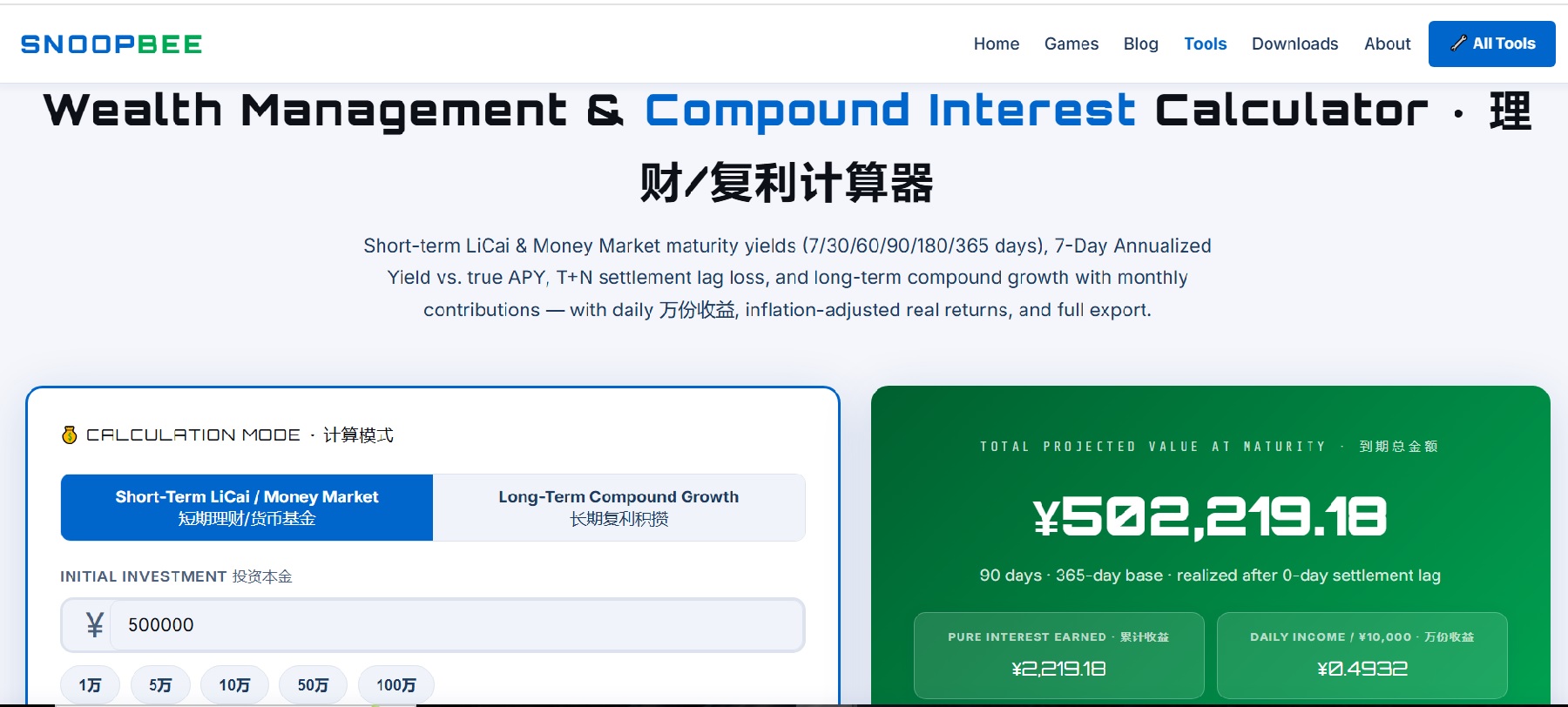
This article expands on the mechanics built into our Wealth Management & Compound Interest Calculator (理财/复利计算器), covering both short-term Chinese bank wealth-management products (LiCai, 理财) and money market funds, as well as long-term compound growth with regular contributions — written so the ideas make sense whether you're a first-year student or someone managing a family's retirement savings.
What Is 7-Day Annualized Yield (七日年化)?
7-Day Annualized Yield (七日年化收益率) is the average daily return a money market fund earned over the past seven days, mathematically stretched out as if that same daily rate continued for a full 365-day year. It is a backward-looking snapshot of recent performance, re-calculated fresh every single day — not a locked-in promise about what you'll earn tomorrow.
This is arguably the single most misunderstood number in Chinese retail finance. Millions of people check their money market fund's 七日年化 daily and treat it like an interest rate on a fixed deposit. It isn't. It's closer to a rolling seven-day average speedometer reading — useful for seeing which direction returns are heading, but not a fixed commitment. A fund's 七日年化 can rise or fall meaningfully within a single week if short-term interest rates in the broader economy move.
Why this trips people up: a headline yield of "1.8%" doesn't mean your money definitely earns 1.8% for the year — it means that, based on the last seven days only, if conditions stayed exactly the same, you'd be on pace for roughly 1.8% annualized. Conditions rarely stay exactly the same for a full year.
Case Study: Yu'e Bao's Decade-Long Yield Decline
No example illustrates 7-Day Annualized Yield better than Yu'e Bao (余额宝), China's largest money market fund, used by hundreds of millions of people through Alipay. Its yield history is a real-world lesson in how these products track the broader interest-rate environment.
In January 2014, shortly after launch, Yu'e Bao's 7-day annualized yield peaked above 6.76%. By April 2020 it had fallen below 2%. By November 2022 it slipped under 1.5%. By December 2025 it sat around 1.04%, and by early May 2026 it crossed below the symbolic 1% line for the first time in its history. As of July 6, 2026, independent market-data trackers put it at roughly 0.88%. That's not a fund manager doing a worse job — it's the fund faithfully tracking China's broader money-market interest rates, which have trended steadily lower over the same period. A "万份收益" (income per 10,000 units) that was once approaching ¥1.85 a day in 2014 is now closer to ¥0.24 a day at similar fund sizes — a useful, concrete reminder of just how much a headline percentage can compress into a tiny daily cash number once you actually compute it.
365-Day vs. 360-Day Count Conventions
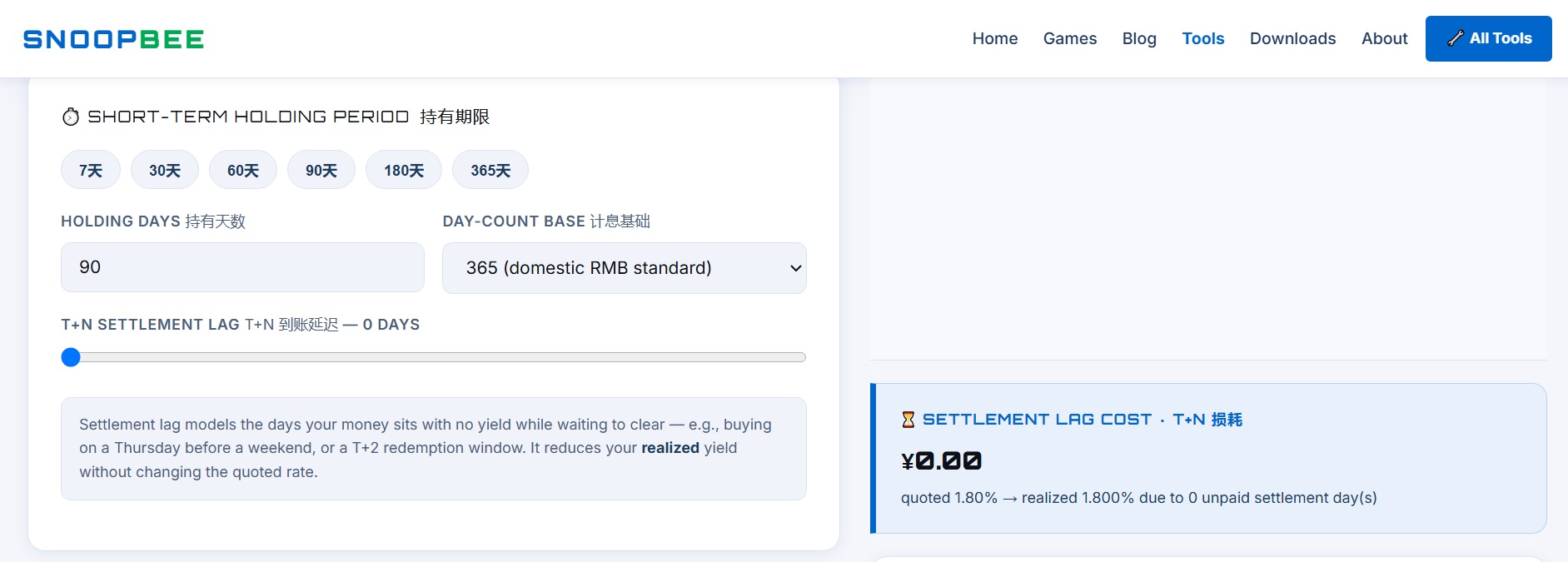
A detail that trips up even experienced spreadsheet-builders: not every financial product assumes the same number of days in a year for interest calculations. Domestic RMB wealth management products conventionally use a 365-day year. Certain foreign-currency products, and some international-style money-market instruments, use a 360-day year instead — a centuries-old banking convention that predates modern computing, originally adopted because 360 divides evenly by 12, 30, and other convenient numbers.
Worked example: ¥100,000 at a quoted 3.5% annualized rate for 90 days returns ¥863.01 on a 365-day base, but ¥875.00 on a 360-day base — a difference of nearly ¥12 for the exact same quoted rate and holding period, purely from which day-count convention applies. It's a small gap on a single ¥100,000, 90-day product, but it's exactly the kind of assumption that, left unchecked, silently throws off a larger portfolio or a longer projection.
The Hidden Cost of T+N Settlement Lag
T+N settlement lag is the gap between the day you place a purchase or redemption order and the day your money actually starts (or stops) earning yield. "T" is your transaction date; "N" is the number of business days until settlement actually completes. During that gap, your money typically earns nothing at all.
Here's the classic scenario that catches people off guard: you submit a purchase order for a money market fund on a Thursday afternoon. Because of same-day cutoff times and non-processing on weekends, your money might not actually start earning yield until the following Monday or Tuesday — meaning you've lost two or three days of yield purely because of which day of the week you happened to click "buy."
Worked example: a 90-day product quoted at 2.00%, with 2 unpaid lag days (say, a purchase submitted right before a long weekend), realizes an actual rate of 1.9565% instead of 2.00% — a loss of about ¥10.72 on a ¥100,000 investment. That may look small in isolation, but for institutions moving large sums, or for retail investors who repeat this mistake on every single rollover of a short-term product, the settlement drag compounds into a real, recurring cost over a year of repeated 30-, 60-, or 90-day cycles.
Practical takeaway: if a product allows same-day purchase confirmation, submitting your order earlier in the day and earlier in the week — rather than late on a Thursday or Friday — measurably reduces how much yield you lose to settlement lag over time.
万份收益: Daily Income per ¥10,000 Units
Chinese money market funds report a second number alongside 七日年化: 万份收益 (income per 10,000 units), the actual RMB amount a holder of 10,000 fund units earned that specific day. This exists precisely because a percentage can feel abstract, while a concrete daily cash figure — "you earned ¥0.24 today" — is immediately understandable to anyone, regardless of their math background.
| 7-Day Annualized Yield | 万份收益 (¥ per 10,000 units, per day) |
|---|---|
| 0.88% (Yu'e Bao, Jul 2026) | ¥0.2411 |
| 1.80% (typical short-term LiCai example) | ¥0.4932 |
| 3.50% (illustrative higher-yield example) | ¥0.9589 |
Monthly-Step Compounding, Done Correctly
For long-term wealth accumulation — a lump sum plus a recurring monthly contribution — the standard formula looks like this:
where P = initial principal, PMT = monthly contribution, t = years, and i is the periodic rate per compounding period, i = r/n (annual nominal rate ÷ compounding periods per year).
A word of caution on worked examples floating around online: while researching typical templates for this kind of calculator, we came across a widely-circulated example claiming that ¥100,000 principal plus ¥2,000 per month, compounded monthly at 4.0% for 5 years, grows to ¥247,432.22. We plugged those exact numbers into the formula above — and independently into a full month-by-month simulation — and both methods agree on ¥254,697.62, not ¥247,432.22. It's a useful reminder that even confident-looking financial "reference" figures circulating online are worth checking against the actual formula rather than trusting at face value — which is exactly why our calculator runs a real month-by-month engine and cross-checks it against the closed-form formula, rather than hard-coding a claimed answer.
The "monthly-step" part of the phrase matters as much as the compounding itself. A common shortcut mistake is crediting an entire year's worth of growth to a contribution the moment it's deposited, as if every deposit had been sitting there since January 1st. In reality, a contribution made in month 8 has only 4-5 months left to grow that year, not 12. A correct engine steps through the timeline one month at a time, applying growth only to the balance that has actually accumulated by that point, and adding each new contribution only when it actually arrives.
Does Compounding Frequency Really Matter?
Money market funds often compound daily; some bank products compound monthly, quarterly, or only pay out once at maturity (simple interest, no compounding at all). Using the same ¥100,000 + ¥2,000/month at a 4.0% annual rate over 5 years, here's how the four systematic options compare:
| Compounding Frequency | Final Value After 5 Years |
|---|---|
| Daily | ¥254,758.57 |
| Monthly | ¥254,697.62 |
| Quarterly | ¥254,572.43 |
| Annually | ¥254,023.34 |
More frequent compounding does produce a higher final value — but notice how small the gap actually is between daily and annual compounding here: about ¥735, or roughly 0.3% of the total, over five full years. For most retail savers, the choice of provider, the rate itself, and simply staying invested consistently matter far more than obsessing over daily-vs-monthly compounding mechanics.
The Rule of 72 & Compound Magic
The Rule of 72 is a mental-math shortcut: divide 72 by your annual percentage return to estimate how many years it takes an investment to roughly double, without doing the full exponential calculation.
| Annual Rate | Approx. Years to Double |
|---|---|
| 0.9% (money market example) | 80.0 years |
| 1.8% (short-term LiCai example) | 40.0 years |
| 4.0% | 18.0 years |
| 6.0% | 12.0 years |
| 7.2% | 10.0 years |
This table is one of the most persuasive arguments for understanding compound growth early: at a money-market-style yield near 0.9%, your money essentially takes a working lifetime to double. At a more growth-oriented long-term rate, doubling happens in a fraction of that time — which is exactly why short-term cash-parking products and long-term compound-growth vehicles serve very different jobs in a financial plan, and shouldn't be judged by the same yardstick.
Real Returns: Adjusting for Inflation
A return that sounds positive can still lose purchasing power if inflation runs higher than your yield. The real (purchasing-power-adjusted) value of a future sum is found by discounting it back at the inflation rate:
If a money market fund yields 0.9% annually while consumer prices rise 2% a year, the real value of that money is quietly shrinking every year in terms of what it can actually buy, even though the account balance itself is technically growing. This is one of the most important — and most often overlooked — reasons that ultra-safe, ultra-liquid cash instruments are best treated as a place to park short-term spending money, rather than as a primary long-term wealth-building tool.
A Regional Comparison: China, Hong Kong, Singapore & Vietnam
While this guide focuses heavily on mainland Chinese products, the same underlying ideas — annualized-yield quoting conventions, settlement lag, and the power of compounding — show up across the wider region in locally-flavored forms.
- Mainland China: the LiCai (理财) and money-market-fund ecosystem described throughout this guide, alongside the Housing Provident Fund system covered in our separate housing loan guide.
- Hong Kong: retail investors commonly compare HIBOR-linked time deposits and structured deposits, where settlement and value-dating conventions matter just as much as in mainland LiCai products.
- Singapore: T-bills, Singapore Savings Bonds, and CPF-linked instruments are the closer local equivalents, with their own specific settlement and interest-crediting rules that a saver needs to check individually.
- Vietnam: bank term deposits remain the dominant short-term savings vehicle, typically quoted as simple annualized rates without the 7-day rolling convention used by Chinese money market funds, so the "365 vs 360 day count" distinction described earlier is particularly relevant there.
Whichever market you're saving in, the same three questions are worth asking of any short-term product: what day-count convention is being used, how many settlement lag days apply on both purchase and redemption, and whether the quoted rate is a trailing historical figure (like 七日年化) or a genuinely fixed contractual rate for the full term.
Frequently Asked Questions
What is 7-Day Annualized Yield (七日年化收益率)?
It's the average daily yield a money market fund earned over the past seven days, annualized as if that rate continued for a full year. It reflects recent past performance only, not a guaranteed future rate.
What is T+N settlement lag and why does it cost me money?
It's the delay between placing an order and when your money actually starts or stops earning yield. Money in transit during that lag earns nothing, lowering your realized return below the quoted rate.
What is the difference between a 365-day and 360-day count convention?
Domestic RMB products typically use 365 days; some foreign-currency products use 360. A 360-day base spreads the same annual rate over fewer days, producing a slightly higher return for the same quoted rate and holding period.
What is the Rule of 72?
Divide 72 by your annual percentage return to estimate how many years it takes an investment to roughly double through compounding.
Why has Yu'e Bao's yield fallen so much since 2014?
Money market funds track broader money-market interest rates. As China's benchmark rates have declined over the past decade, Yu'e Bao's 7-day annualized yield fell from over 6.7% in January 2014 to below 1% by 2026.
Run Your Own Numbers With the Full Calculator
Open the Wealth Management Calculator →This article is for general educational purposes only and is not financial or investment advice. Yields referenced (including Yu'e Bao's historical 7-day annualized yield figures) are drawn from public reporting current as of July 2026 and change constantly — wealth management products are not bank deposits, are not principal-guaranteed, and past performance never guarantees future returns (理财非存款,产品有风险,投资须谨慎). Always verify the current published yield of any specific product before investing. Last updated: July 2026.
💬 Questions & Reader Comments
Ask a question about LiCai yields, settlement lag, or compound growth, or share your own experience. (Max 200 words)