What Is a Currency Corridor, and Why Does Sending Money Abroad Cost More Than You Think?
A currency corridor is simply the path money takes between two countries and currencies — for example, "Singapore to Vietnam" (SGD to VND) or "US marketplace payout to a Hong Kong seller" (USD to HKD). Every corridor has its own mid-market exchange rate, and every bank or payment provider adds its own markup on top of that rate.
Imagine you're a student ordering a $20 item from an overseas online shop. Your bank card converts your local currency to US dollars automatically, and you probably never notice the small markup buried in that conversion. Now imagine you're a small business owner in Singapore who needs to pay a supplier in Vietnam $20,000 worth of goods every month. That same small, invisible markup — usually 1% to 4% — is suddenly hundreds or thousands of dollars a year, real money that never shows up as a separate line item on any bill. It just quietly disappears into the exchange rate.
This guide walks through exactly where that money goes, in plain language a high-school student can follow, with enough precision that a professional treasury manager or accountant can use it too. It explains the ideas built into our Currency & Remittance Converter, which is aimed squarely at the trade-heavy corridors of Singapore, Hong Kong, and Vietnam, but the underlying concepts apply to any country and any currency pair.
Mid-Market Rate vs. Spread — the Number Everyone Mixes Up
Every currency pair has a mid-market rate: the midpoint between the price banks pay to buy a currency and the price they charge to sell it on the wholesale (interbank) market. This is the number you see when you type "SGD to VND" into Google, or look it up on Reuters or XE. It is not a marketing number and nobody can charge you a fee to look at it — it is simply where the world's biggest banks are trading that currency pair with each other at that moment.
Here's the part that surprises most people: you almost never get the mid-market rate when you actually convert money. Your bank, credit card network, or remittance app quotes you a slightly worse rate and pockets the difference. That difference is called the spread, and it's how most FX providers make money without ever calling it a "fee."
Worked example: suppose the mid-market rate for SGD to VND is 20,356.04 (this is a real snapshot we used while building the calculator, valid around July 2026). A bank quotes you 19,847.14 instead. Plugging into the formula: (20,356.04 − 19,847.14) ÷ 20,356.04 × 100 = 2.50%. That 2.5% is the bank's spread — and it applies to every single dollar you convert, whether you're sending $100 or $100,000.
Why this matters for students: the spread is completely separate from any flat fee a bank charges. A transfer can advertise "$0 fee" and still be expensive, because the spread is baked invisibly into the exchange rate itself rather than shown as a line-item charge.
Bank SWIFT Wires vs. Fintech Multi-Currency Accounts
There are two broad ways to move money internationally today, and they have very different cost structures.
Traditional Bank SWIFT Wires
SWIFT (the Society for Worldwide Interbank Financial Telecommunication) is the messaging network banks use to instruct each other to move money. A wire often passes through one or more correspondent banks — intermediary banks that bridge two banks that don't have a direct relationship — and each hop in that chain can take a cut. Typical costs: a spread of roughly 2%–3.5% over the mid-market rate, plus a flat outgoing wire fee (often USD 25–35), plus a correspondent bank fee (often another USD 20–35) that may or may not be visible to you up front.
Fintech Multi-Currency Accounts
Providers like Wise, Airwallex, Aspire, WorldFirst, and Instarem built newer infrastructure that avoids the SWIFT correspondent chain wherever possible, settling instead over local payment rails or by netting currency balances internally. The result is usually a much smaller spread (often 0.3%–0.8%) and frequently no flat fee and no correspondent fee at all, because there's no correspondent bank in the chain to pay.
| Provider Type | Typical Spread | Typical Flat Fee | Correspondent Fee |
|---|---|---|---|
| Traditional Bank (SWIFT) | 2.0% – 3.5% | USD 25 – 35 | USD 20 – 35 (often hidden) |
| Fintech Multi-Currency Account | 0.3% – 0.8% | USD 0 – 5 | None |
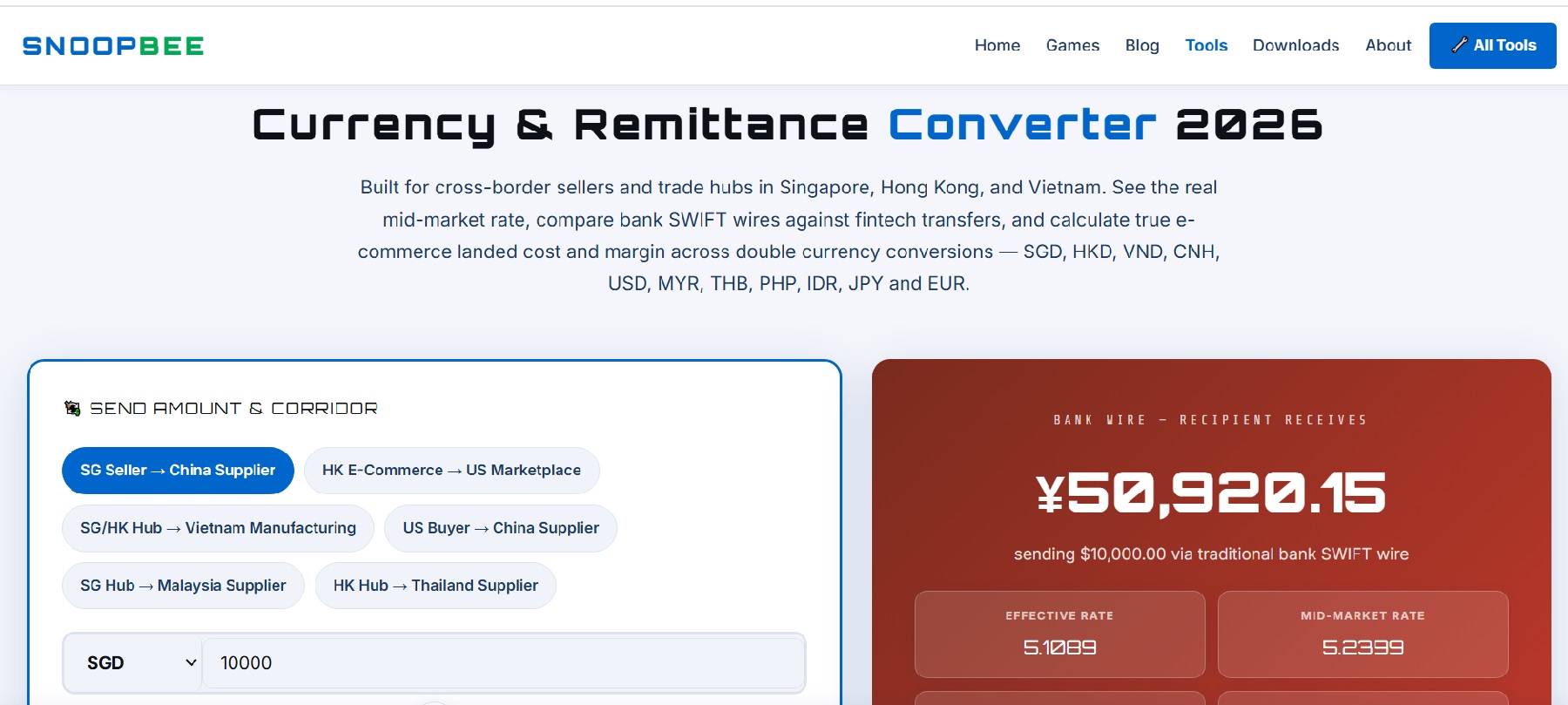
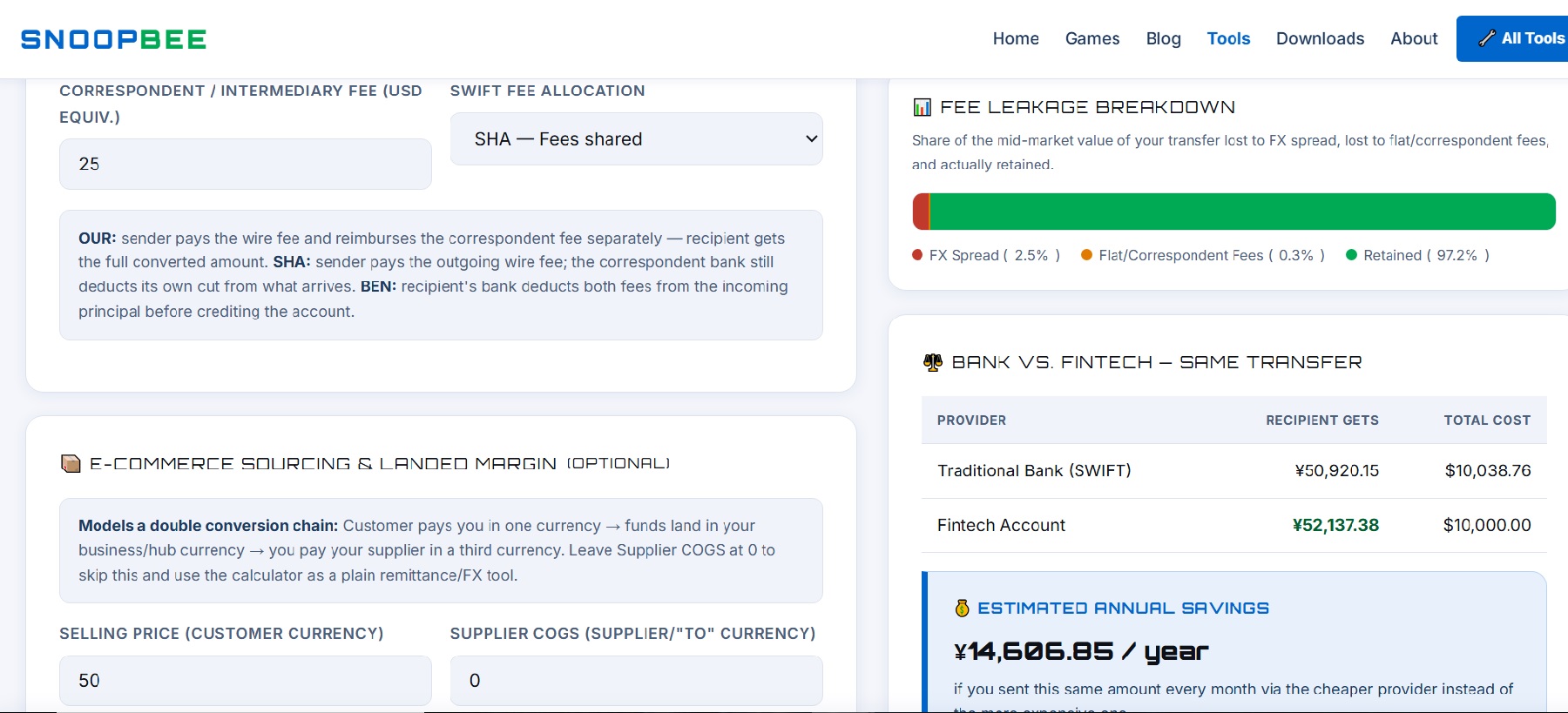
Worked example — SGD 10,000 sent to a China-based supplier in CNH: at a mid-market rate of 5.2399, a traditional bank charging a 2.5% spread plus fees under a shared (SHA) fee arrangement delivers roughly ¥50,920 to the supplier. A fintech account at a 0.5% spread with no flat fee delivers roughly ¥52,137 — over ¥1,217 more on a single transfer, or an extra ¥14,600 a year if you send that amount monthly. Multiply that across a whole supply chain of monthly supplier payments, and the provider you pick stops being a minor detail and becomes a real line item in your annual costs.
SWIFT Fee Allocation: OUR, SHA, and BEN
If you've ever sent an international wire, you may have seen a dropdown asking you to choose "OUR," "SHA," or "BEN" and wondered what it meant. This single setting decides who ends up paying the wire fee and the correspondent bank's cut — and it can change how much money actually lands in the recipient's account, even with the exact same spread.
- OUR — the sender pays every fee up front, including reimbursing any correspondent bank charge. The recipient receives the full converted principal with nothing deducted. This is the most expensive option for the sender but the cleanest for the recipient — commonly required for supplier invoices that specify "net of all charges."
- SHA (shared) — the sender pays only their own bank's outgoing fee. Any correspondent bank in the chain, however, still takes its own cut out of the money in transit, so the recipient typically receives a little less than the full converted amount. This is the default on most international wires.
- BEN (beneficiary) — the sender pays nothing extra; the recipient's bank deducts both the originator's fee and the correspondent fee from the incoming principal before crediting the account. The recipient receives the least, but the sender's cost is simplest to predict.
Why this trips people up: OUR, SHA, and BEN don't change the exchange rate itself — only who absorbs the flat and correspondent fees, and at which point in the chain they're deducted. Two wires with an identical spread can still land differently in the recipient's account purely because of this one setting.
Worked example — HK$500,000 sent to a US-based supplier (3% spread, a HK$300 flat wire fee, and a US$35 correspondent fee):
| Fee Allocation | Recipient Receives (USD) | Sender's Total Cost (HKD) |
|---|---|---|
| OUR | $61,862.24 | HK$500,574.40 |
| SHA | $61,827.24 | HK$500,300.00 |
| BEN | $61,790.13 | HK$500,000.00 |
Notice the ordering: OUR gives the recipient the most and costs the sender the most; BEN gives the recipient the least while the sender pays exactly the invoiced amount and nothing more; SHA sits in between. If a supplier contract says "all bank charges to be borne by the buyer," that's asking for OUR. If it's silent on the topic, assume SHA — it's the market default, and it means the invoiced amount and the amount actually received are not quite the same number.
Onshore CNY vs. Offshore CNH
China operates a somewhat unusual currency system: the same underlying currency, the yuan (renminbi), trades under two different codes depending on where the transaction happens. CNY is the onshore yuan, traded within mainland China and subject to capital controls set by Chinese regulators. CNH is the offshore yuan, traded freely in Hong Kong, Singapore, London, and other international financial centers, without those mainland restrictions.
For a foreign business paying a Chinese supplier, this matters in a very practical way: cross-border payments into China are typically settled in CNH, not CNY, because CNH can move freely across borders while CNY generally cannot without going through China's own banking and regulatory channels. CNY and CNH usually trade within a fraction of a percent of each other, but they can diverge more noticeably during periods of capital-flow pressure or central bank intervention — so a quote you see for CNH is not always identical to an onshore CNY rate referenced elsewhere, and the two should not be treated as perfectly interchangeable numbers.
The Zero-Decimal Currency Rule
Most currencies — the US dollar, the Singapore dollar, the euro — have 100 subunits (cents) and are conventionally shown with two decimal places. But a handful of currencies function differently in everyday commerce. The Vietnamese Dong (VND), the Japanese Yen (JPY), and the Indonesian Rupiah (IDR) are quoted, invoiced, and priced in whole units, because their official smallest subunit (if one even still circulates) has no meaningful purchasing power in practice.
Why it matters for a calculator: showing "₫26,300,000.00" implies a level of precision — down to a fraction of one Dong — that simply doesn't exist in how anyone actually invoices or pays in Vietnam. The correct, professional formatting is "₫26,300,000," with no decimal places at all. Any FX or accounting tool that shows two decimals on VND, JPY, or IDR is a small but telling sign it wasn't built with those markets specifically in mind.
This is a simple rule, but it trips up a surprising number of spreadsheet templates and even some commercial software, because most currency-formatting defaults assume two decimal places for everything.
Double Conversion Chains & E-Commerce Margin
Cross-border e-commerce sellers often face not one currency conversion, but two, and this is where hidden costs multiply rather than simply add up. Picture a seller based in Singapore, listing products on a US marketplace, sourcing goods from a supplier in Vietnam: a customer pays in USD → the marketplace pays the seller out in USD or converts to SGD in their business account → the seller then converts SGD to VND to pay the supplier. Two conversions, two separate spreads.
A common mistake: averaging the two spreads instead of multiplying the two effective rates in sequence. If a customer-to-hub conversion has a 1% markup and a hub-to-supplier conversion has a 1.5% markup, the combined effect is not simply 2.5% — it compounds slightly, because the second spread is applied to an amount that's already been reduced by the first spread. A calculator (or a spreadsheet) that averages instead of chaining the two rates will understate your true landed cost, especially at higher spread percentages.
The correct approach is to convert step by step, in order:
Where Reff,1 and Reff,2 are the effective (spread-adjusted) rates for each leg of the chain, multiplied together — never averaged. Once you have the true landed cost of goods back in your selling currency, your net margin is simply your net marketplace payout (selling price, minus platform fee, minus payment gateway fee, minus shipping) minus that landed cost.
Breakeven Sales Multiplier
A useful shortcut for sellers: how much do you need to mark up your price just to cover payment-processing and FX friction alone, before any actual profit?
If your payment gateway charges 2.9% and your combined FX markup across both conversions comes to roughly 3%, your breakeven multiplier is about 1 ÷ (1 − 0.059) ≈ 1.063× — meaning your selling price needs to be about 6.3% above your true landed cost just to break even on fees and FX friction alone, before you've made a single cent of profit.
Corridor Spotlight: Singapore, Hong Kong & Vietnam
These three markets sit at the center of a huge amount of intra-Asian and China-linked trade, and each has its own quirks worth knowing.
Singapore (SGD)
Singapore functions as a regional treasury and invoicing hub for many businesses that sell across Southeast Asia while sourcing from China or Vietnam. Its currency is fully convertible and highly liquid, which is exactly why so many multi-currency business accounts are opened here first.
Hong Kong (HKD)
The Hong Kong dollar has traded within a narrow, government-managed band against the US dollar for decades (broadly close to 7.75–7.85 per USD), which makes USD/HKD conversions comparatively predictable — but it also means Hong Kong is frequently used as the offshore gateway currency for payments ultimately destined for mainland Chinese suppliers, via CNH.
Vietnam (VND)
Vietnam's fast-growing manufacturing sector means many sourcing businesses now pay Vietnamese suppliers directly. Because the Dong trades at tens of thousands to one US dollar, VND amounts look enormous in raw numbers — all the more reason to get the zero-decimal formatting and sequential double-conversion math right, since a small percentage error becomes a very large-looking Dong figure.
Five Practical Ways to Reduce FX Leakage
- Compare the effective rate, not the advertised fee. "Zero fee" transfers can still carry a wide spread. Always compare against the mid-market rate for the same day.
- Consider a multi-currency business account if you regularly pay suppliers or receive marketplace payouts in more than one currency — holding balances in multiple currencies can avoid a conversion entirely on one leg of your supply chain.
- Clarify OUR/SHA/BEN in supplier contracts. If a contract specifies a net amount the supplier must receive, agreeing on OUR up front avoids disputes over a wire that arrived a little short.
- Batch smaller transfers into fewer, larger ones where possible — flat fees matter proportionally less on a $50,000 transfer than on a $500 one, though the percentage spread applies regardless of size.
- Re-check rates during periods of high volatility. Spreads tend to widen automatically when a currency is moving quickly, so providers can protect themselves — timing a large transfer around a calmer period can help, though this is not something to try to predict or time speculatively.
International Terminology Key
| Currency | Common Name | Decimal Places in Practice |
|---|---|---|
| SGD | Singapore Dollar | 2 |
| HKD | Hong Kong Dollar | 2 |
| CNH / CNY | Chinese Yuan (offshore / onshore) | 2 |
| VND | Vietnamese Dong | 0 |
| USD | US Dollar | 2 |
| MYR | Malaysian Ringgit | 2 |
| THB | Thai Baht | 2 |
| PHP | Philippine Peso | 2 |
| IDR | Indonesian Rupiah | 0 |
| JPY | Japanese Yen | 0 |
| EUR | Euro | 2 |
Frequently Asked Questions
What is the mid-market exchange rate?
It's the midpoint between the wholesale buy and sell price of a currency pair — the rate you see on Google, Reuters, or XE, before any bank or provider adds their spread.
What do OUR, SHA, and BEN mean on a SWIFT wire transfer?
They're fee-allocation instructions. OUR means the sender pays every fee and the recipient gets the full amount. BEN means the recipient's bank deducts all fees. SHA (shared) means the sender pays their own bank's fee, but a correspondent bank in the chain can still deduct its own cut before the funds arrive.
What is the difference between onshore CNY and offshore CNH?
CNY trades within mainland China under capital controls; CNH trades freely offshore in places like Hong Kong. They usually move together closely but are not always identical, and cross-border supplier payments to China typically settle in CNH.
Why do some currencies like VND, JPY, and IDR not use decimal places?
Their smallest official subunit has effectively no practical purchasing power in everyday commerce, so they're quoted, priced, and invoiced in whole units instead.
Is a fintech transfer always cheaper than a bank wire?
Usually, for typical retail and small-business transfers, because fintech providers avoid the SWIFT correspondent chain and its extra fees. Very large one-off transfers negotiated directly with a bank relationship manager can sometimes close the gap.
Why do double currency conversions cost more than one?
Each conversion applies its own spread on top of the mid-market rate, and these compound multiplicatively rather than averaging out — so two conversions almost always cost a little more than the sum of the two individual spreads would suggest.
Run Your Own Numbers With the Full Calculator
Open the Currency & Remittance Converter →This article is for general educational purposes only and is not financial, tax, or legal advice. Exchange rates and fee benchmarks referenced are illustrative snapshots from around July 2026 and fluctuate constantly — always confirm the live, quoted rate and all applicable fees with your bank or payment provider before transacting. Consult a licensed financial advisor for guidance specific to your business. Last updated: July 2026.
💬 Questions & Reader Comments
Ask a question about cross-border payments, remittance fees, or e-commerce FX margins, or share your own corridor. (Max 200 words)