What Is a CD, GIC, or Fixed Deposit?
A Certificate of Deposit (CD) — called a GIC in Canada, a Fixed-Term Bond in the UK, a Term Deposit in Europe, Australia, and New Zealand, or a Fixed Deposit (FD) in India — is a simple deal between you and a bank: you hand over a lump sum of money and agree not to touch it for a set period (the "term"). In exchange, the bank guarantees you a fixed interest rate for that entire term, no matter what happens to interest rates elsewhere in the economy.
Think of it like planting a tree and agreeing not to cut it down for a set number of years. You know in advance exactly how tall it will be when you're allowed to harvest it — there's no guessing, no market crash risk, and no surprise storms that shrink your investment. That predictability is the whole point of a CD: it trades away flexibility (you can't easily access the money early) in exchange for a locked-in, guaranteed rate of return.
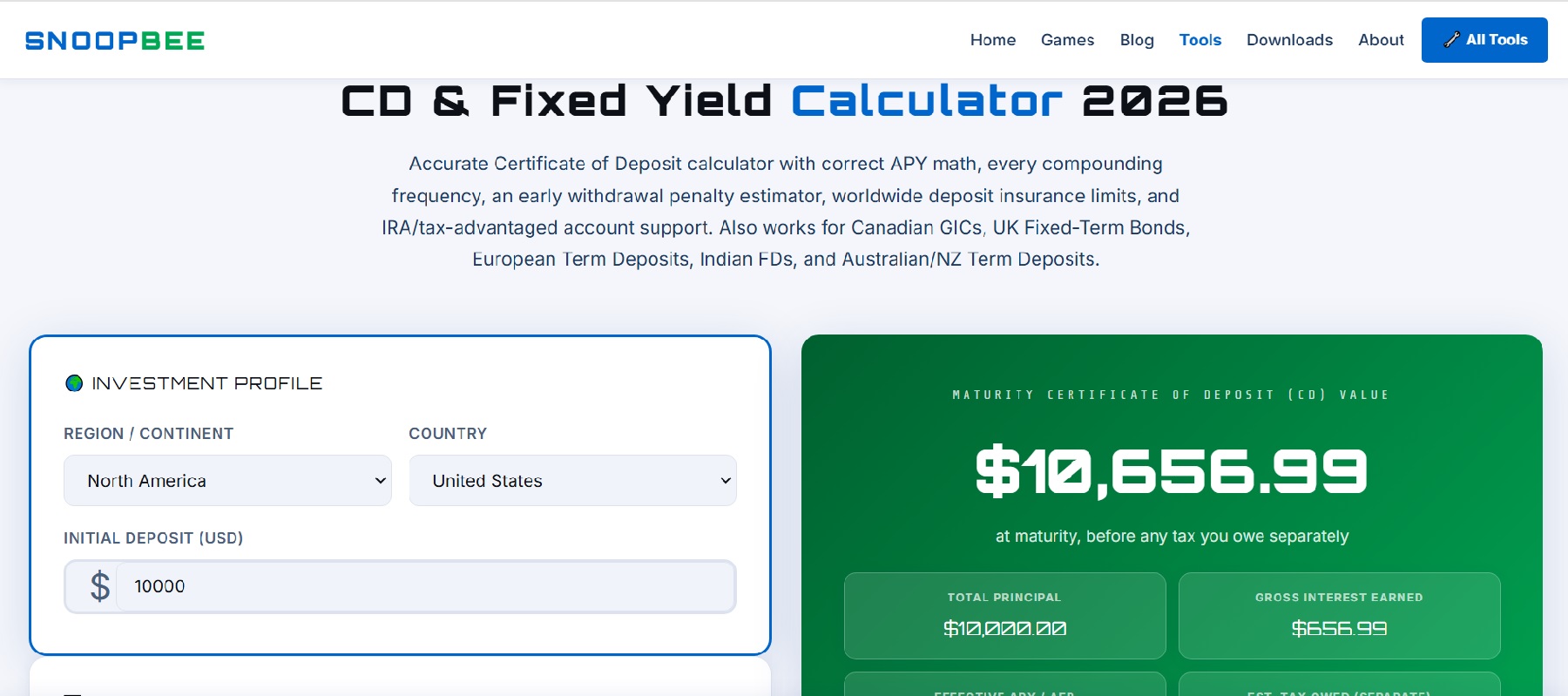
This makes CDs fundamentally different from stocks, mutual funds, or real estate, where your balance can go up or down with the market. A CD's growth path is a straight mathematical line you can calculate on day one — which is exactly what our CD & Fixed Yield Calculator does for you instantly.
Global Terminology: Same Idea, Different Names
Money is universal, but financial marketing is local. If you grew up in Mumbai, you learned to say "FD." If you grew up in Toronto, you learned to say "GIC." Same underlying product, different name and slightly different local rules.
| Region | Local Name | Rate Label Banks Must Quote |
|---|---|---|
| United States | Certificate of Deposit (CD) | APY (Annual Percentage Yield) |
| Canada | Guaranteed Investment Certificate (GIC) | Effective annual rate |
| United Kingdom | Fixed-Term Bond | AER (Annual Equivalent Rate) |
| Eurozone | Term Deposit / Festgeld / Dépôt à terme | Effective annual rate |
| India | Fixed Deposit (FD) | Cumulative / effective yield |
| Australia & New Zealand | Term Deposit | Effective annual rate |
A few regional quirks worth knowing: Canadian GICs sometimes come in a "market-linked" flavor, where your minimum return is guaranteed but part of your yield can scale with a stock index like the S&P/TSX 60. Indian FDs come in two payout styles — cumulative FDs compound quarterly and pay everything at maturity, while non-cumulative FDs pay out interest monthly or quarterly, which many retirees prefer as a regular income stream. Australian and New Zealand banks frequently run odd, irregular term lengths (like an "8-month special" or an "11-month special") to attract savers, which is exactly the kind of comparison our calculator's term-in-months option is built to normalize.
Simple vs. Compound Interest
Every CD calculation boils down to one of two methods. If you're a student seeing this for the first time: imagine you lend a friend $100 and they agree to pay you back with interest.
Simple Interest — The Linear Path
With simple interest, your friend calculates interest only on the original $100 you lent — never on any interest that's piled up along the way. It grows in a straight line.
Where I is total interest earned, P is your principal (starting amount), r is the annual interest rate (as a decimal), and t is time in years.
Example: Deposit $10,000 at a 5% simple interest rate for 5 years: I = 10,000 × 0.05 × 5 = $2,500. Your final balance is $12,500 — and you earn exactly $500 every single year, no more, no less, because each year's interest is still calculated only off that original $10,000.
Compound Interest — The Snowball Effect
Compound interest is different: at the end of each period, the interest you earned gets added back into your balance, and the next period's interest is calculated on that new, larger balance. It's the financial version of a snowball rolling downhill — the bigger it gets, the more snow it picks up with each roll, and the faster it grows.
Where A is your final maturity balance, n is how many times per year interest compounds, and everything else is the same as above.
Same example, monthly compounding (n = 12): A = 10,000 × (1 + 0.05/12)60 = $12,833.59. Switching from simple to monthly-compounded interest turned your $2,500 return into $2,833.59 — an extra $333.59 that came from nowhere except letting your money earn interest on its own interest.
Why this matters for students: almost every real-world CD, GIC, and Fixed Deposit uses compound interest, not simple interest. Simple interest mostly shows up in textbooks and certain short-term loans. If a calculator or bank ad doesn't specify, assume compound.
APY / AER vs. the Stated Rate — The Number Everyone Mixes Up
Here's the single most common mistake people make with CD math — including, frankly, a lot of online calculators. Banks quote two different numbers, and they are not interchangeable:
- The stated (nominal) rate — the plain annual rate before compounding is factored in. This is the number you plug into the compound interest formula above as r.
- APY (or AER in the UK) — the actual, effective return you'll earn in one year once compounding is already baked in. It's always equal to or higher than the stated rate.
Accuracy note: if you take a bank's advertised APY and then run it back through the compound interest formula a second time — applying r/n and raising it to the n·t power again — you will overstate your real return, because APY has already absorbed the compounding effect once. This is a subtle but genuine bug we found and fixed while building our own calculator: always enter the stated rate, and let the math derive the APY for you, not the other way around.
The gap between stated rate and APY grows with compounding frequency. At low rates the difference is small change; at higher rates over long terms it becomes real money, which is exactly why the next section matters.
How Compounding Frequency Changes Your Return
The compounding frequency n tells you how often the bank "stops the clock," calculates interest, and folds it back into your balance. The more often that happens, the faster your snowball grows — though, as you'll see, there's a point of rapidly diminishing returns.
Here's $100,000 at a 5.50% stated annual rate over a 10-year term, shown at every common compounding frequency:
| Compounding | Times / Year | Maturity Balance | Total Interest |
|---|---|---|---|
| Annually | 1 | $170,814.45 | $70,814.45 |
| Semi-Annually | 2 | $172,042.84 | $72,042.84 |
| Quarterly | 4 | $172,677.08 | $72,677.08 |
| Monthly | 12 | $173,107.64 | $73,107.64 |
| Daily | 365 | $173,318.12 | $73,318.12 |
Notice the pattern: moving from annual to monthly compounding gains you about $2,293 in extra interest — meaningful. But moving from monthly all the way to daily only gains you another $210. This is the principle of diminishing returns in compounding: as the number of compounding periods per year approaches infinity, the formula converges toward continuous compounding, A = P·ert, and each additional compounding period adds less and less. In plain terms: daily compounding is nice to have, but don't let a bank distract you with "we compound daily!" if their underlying stated rate is meaningfully lower than a competitor who only compounds monthly — always compare the resulting APY, not the compounding frequency alone.
Worldwide Deposit Insurance — Is Your Money Actually Protected?
The single biggest reason CDs, GICs, and Fixed Deposits are considered "safe" isn't the bank's promise — it's that a government-backed insurance scheme stands behind it, up to a statutory limit. If your bank fails, this scheme (not the bank) pays you back, up to the limit, usually within days.
| Country | Scheme | Coverage Limit |
|---|---|---|
| United States | FDIC (banks) / NCUA (credit unions) | $250,000 per depositor, per bank, per ownership category |
| Canada | CDIC | $100,000 CAD per depositor, per category, per member institution (a 2025 federal proposal would raise this to $150,000 — not yet enacted) |
| United Kingdom | FSCS | £120,000 per person, per authorised firm — raised from £85,000 on 1 December 2025 |
| Eurozone | National Deposit Guarantee Scheme (EU-harmonized) | €100,000 per depositor, per bank |
| India | DICGC | ₹5,00,000 per depositor, per bank (principal + interest combined) |
| Australia | Financial Claims Scheme (FCS) | A$250,000 per account-holder, per ADI |
| New Zealand | Depositor Compensation Scheme (DCS) | NZ$100,000 per depositor, per licensed deposit taker — effective since 1 July 2025 |
Accuracy correction: a lot of older articles (and some AI-generated content) still quote the UK's FSCS limit as £85,000. That was raised to £120,000 effective 1 December 2025 — always check the current figure before relying on it, since these limits do get revised periodically.
Two practical notes: coverage is usually per depositor, per institution — so if you split $500,000 across two separately-chartered US banks, both amounts are fully FDIC-insured. And coverage typically applies only to licensed banks/credit unions, not every fintech app that merely "partners" with a bank — always confirm the exact legal entity holding your deposit.
Early Withdrawal Penalties — What Breaking a CD Really Costs
A CD is a promise, and breaking that promise early usually comes with a fee. This is the #1 practical difference between a CD and a regular savings account, and it's the reason CDs aren't a good place for money you might need on short notice.
Penalties are most often expressed as a number of months of interest, and they typically scale with the CD's original term:
| Original CD Term | Typical Penalty (Industry Pattern) |
|---|---|
| Under 12 months | ~3 months of interest |
| 12 – 24 months | ~6 months of interest |
| 24 – 48 months | ~9 months of interest |
| 48+ months | ~12 months of interest |
Many institutions cap the penalty at the interest you've actually earned so far, meaning your original deposit is protected even if you withdraw very early — but this isn't a universal rule, and in rarer cases a penalty can dip into principal. Our CD calculator includes a built-in Early Withdrawal Penalty Estimator using these typical tiers (with a custom override), so you can see roughly what breaking a CD early would cost before you ever open one — then confirm the exact number against your bank's disclosure statement.
Taxes and Tax-Advantaged Accounts
In most countries, the interest a CD pays you is treated as ordinary taxable income — not the more favorable capital gains rate stocks can qualify for. That matters more than people expect, especially at higher tax brackets.
Worked example: a $50,000 Fixed Deposit at a 6.00% stated rate, compounding annually, for 3 years. Gross maturity balance: $59,550.80. Gross interest earned: $9,550.80. At a 22% tax bracket, you'd owe roughly $2,101.18 in tax on that interest, leaving you with a net-of-tax gain of about $7,449.62.
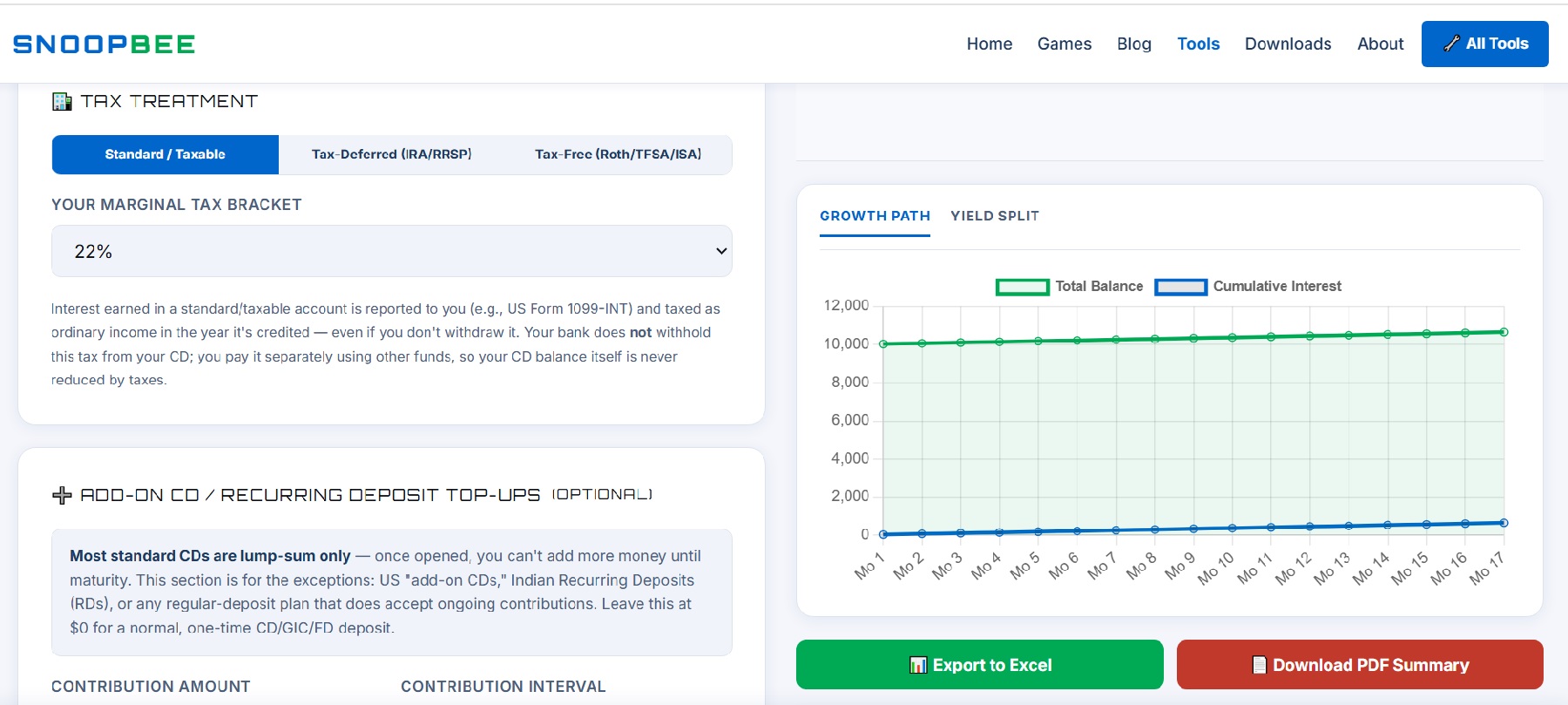
Important nuance most calculators get wrong: in countries like the US, your bank does not withhold this tax from your CD balance. You receive the full stated interest (reported to you on a form like the 1099-INT), and you settle the tax bill separately, using other funds, when you file your return. A calculator that silently subtracts tax from your CD balance is showing you a number your bank will never actually apply — ours shows the tax as a separate, informational estimate instead.
Sheltering CDs From Tax Entirely
Experienced savers often hold CDs inside tax-advantaged accounts rather than as a standalone taxable deposit:
- United States: holding a CD inside a Traditional IRA defers tax until retirement withdrawal; inside a Roth IRA, growth and qualified withdrawals are entirely tax-free.
- Canada: a GIC inside a TFSA (Tax-Free Savings Account) eliminates tax on the growth entirely; inside an RRSP, tax is deferred until retirement.
- United Kingdom: a Fixed-Term Bond bought through an ISA wrapper is tax-free up to the annual ISA contribution ceiling.
Rules and account names differ elsewhere (superannuation in Australia, PPF/ELSS in India), so always check your local tax-advantaged options — the underlying idea is the same everywhere: shelter the interest, and it either grows tax-deferred or tax-free instead of being taxed as ordinary income every year.
Add-On CDs & Recurring Deposits — When You Can Keep Contributing
A standard CD is a single-deposit vault: you put money in once, lock the door, and collect the balance at maturity — you generally cannot add more later. But some banks offer "Add-On CDs," and India's Recurring Deposit (RD) product is specifically designed around ongoing monthly contributions. When contributions are involved, the math changes from a single compound-interest calculation into a compound interest + annuity calculation:
Where i is the periodic interest rate (r ÷ n), m is the total number of compounding periods, and PMT is your contribution each period.
Example: start with $10,000, a 4.50% stated rate compounded monthly, and add $200 every month for 5 years (60 months). Your original $10,000 grows to $12,517.96 on its own. Your monthly $200 contributions, growing along the way, add another $13,429.11. Total maturity value: $25,947.07 — combining the safety of a locked-in rate with the discipline of a regular savings habit.
CD vs. High-Yield Savings Account (HYSA) — Which Should You Choose?
This is the single most common real-world decision CD shoppers face, and the right answer depends entirely on where you think interest rates are headed.
- Choose a CD when rates look like they've peaked or are likely to fall — you lock in today's higher rate before HYSA rates start dropping.
- Choose a HYSA when you want flexibility, expect rates to keep climbing, or might need the cash on short notice — HYSA rates float up (or down) immediately with the market.
- Not sure which way rates are headed? That uncertainty is exactly what the CD ladder strategy below is designed to solve.
The CD Ladder Strategy — Getting Both Liquidity and Yield
The biggest downside of a CD is that your money is locked up — and breaking it early costs a penalty. The CD ladder is a simple way around that: instead of putting all your money into one CD with one maturity date, you split it across several CDs with staggered terms.
Building a 5-Year Ladder
Instead of locking $50,000 into a single 5-year CD, split it into five $10,000 buckets across five different terms:
- Bucket 1: $10,000 in a 1-Year CD
- Bucket 2: $10,000 in a 2-Year CD
- Bucket 3: $10,000 in a 3-Year CD
- Bucket 4: $10,000 in a 4-Year CD
- Bucket 5: $10,000 in a 5-Year CD
When Year 1 ends, your first $10,000 CD matures — cash you can spend, or reinvest into a fresh 5-year CD at whatever the current rate is. Repeat this every year, and by Year 5 your entire ladder has rotated once. From then on, exactly one-fifth of your portfolio becomes liquid every single year, while the whole ladder still earns the higher rates typically reserved for longer 5-year terms. It's a genuinely simple way to get both flexibility and yield without guessing which way rates will move.
International Terminology Key
| Country | Local Name | Effective-Rate Term |
|---|---|---|
| United States | Certificate of Deposit (CD) | Annual Percentage Yield (APY) |
| Canada | Guaranteed Investment Certificate (GIC) | Effective annual rate |
| United Kingdom | Fixed-Term Bond | Annual Equivalent Rate (AER) |
| Eurozone | Term Deposit / Festgeld | Effective annual rate |
| India | Fixed Deposit (FD) | Cumulative interest / effective yield |
| Australia / New Zealand | Term Deposit | Effective annual rate |
Frequently Asked Questions
What is the difference between a CD's interest rate and its APY?
The stated rate is the raw annual number before compounding; APY (AER in the UK) is the real return you get once compounding is already included. Never compound an APY a second time — that's the most common CD math error.
Is my money safe in a CD, GIC, or Fixed Deposit?
Yes, up to your country's statutory limit at a covered institution — see the worldwide insurance table above for exact figures by country.
What happens if I withdraw money from a CD before it matures?
You'll typically face an early withdrawal penalty, usually a few months' worth of interest, often (but not always) capped at the interest you've earned so far.
Should I choose a CD or a high-yield savings account?
A CD locks in today's rate; a HYSA floats with the market. Choose based on whether you think rates are more likely to rise or fall — or split the difference with a CD ladder.
What is a CD ladder?
Splitting your money across several CDs with staggered maturities, so a portion of your money becomes liquid every year while the rest still earns longer-term rates.
Can I keep adding money to a CD after I open it?
Usually not — standard CDs are lump-sum products. Add-on CDs and Recurring Deposits (common in India) are the exceptions.
Run Your Own Numbers With the Full Calculator
Open the CD & Fixed Yield Calculator →This article is for general educational purposes only and is not tax, legal, or financial advice. Deposit insurance limits reflect published scheme rules as of mid-2026 and may change — verify current limits with the relevant scheme before relying on them. Consult a licensed financial advisor or tax professional for your specific circumstances. Last updated: July 2026.
💬 Questions & Reader Comments
Ask a question about CDs, GICs, or Fixed Deposits, share your own scenario, or leave feedback. (Max 200 words)