Three Kinds of Home Loan in China, in Plain Language
A Commercial Loan (商业贷款) is an ordinary mortgage from a bank, priced off a national benchmark rate. A Housing Provident Fund Loan (公积金贷款) comes from a government-backed employee housing fund that both you and your employer pay into every month, and it's cheaper — but capped at a maximum amount that depends on your city. A Combination Loan (组合贷款) uses both at once: the Provident Fund portion up to its cap, and a Commercial loan to cover whatever's left.
Picture two friends buying identical ¥3,000,000 apartments in the same city. One takes a pure commercial mortgage. The other has been contributing to their Housing Provident Fund account for years and combines a Provident Fund loan with a smaller commercial top-up. Over 30 years, that second friend can end up paying well over ¥100,000 less in interest — for the exact same apartment, the exact same price, the exact same down payment. The difference isn't luck. It's understanding how China's dual-track mortgage system works, and this guide explains every moving part of it, from a first-year university student's budget spreadsheet to a working professional structuring a real purchase.
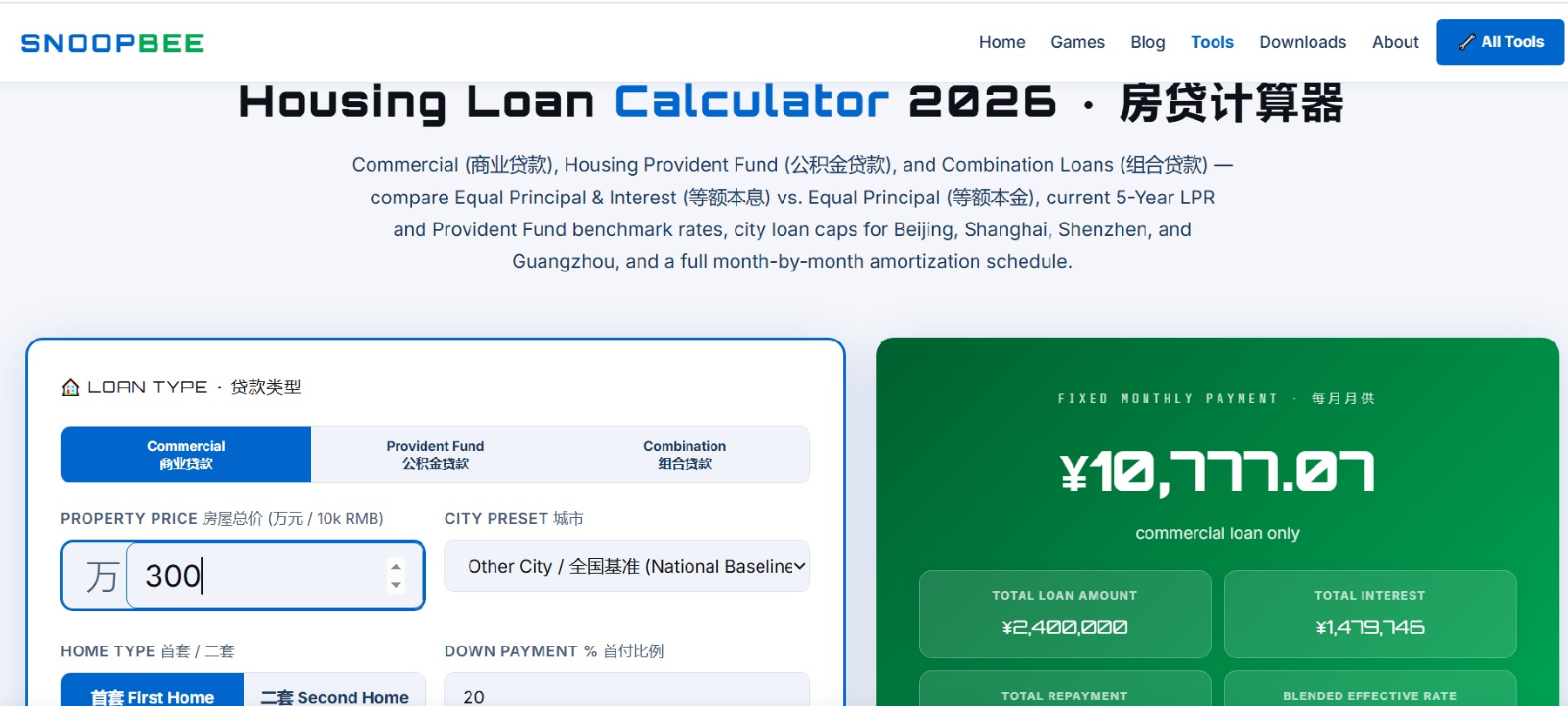
This article expands on the ideas built into our Housing Loan Calculator (房贷计算器), and while it's written with mainland China specifically in mind, the underlying math — amortization, benchmark-rate-plus-spread pricing, and down-payment-driven loan-to-value limits — applies just as well to mortgage systems in Hong Kong, Singapore, and much of East Asia.
What Is the LPR, and What Are "Basis Points"?
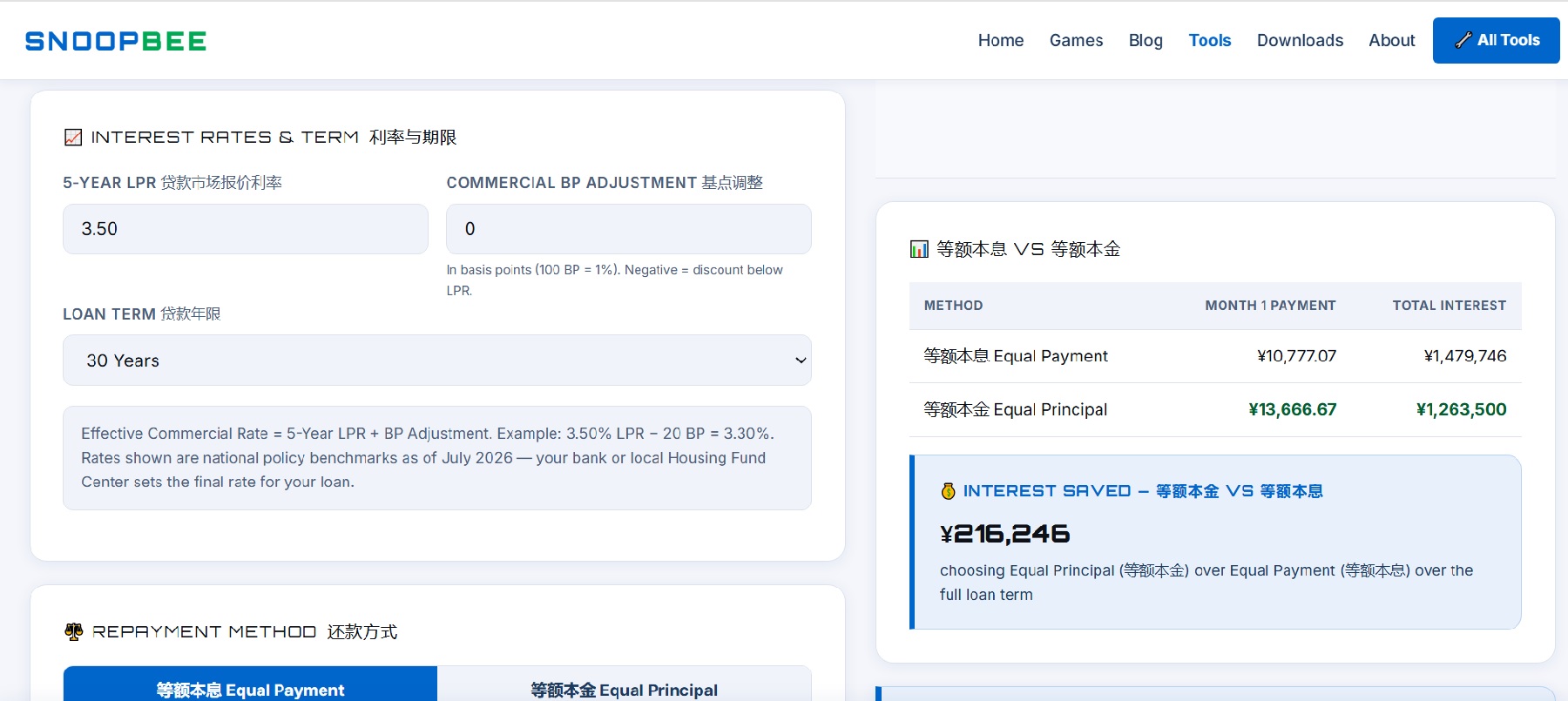
The Loan Prime Rate (LPR, 贷款市场报价利率) is a benchmark interest rate published monthly by the People's Bank of China, based on rates that major banks say they'd offer their best customers. There are two versions: a 1-year LPR (used for shorter loans and as a general economic indicator) and a 5-Year LPR, which is the reference rate for mortgages. As of July 2026, the 5-Year LPR has held at 3.50% for eleven consecutive months, reflecting a cautious, "wait and observe" phase in China's monetary policy.
Your bank doesn't necessarily charge you exactly the LPR. Instead, your rate is quoted as "LPR plus or minus basis points." A basis point (BP) is simply one-hundredth of one percent — so 100 basis points equal 1 percentage point. If your bank offers you "LPR − 20 BP," that means:
Basis points matter because mortgage rates are often quoted with several decimal places, and a "small" adjustment of even 20–30 BP compounds into real money over a 30-year loan. On a ¥1,000,000 commercial loan, moving from 3.50% down to 3.30% under Equal Payment lowers your total interest by roughly ¥12,000–¥13,000 over the full term — not life-changing on its own, but a useful reminder that the rate you negotiate is worth paying attention to.
Commercial vs. Housing Provident Fund — Why One Is So Much Cheaper
The Housing Provident Fund (住房公积金) is a mandatory savings-and-lending scheme: every month, a percentage of your salary is deposited into a personal account, matched by an equal contribution from your employer. You can later withdraw this money for housing-related purposes, and — crucially — you become eligible to borrow against the system at a rate well below what any commercial bank offers.
As of policy effective January 1, 2026, the national benchmark Provident Fund rate for loans over 5 years is 2.60% for a first home and 3.075% for a second home — compared with the 3.50% Commercial (LPR-based) rate most borrowers face. That's roughly a 0.9 percentage-point gap for first-time buyers.
Worked example — ¥1,000,000, 30 years, Equal Payment: a Commercial loan at 3.50% costs ¥4,490.45/month and ¥616,560.88 in total interest. The same amount as a first-home Provident Fund loan at 2.60% costs only ¥4,003.40/month and ¥441,222.96 in total interest — a lifetime saving of roughly ¥175,338, purely from using the cheaper source of the same amount of money.
The catch is the loan cap. Provident Fund loans are limited to a maximum amount set by your city's Housing Provident Fund Management Center (住房公积金管理中心), and that cap is usually far below the price of an apartment in a major city. This is exactly why most buyers in expensive cities end up needing a Combination Loan.
How a Combination Loan (组合贷款) Actually Works
A Combination Loan is not a single blended interest rate — it's two entirely separate loans running side by side, each with its own principal, its own rate, and its own amortization schedule. Your monthly payment is simply the sum of both:
A common mistake: treating a Combination Loan as one big loan at a single "average" rate. That's not how banks calculate it, and averaging the two rates instead of computing each tranche's payment separately and adding them will give you the wrong monthly figure — sometimes by a meaningful margin, especially when the two loan amounts aren't close to equal.
Worked example: a ¥3,000,000 property with a 20% down payment needs a ¥2,400,000 loan. Suppose the local Provident Fund cap is ¥600,000 (a national-baseline city figure) — the Provident Fund loan takes ¥600,000 at 2.60%, and the remaining ¥1,800,000 goes to a Commercial loan at 3.50%. Computed independently:
| Tranche | Amount | Rate | Month 1 Payment (等额本息) |
|---|---|---|---|
| Commercial | ¥1,800,000 | 3.50% | ¥8,082.80 |
| Provident Fund | ¥600,000 | 2.60% | ¥2,402.04 |
| Combined | ¥2,400,000 | 3.275% blended | ¥10,484.84 |
Notice the "3.275% blended" rate in the table is a derived, informational figure — a weighted average of the two rates by loan size — useful for comparing offers at a glance, but it is never the number actually used in the payment calculation itself. The payment always comes from summing the two independently-computed tranches.
等额本息 vs 等额本金: Which Should You Choose?
Every home loan in China (and most loans everywhere) can be repaid one of two ways.
等额本息 (Equal Principal & Interest / "Equal Payment"): your monthly payment is fixed for the entire loan — the same number every single month, though the mix inside it shifts from mostly-interest early on to mostly-principal later. 等额本金 (Equal Principal): the amount of principal you repay each month is fixed instead, so your total payment starts noticeably higher and steadily decreases every month as the loan balance — and therefore the interest charged on it — shrinks.
where M is the fixed monthly payment under 等额本息, P is the loan principal, r is the monthly interest rate (annual rate ÷ 12), and n is the total number of months. For 等额本金, the formula for the payment in month k is simpler in spirit but changes every month:
Worked example — ¥1,000,000 at 3.50% over 30 years: 等额本息 gives a fixed ¥4,490.45 every month and ¥616,560.88 total interest. 等额本金 starts at ¥5,694.44 in month one, dropping by roughly ¥8.10 every subsequent month, and totals just ¥526,458.33 in interest — a saving of about ¥90,103 over the life of the loan, in exchange for a bigger bite out of your budget in the early years.
Who tends to prefer which?
- 等额本息 (Equal Payment) suits borrowers who want a predictable, budgetable number every month — useful for dual-income households planning tightly around a fixed housing cost, or anyone whose income isn't expected to rise much.
- 等额本金 (Equal Principal) suits borrowers who can comfortably absorb a higher payment now — often younger professionals early in a rising-income career — and who prioritize minimizing total lifetime interest over smoothness of monthly cash flow.
First Home vs. Second Home: Down Payment & LTV Rules
China's mortgage rules distinguish sharply between a first home (首套房) and a second home (二套房), both in the minimum down payment required and in the interest rate offered.
As of 2026, the national baseline policy sets a minimum down payment of around 15% for a first home and 25% for a second home under commercial financing, though individual cities can and do set their own, sometimes stricter, local floors — Beijing, for instance, has historically required a much higher down payment (in some district and loan-type combinations, up to 50%) for second homes in its central six districts. Provident Fund loans typically carry somewhat higher minimum down payments than commercial loans for the same home-count category, and the Provident Fund interest rate itself steps up too — from 2.60% for a first home to 3.075% for a second home, a gap of roughly 0.475 percentage points that, on a ¥1,000,000 loan over 30 years, adds up to over ¥91,000 in extra interest.
Why "first" and "second" isn't always literal: many cities apply a rule called 认房又认贷 ("recognize the home, and recognize the loan") — meaning that even if you don't currently own a home, if you have an existing, un-cleared mortgage record anywhere, your next purchase may still be classified as a second home for rate and down-payment purposes. Always confirm your exact classification with your bank and local housing authority before assuming you qualify for first-home terms.
The 万元 Unit Trap
In mainland China, property prices, loan amounts, and salaries are almost universally quoted in 万元 (ten-thousand RMB) rather than plain yuan — a property advertised as "300万" means ¥3,000,000, not ¥300. This convention is so deeply embedded in everyday conversation, real-estate listings, and even bank paperwork that a calculator or spreadsheet which doesn't explicitly handle 万元 as its own unit is an easy place to introduce an accidental factor-of-10,000 error. Our calculator takes all property price and loan amount inputs in 万元 and expands them internally to full yuan only at the moment of calculation, specifically to avoid that class of mistake.
City Spotlight: Beijing, Shanghai, Shenzhen & Guangzhou
Provident Fund rules are set locally, so the loan cap you're entitled to varies significantly by city. As illustrative 2026 benchmarks (family/household limits; always confirm your personal entitlement with your city's Housing Provident Fund Management Center, since caps, multi-child family bonuses, and "commercial-to-provident-fund" conversion rules change frequently):
| City | Approx. Family Loan Cap | Notes |
|---|---|---|
| Beijing 北京 | ≈ ¥1,200,000 | Individual cap typically lower (≈¥800,000); central six-district second-home down payments can run notably higher than the national baseline. |
| Shanghai 上海 | ≈ ¥1,300,000 | One of the higher family caps among tier-1 cities; individual cap around ¥650,000. |
| Shenzhen 深圳 | ≈ ¥1,260,000 | Frequently adjusted alongside broader Guangdong-Hong Kong-Macao Greater Bay Area housing policy. |
| Guangzhou 广州 | ≈ ¥1,000,000 | Generally the most accessible cap among the four tier-1 cities, though still well below typical property prices in central districts. |
In every one of these cities, the Provident Fund cap alone is rarely enough to cover a typical urban apartment purchase outright — which is exactly why the Combination Loan exists as the default structure for the large majority of urban home buyers, rather than a niche option.
A Note for Hong Kong, Singapore & Vietnam Readers
While the Provident Fund mechanism is specific to mainland China, the broader principles in this guide travel well across the region. Hong Kong's mortgage market is dominated by rates tied to HIBOR (the Hong Kong Interbank Offered Rate) rather than the LPR, but the same benchmark-plus-spread pricing logic applies. Singapore uses SORA (the Singapore Overnight Rate Average) as its reference rate, alongside a Central Provident Fund (CPF) that — much like China's Provident Fund — can be used toward housing, though its mechanics differ in important ways. Vietnam's mortgage market is more bank-rate-driven with less of a nationwide subsidized-loan tier, but the fixed-payment-vs-decreasing-payment amortization choice, and the first-home-vs-second-home down payment distinction, remain broadly similar concepts worth understanding no matter which East Asian housing market you're navigating.
Five Practical Tips Before You Sign
- Check your Provident Fund balance and eligibility early. The maximum loan you can access often depends on your account balance and contribution history, not just the city-wide cap.
- Ask specifically whether you qualify as 首套 or 二套. Don't assume — prior mortgage history anywhere can reclassify a purchase even if you don't currently own property.
- Get the exact basis-point adjustment in writing. "Around LPR" is not a rate; ask your bank for the precise BP spread that will apply to your specific loan.
- Model both repayment methods before deciding. The "right" choice between 等额本息 and 等额本金 depends heavily on your income trajectory and monthly cash-flow comfort, not just the total-interest number alone.
- Ask about 商转公 (commercial-to-provident-fund conversion). Many cities allow refinancing an existing commercial mortgage into Provident Fund terms after certain conditions are met — potentially unlocking meaningful savings on a loan you already hold.
Frequently Asked Questions
What is the LPR and how does it affect my mortgage rate?
The Loan Prime Rate is a monthly benchmark published by the People's Bank of China. Commercial mortgage rates are set as the 5-Year LPR plus or minus a basis-point adjustment, so when the LPR changes, most floating-rate mortgages change with it.
What is the difference between a Commercial loan and a Housing Provident Fund loan?
A Commercial loan comes from a bank at a market rate tied to the LPR. A Provident Fund loan comes from a government-backed employee housing fund and carries a significantly lower rate, but only up to a city-specific cap.
What is a Combination Loan (组合贷款)?
It blends a Provident Fund loan (up to its cap) with a Commercial loan for the rest of what's needed. The two tranches amortize independently at their own rates, and the total monthly payment is the sum of both.
Should I choose 等额本息 or 等额本金?
Equal Payment (等额本息) keeps your monthly cost flat and predictable but costs more total interest. Equal Principal (等额本金) starts higher and decreases, saving total interest — often a better fit if you expect stable or rising income and can handle a bigger payment early on.
How much down payment do I need for a first home versus a second home?
The 2026 national baseline is roughly 15% for a first home and 25% for a second home, though individual cities — especially Beijing, Shanghai, and Shenzhen — can and do set higher local minimums, particularly for second homes in central districts.
Run Your Own Numbers With the Full Calculator
Open the Housing Loan Calculator →This article is for general educational purposes only and is not financial, tax, or legal advice. Interest rates, Provident Fund caps, and down payment ratios referenced are national policy benchmarks as of July 2026, sourced from public reporting, and change frequently at both the national and city level — always confirm your exact rate, cap, and down payment requirement with your bank and local Housing Provident Fund Management Center (住房公积金管理中心) before signing any loan agreement. Last updated: July 2026.
💬 Questions & Reader Comments
Ask a question about Commercial loans, Provident Fund loans, or Combination Loan math, or share your own city's rules. (Max 200 words)