What Is VAT? The Tax Hiding in Every Price Tag
Value Added Tax (VAT) is a consumption tax added to the price of most goods and services, ultimately paid by whoever buys the item at the end of the chain. It goes by different names depending on where you are: VAT in the UK and Ireland, Mehrwertsteuer (MwSt) in Germany and Austria, Taxe sur la Valeur Ajoutée (TVA) in France, and Imposta sul Valore Aggiunto (IVA) in Italy and Spain. Roughly 170 countries around the world run some version of this same system, sometimes under the name GST (Goods and Services Tax) instead.
If you've ever bought a coffee, a phone, or a train ticket in the UK or Europe, you've paid VAT — you just might not have noticed, because unlike some countries, most UK and EU price tags already include it. A £12.00 T-shirt in a UK shop isn't £12.00 plus tax at the till; the £12.00 already has the VAT baked in. That's exactly why a calculator that can work backward — pulling the VAT back out of a price you've already paid — is just as useful as one that adds it forward.
For a ten-year-old, the simplest way to think about VAT is this: it's a small slice of almost everything you buy that goes to the government instead of the shop. If a rate is 20%, then for every £5 slice of the price, £1 of it belongs to the tax authority, not the seller. The shop never gets to keep that slice — it just collects it on the government's behalf and hands it over later.
How VAT Actually Flows Through the Supply Chain
Here's the part that trips up even a lot of adults: VAT isn't collected just once, at the shop till. It's collected in stages, all the way back through the supply chain — the factory, the wholesaler, the retailer — and each business in that chain only pays the government the difference between the VAT it charged and the VAT it was charged. This is sometimes called the credit-invoice method, and it's the single biggest structural difference between VAT and an ordinary sales tax.
Walk through a simplified example at a flat 20% rate. A raw-materials supplier sells fabric to a clothing manufacturer for a net £100, adding £20 VAT, so the manufacturer pays £120. The supplier passes that £20 straight to the tax authority. The manufacturer then turns that fabric into a jacket and sells it to a retailer for a net £200, charging £40 VAT (£240 total) — but the manufacturer already paid £20 of VAT on the fabric, so it only hands over the £20 difference (£40 charged − £20 already paid = £20 remitted). Finally, the retailer sells the jacket to you, the customer, for a net £300, charging £60 VAT (£360 total) — and having already paid £40 to the manufacturer, the retailer remits just the £20 difference.
Notice the punchline: the government still ends up with exactly £60 — 20% of the final £300 net price — and you, the end consumer, are the only one who actually bears that cost. The three businesses in between never lose a penny of their own money to VAT; they're just unpaid tax collectors passing installments up the chain. This is why VAT is described as a tax on consumption rather than a tax on business.
The Four Rate Buckets: Standard, Reduced, Zero & Exempt
Not everything is taxed at the same rate. Every VAT system sorts goods and services into a small number of buckets:
- Standard rate — the default rate that applies unless something specifically qualifies for a lower category. Most electronics, clothing (for adults), restaurant meals, and professional services fall here.
- Reduced rate(s) — a lower rate applied to categories a government wants to make cheaper or considers essential: household energy, some food, books, public transport, hospitality. Several countries run more than one reduced tier.
- Super-reduced rate — a handful of countries (including France, Italy, and Spain) keep a legacy rate under 5% for a narrow list of items like newspapers or prescription medicine.
- Zero-rated / Exempt — these sound similar but are legally different. Zero-rated goods are technically inside the VAT system, just taxed at 0% — the seller can still reclaim VAT on their own costs. Exempt goods sit entirely outside the system, meaning the seller cannot register for VAT or claim anything back on related costs.
Real-world quirk: classification isn't always obvious. In the UK, hot takeaway food is standard-rated, but most cold takeaway food is zero-rated — the same sandwich can be taxed differently depending on whether it was served warm. Rules like this exist across every VAT system, which is exactly why product classification (not the math) is usually the hardest part of getting VAT right.
2026 VAT Rates: UK, Germany, France, Italy & Spain
| Country | Standard Rate | Reduced Rate(s) | Super-Reduced |
|---|---|---|---|
| United Kingdom | 20% | 5% | 0% (zero-rated) |
| Germany | 19% | 7% | — |
| France | 20% | 10%, 5.5% | 2.1% |
| Italy | 22% | 10%, 5% | 4% |
| Spain | 21% | 10% | 4% |
Rates are set nationally and reviewed periodically, so treat this table as a snapshot rather than the final word — always cross-check against HMRC, your national tax authority, or a qualified accountant before filing a return or pricing a high-value invoice. There is also no single "EU rate": each member state sets its own standard and reduced rates within EU-mandated floors (a 15% minimum for the standard rate, 5% for the general reduced category), which is exactly why rates range from under 20% to well above it across the bloc.
The Three Formulas: Add, Remove, Reverse
Every VAT calculation, no matter which way you're working, comes down to one relationship: Gross = Net × (1 + r), where r is the VAT rate written as a decimal (20% becomes 0.20). Everything else is just rearranging that one equation.
1. Adding VAT to a net price
You know the net (pre-tax) price and want the VAT and the final price:
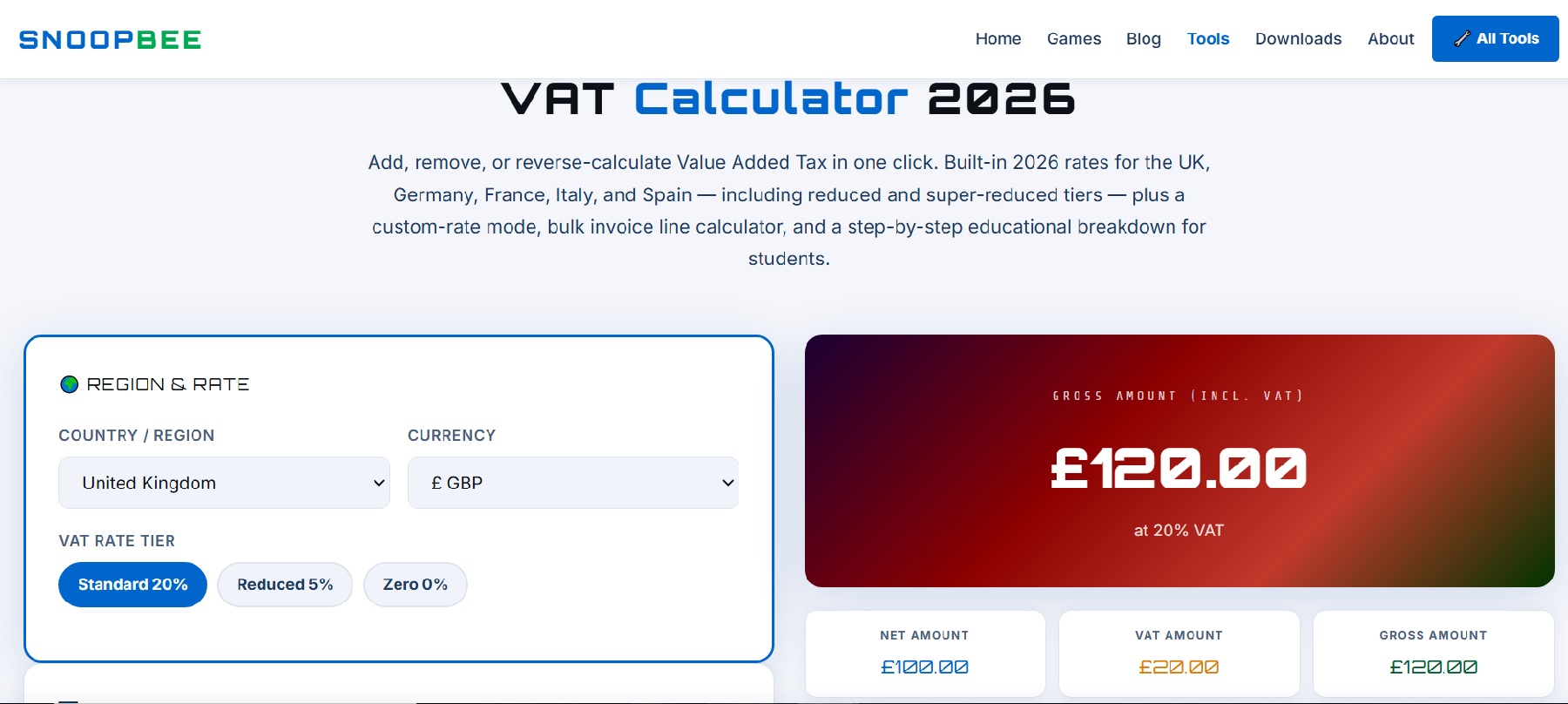
Example at 20%: net £100 → VAT = £100 × 0.20 = £20 → gross = £100 × 1.20 = £120.
2. Removing VAT from a gross price
You only have the tax-inclusive total — like a receipt — and want to know the net price and the VAT it contained. You divide, not multiply:
Example: gross £120 at 20% → net = £120 ÷ 1.20 = £100 → VAT = £120 − £100 = £20.
3. Working from a known VAT amount
Occasionally you're handed just the tax line itself — from an invoice, say — and need to reconstruct everything else:
Example: a VAT line of £20 at 20% → net = £20 ÷ 0.20 = £100 → gross = £100 + £20 = £120. This is exactly what the calculator's three modes — Add VAT, Remove VAT, and From VAT Amount — automate for you.
The #1 Mistake Almost Everyone Makes
The trap: if you have a gross price of £120 at 20% VAT and you multiply £120 × 20%, you get £24 — which looks like a reasonable answer but is wrong. The actual VAT hidden in that £120 is only £20, as shown above.
Why does this happen? Because 20% of the gross figure is not the same as 20% of the smaller net figure that the VAT was originally calculated on. The VAT was added on top of £100, not on top of £120 — so pulling it back out means dividing by 1.20 first, not multiplying the bigger number by 0.20. If you want a single-step shortcut instead of two steps, the mathematically correct one is:
At 20%, that's Gross × (0.20 ÷ 1.20), which simplifies to Gross × ⅙ — not Gross × 0.20. This single mix-up is responsible for more incorrect invoices, mispriced products, and failed bookkeeping reconciliations than almost any other VAT error, which is exactly why this calculator's Remove VAT mode exists as a dedicated, separate function rather than expecting you to remember to divide.
VAT vs. Sales Tax: Why They Aren't the Same
If you've grown up around a country that uses a simple retail sales tax instead of VAT, the two can look identical from the till receipt — a percentage gets added, you pay more than the sticker price. But structurally, they work quite differently:
| VAT | Retail Sales Tax | |
|---|---|---|
| Collected | At every stage of the supply chain | Once, at the final sale to the consumer |
| Who remits it | Every registered business in the chain (net of what they've already paid) | Only the final retailer |
| Visible on receipt | Often already included in the shelf price | Usually added at the till, on top of the shelf price |
| Business burden | Businesses reclaim what they paid — net cost to them is zero | Businesses don't pay it on purchases for resale, if properly certified |
Despite the different mechanics, the amount the end consumer ultimately pays tends to work out to roughly the same thing under both systems — the headline rate applied to the final retail price. The difference mostly matters to businesses (who have extra bookkeeping under VAT, tracking what they charged versus what they paid) and to tax authorities (VAT is harder to evade, since each stage cross-checks the next).
Reading (and Writing) a Real VAT Invoice
A compliant VAT invoice typically needs to show, at minimum: the seller's name, address, and VAT registration number; the invoice date and a unique invoice number; a description of the goods or services; and — critically — the net amount, the VAT rate applied, the VAT amount, and the gross total, broken out separately for each rate if more than one applies on the same invoice.
That last point matters more than it sounds: a single invoice can legitimately mix rates. A café selling a hot meal (standard rate) alongside a bottled soft drink (potentially a different rate) needs to show each portion's VAT separately, then sum them into one grand total. This is precisely the gap a simple single-amount calculator can't fill, and why a bulk, multi-line invoice mode — where every line item carries its own rate — matters for anyone actually issuing or checking real invoices rather than doing a single one-off calculation.
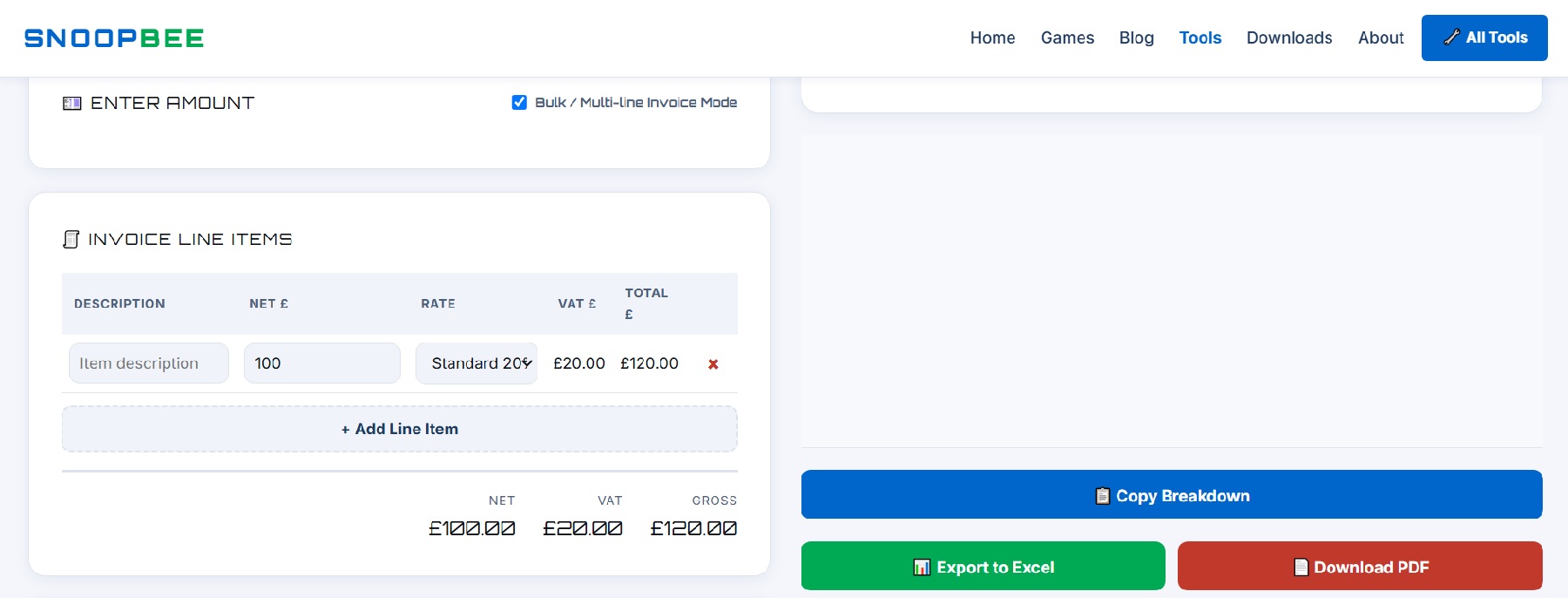
Quick sanity check for any invoice: Net + VAT should always equal Gross, and VAT ÷ Net should always equal the stated rate (allowing for small rounding). If either check fails, something on the invoice was miscalculated.
VAT Registration: When a Business Must Charge It
Not every business charges VAT. In most countries, a business only needs to register for VAT once its taxable turnover crosses a threshold set by the relevant tax authority; below that line, many small businesses and sole traders aren't required to charge VAT on their sales at all — though some choose to register voluntarily anyway, since it lets them reclaim VAT on their own purchases.
Registration thresholds, filing frequencies (monthly, quarterly, or annual), and the exact documentation a valid invoice must contain differ by country and change periodically. Treat any specific threshold figure you see quoted online as a starting point to verify directly with HMRC or your national tax authority, rather than something to rely on indefinitely — these numbers are exactly the kind of detail that gets updated in annual budget announcements.
VAT Through Life: Student, Professional, Retiree, Business Owner
Students (K-12 & College)
If you're a student, VAT is probably the first "invisible tax" you've ever paid — it's already folded into the price of your lunch, your phone case, and your bus ticket. The one place it's genuinely useful to understand the math is when you see a receipt and want to know how much of what you paid was actually tax versus how much the shop kept. That's the "Remove VAT" calculation in action, and it's a genuinely good way to practice percentages and division in a real-world context rather than an abstract textbook problem.
Working Professionals & Freelancers
If you invoice clients directly — as a freelancer, contractor, or small business owner — getting VAT right isn't optional homework, it's the difference between a correct invoice and one that under- or overcharges your client (or underpays the tax authority). Knowing when to add VAT to a quote, how to handle mixed-rate invoices, and how to double-check a VAT line someone else has sent you are all everyday, practical skills once you're the one issuing invoices rather than just receiving receipts.
Retirees
VAT doesn't change dramatically in retirement, but fixed incomes make it worth knowing which everyday essentials sit in the reduced or zero-rated bucket in your country — domestic energy, certain food items, and some medical products often qualify for a lower rate than the standard one, and that difference compounds meaningfully over a year of household bills.
Small Business Owners
If you run a VAT-registered business, the mechanics above aren't background trivia — they're your monthly or quarterly bookkeeping. Getting comfortable with net vs. gross, per-rate invoice breakdowns, and the credit-invoice mechanic (what you charge minus what you were charged) is the foundation of filing an accurate VAT return.
International Terminology Key
| Country | Local Name | 2026 Standard Rate |
|---|---|---|
| United Kingdom | VAT (Value Added Tax) | 20% |
| Germany / Austria | Mehrwertsteuer (MwSt / USt) | 19% |
| France | Taxe sur la Valeur Ajoutée (TVA) | 20% |
| Italy | Imposta sul Valore Aggiunto (IVA) | 22% |
| Spain | Impuesto sobre el Valor Añadido (IVA) | 21% |
Every one of these systems shares the exact same underlying math this guide covers — only the name, the exact rate, and the local category rules differ. Always confirm your own country's current rules with the relevant tax authority before relying on any figure here for filing purposes.
Frequently Asked Questions
Is VAT the same as sales tax?
Not quite. A retail sales tax is collected once, at the final point of sale. VAT is collected in stages throughout the supply chain, with each registered business reclaiming the VAT it paid on its own inputs — but the cumulative effect on the price the end consumer pays is broadly equivalent to a single-stage sales tax at the same rate.
How do I calculate 20% VAT quickly in my head?
To add 20% VAT to a net price, multiply by 1.2. To remove 20% VAT from a gross price, divide by 1.2 — not by 0.8, and don't just subtract 20% of the gross figure, both of which are common shortcuts that give the wrong answer.
Why is my reduced-rate item still showing the standard rate?
Whether an item qualifies for a reduced or zero rate depends on strict local classification rules, and the same physical product can fall into different categories depending on packaging, quantity, or how it's served. Always check the applicable category for your specific goods or service with the relevant tax authority rather than assuming based on the product type alone.
Do exported goods carry VAT?
Exports outside the taxing jurisdiction are typically zero-rated, provided the seller retains the correct evidence of export, but the exact conditions vary by country and by whether the sale is B2B or B2C.
What's the difference between zero-rated and VAT-exempt?
Zero-rated goods are technically within the VAT system, taxed at 0% — the seller can still reclaim VAT on related costs. Exempt supplies sit entirely outside the VAT system, meaning the seller cannot register for VAT or reclaim input VAT on costs related to those supplies.
Run Your Own Numbers With the Full Calculator
Open the VAT Calculator →This article is for general educational purposes only and is not tax, legal, or accounting advice. VAT rates and category classifications vary by country and change over time — confirm current figures with HMRC, your national tax authority, or a qualified accountant before making business or filing decisions. Last updated: July 2026.
💬 Questions & Reader Comments
Ask a question about VAT, share a real invoice scenario, or leave feedback. (Max 200 words)