Where "401(k)" and "Roth" Actually Come From
"401(k)" isn't a brand name — it's literally a citation. It's named after Subsection 401(k) of the U.S. Internal Revenue Code, a provision tucked into the Revenue Act of 1978 that let employees defer part of their pay, tax-free, into a savings plan. Nobody designed it to become America's dominant retirement vehicle — that happened almost by accident in 1980, when a benefits consultant named Ted Benna re-read the obscure clause and realized it could be turned into a self-directed, employee-funded savings plan with employer matching. Within a few years, it had largely replaced the old-style pension for most private-sector workers.
"Roth" has an equally human origin: it's named after Senator William Roth of Delaware, who championed the Taxpayer Relief Act of 1997 that created the Roth IRA. His idea was the mirror image of the 401(k): instead of getting a tax break today and paying tax later, you pay tax today and get a completely tax-free account later. Two different senators' names, two completely different tax philosophies, and today almost every retirement decision in America comes down to choosing between them.
Traditional vs. Roth: The Core Tradeoff
Every retirement dollar has to answer one question: do you want to pay tax on it now, or later? Think of it like a coupon — a Traditional account gives you the discount today; a Roth account gives you the discount at checkout, decades from now, and that "checkout" happens to be tax-free.
- Traditional (pre-tax): your contribution reduces your taxable income today. If you earn $85,000 and contribute $10,000 to a Traditional 401(k), the IRS only taxes you on $75,000 this year. But every dollar you withdraw in retirement — your original contributions and all the growth — gets taxed as ordinary income.
- Roth (post-tax): you get no deduction today; your $85,000 stays fully taxable this year. But every dollar that comes out in retirement, including decades of growth, is completely tax-free.
A Worked Example — Both Ways, Honestly
Say you can set aside $6,000 a year (about $500/month) for 30 years at a 7% average annual return. That grows to a future value of about $584,726 either way — the market doesn't care which account label is on the money.
Compare the same $6,000 contributed to either account (today's marginal rate 22%, expected retirement rate 12%):
- Traditional: $584,726 taxed at 12% on withdrawal → $514,559 spendable.
- Roth: $584,726, completely tax-free → $584,726 spendable.
Looked at this way, Roth appears to win outright — and in raw future dollars, for the same contribution, it usually does, because it avoids tax entirely while Traditional still owes some. But that's not quite a fair fight, because Roth money is already-taxed money: contributing $6,000 to Roth costs you the full $6,000 out of your paycheck today, while contributing $6,000 to Traditional only costs you $4,680 out of your paycheck (since you get a $1,320 tax break this year at the 22% bracket).
Compare them at equal true cost to you today instead: if you only put the same $4,680-a-year "paycheck hit" into Roth (since that's the amount that actually costs you the same as the Traditional path), it grows to just $456,087 — tax-free, but on a smaller base. Now Traditional's $514,559 wins, because your expected retirement rate (12%) is lower than today's rate (22%). This is the classic, correct rule of thumb: expect a higher tax rate in retirement → Roth wins; expect a lower rate → Traditional wins — once you properly account for what today's tax break is actually worth to you.
Employer Match: Free Money on the Table
If there's one setting in our calculator everyone should max out first, it's the employer match. Many employers add money to your account based on how much you contribute yourself — an instant, guaranteed return that no stock market investment can promise.
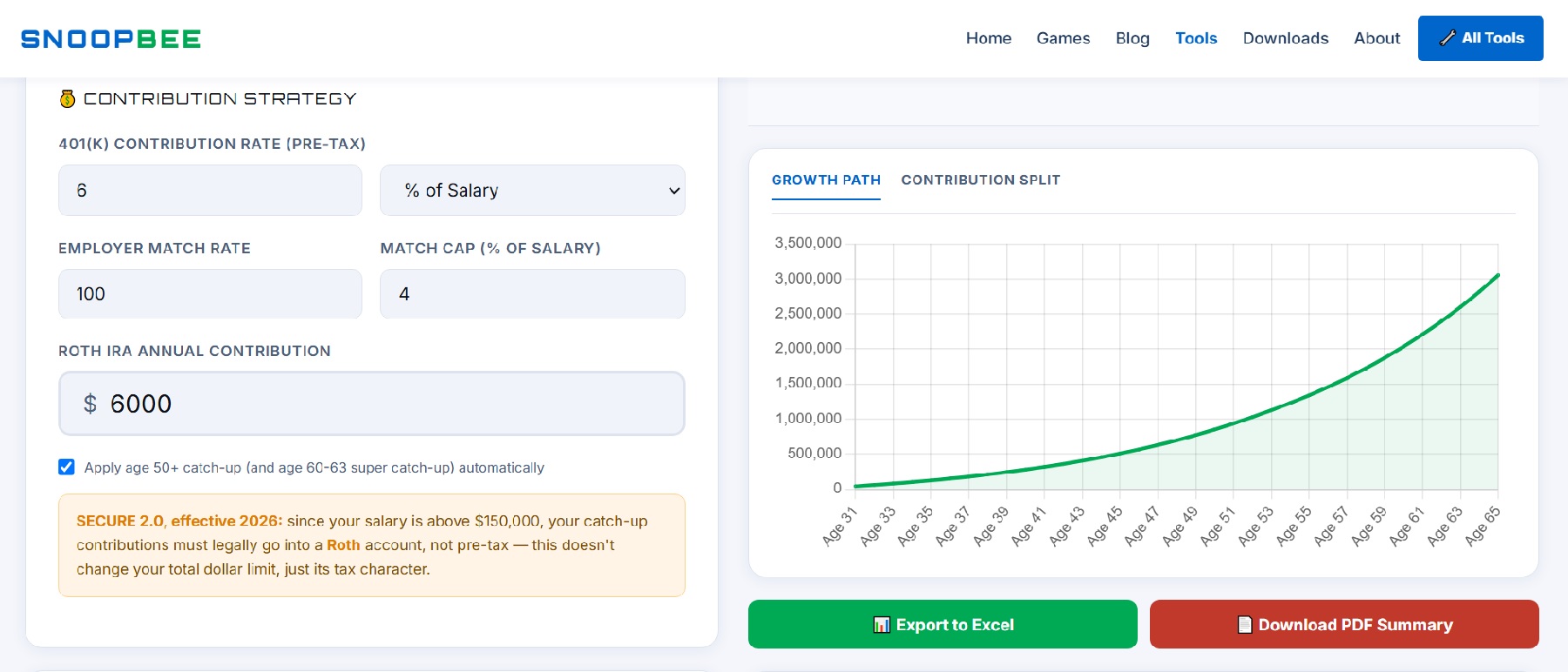
Worked example: you earn $85,000 and contribute 6% ($5,100/year). Your employer matches 100%, dollar-for-dollar, up to 4% of salary. Even though you contributed 6%, the match caps at 4% of $85,000 = $3,400. That means $8,500 total ($5,100 from you + $3,400 free from your employer) lands in your account in year one — before a single dollar of market growth. Contributing less than your match cap is the same as declining part of your paycheck.
2026 Contribution Limits & the New SECURE 2.0 Rules
| Limit | 2026 Amount |
|---|---|
| 401(k) elective deferral limit | $24,500 |
| 401(k) catch-up (age 50+) | $8,000 |
| 401(k) "super" catch-up (age 60-63 only) | $11,250 (replaces, doesn't add to, the standard catch-up) |
| Combined employee + employer limit (IRS §415(c)) | $72,000 |
| IRA contribution limit (Traditional or Roth) | $7,500 |
| IRA catch-up (age 50+) | $1,100 |
New for 2026 — mandatory Roth catch-up for high earners: under SECURE 2.0, if you earned more than $150,000 in FICA wages from your employer last year, any catch-up contributions you make must legally be designated Roth, not pre-tax. It doesn't shrink your total dollar limit — it just changes the tax character of that slice of your contribution.
Roth IRA Income Phase-Outs & the Backdoor Roth
Unlike a 401(k), a direct Roth IRA contribution phases out entirely at higher incomes. For 2026:
| Filing Status | Full Contribution Below | Phased Out Completely At |
|---|---|---|
| Single / Head of Household | $153,000 MAGI | $168,000 MAGI |
| Married Filing Jointly | $242,000 MAGI | $252,000 MAGI |
| Married Filing Separately (lived with spouse) | $0 MAGI | $10,000 MAGI |
If you're phased out entirely, a "backdoor Roth" — contributing to a non-deductible Traditional IRA, then converting it to Roth — remains available at any income level, though it can get tax-complicated if you already hold other pre-tax IRA money. Talk to a tax professional before doing one.
Required Minimum Distributions (RMDs) Explained
The IRS won't let Traditional money grow tax-deferred forever. Starting at age 73 (rising to 75 in 2033), you must withdraw a minimum amount each year, calculated by dividing your prior year-end balance by an IRS life-expectancy divisor — 26.5 at age 73. Example: a $500,000 Traditional balance at 73 requires a first-year withdrawal of about $500,000 ÷ 26.5 = $18,868, taxed as ordinary income.
Roth IRAs — and, since a recent SECURE 2.0 change, Roth 401(k)s too — have no RMDs during the original owner's lifetime. That single fact makes Roth accounts a favorite tool for people who want to leave tax-free money to their heirs rather than being forced to draw it down themselves.
The 4% Rule & Safe Withdrawal Rate
Once you stop contributing, the question flips: how much can you safely spend each year without running out of money? The classic answer comes from the Trinity Study, which examined decades of historical market returns and found that withdrawing about 4% of your portfolio in year one, then adjusting that dollar figure for inflation every year after, gave a strong historical chance of your money lasting 30+ years.
A $1,500,000 nest egg, under this rule, supports about $60,000 a year — or $5,000 a month — of sustainable retirement income. Our calculator also shows your Real Purchasing Equivalent: the same balance adjusted for assumed inflation, since a big number 40 years from now buys less than the same number today.
Why Starting Early Beats Contributing More Later
This is the single most important idea in this entire guide, and it's simple enough for a middle-schooler to grasp: time in the market matters more than the amount you contribute. Compound growth is like a snowball — the earlier you start rolling it downhill, the bigger it gets before it reaches the bottom.
Person A contributes $500/month starting at age 25, but stops entirely after just 10 years (age 35) — total contributed: $60,000. They never add another dollar, but let it sit invested at 7% until age 65.
Person B waits until age 35 to start, then contributes $500/month every year for the next 30 years until age 65 — total contributed: $180,000, three times as much.
Person A ends up with about $651,045 at 65. Person B, despite contributing three times as much money out of pocket, ends up with only about $584,726. The only difference is a 10-year head start. If you're a student or in your twenties reading this: the single best financial decision you can make today isn't finding the perfect investment — it's simply starting now, even with a small amount.
Strategy by Life Stage
Students (K-12 & College)
Your biggest financial asset isn't money — it's time. An 18-year-old who saves just $2,000 a year (about $166/month) into a Roth IRA at a conservative 8% average return will have roughly $938,000 by age 65 — and nearly 90% of that final total comes purely from investment growth, not from money they actually put in. At this stage: start now, favor Roth (your tax bracket is likely at its lowest point in your life), and give compounding as much time as possible.
Working Professionals (25–50)
Contribute at least enough to capture your full employer match — anything less is unclaimed compensation. If your career has pushed you into a high tax bracket, leaning Traditional captures a bigger deduction today; if you're early-career and still in a low bracket, Roth is often the better call. A simple, powerful habit: raise your contribution rate by 1% every time you get a raise, so your savings rate grows without your take-home pay ever feeling smaller.
Approaching Retirement (50–65)
This is exactly when catch-up contributions (and the new age 60-63 super catch-up) exist to help — they let you accelerate savings in your highest-earning, closest-to-retirement years. It's also a sensible time to dial back your assumed pre-retirement return rate in the calculator, modeling a gradual shift toward a more conservative mix, since a market downturn hits much harder two years before retirement than it does at age 25.
Retirees (65+)
The goal flips from accumulation to sustainable distribution. Blending withdrawals across Traditional and Roth balances lets you manage your annual taxable income deliberately — pulling more from Roth in a year you want to stay in a lower tax bracket, for instance. Required Minimum Distributions on Traditional accounts start at 73, so factor that mandatory income into your planning well before it arrives.
International Terminology Key
| Country | Pre-Tax Vehicle | Post-Tax / Tax-Free Vehicle |
|---|---|---|
| United States | Traditional 401(k) | Roth IRA / Roth 401(k) |
| Canada | RRSP | TFSA |
| United Kingdom | Workplace Pension / SIPP | Stocks & Shares ISA |
| Eurozone | Company / Statutory Pension | Private/Voluntary Pension Top-Up |
| India | EPF / NPS (Tier I) | PPF / Voluntary NPS (80CCD(1B)) |
| Australia | Superannuation (Concessional) | Superannuation (Non-Concessional) |
| New Zealand | KiwiSaver | Voluntary Additional Contributions |
Exact tax mechanics vary by country — this table maps each system to the same universal pre-tax/post-tax idea, but always confirm your own country's specific rules with a licensed advisor.
Frequently Asked Questions
Should I choose a Traditional 401(k) or a Roth 401(k)?
Expect a higher tax rate in retirement → Roth tends to win. Expect a lower rate → Traditional tends to win, once you account for the bigger paycheck Traditional gives you today.
What is an employer match and how much should I contribute to get it?
It's extra money your employer adds based on your own contribution, typically up to a percentage of salary — always contribute at least enough to capture the full match.
What are the 401(k) and IRA contribution limits for 2026?
$24,500 for 401(k)s ($8,000 catch-up at 50+, $11,250 super catch-up at 60-63), and $7,500 for IRAs ($1,100 catch-up at 50+).
What is a Required Minimum Distribution (RMD)?
The minimum yearly withdrawal the IRS requires from Traditional accounts starting at age 73. Roth accounts have none during the owner's lifetime.
What is the 4% rule?
A guideline suggesting you can withdraw about 4% of your portfolio in year one of retirement, adjusted for inflation after, with a strong historical chance of lasting 30+ years.
Can I lose direct access to a Roth IRA if I earn too much?
Yes — for 2026, contributions phase out between $153,000-$168,000 MAGI (single) or $242,000-$252,000 (married filing jointly). A backdoor Roth remains available above those limits.
Run Your Own Numbers With the Full Planner
Open the 401(k) & Roth IRA Planner →This article is for general educational purposes only and is not tax, legal, or financial advice. Contribution limits, phase-out ranges, and RMD rules reflect published 2026 figures and may change — verify current numbers with the IRS or your local tax authority before relying on them. Consult a licensed financial advisor or tax professional for your specific circumstances. Last updated: July 2026.
💬 Questions & Reader Comments
Ask a question about 401(k)s, Roth IRAs, or international equivalents, share your own scenario, or leave feedback. (Max 200 words)