
What Is a Buy-to-Let Mortgage?
A Buy-to-Let (BTL) mortgage is a loan specifically designed for purchasing a property you intend to rent out, rather than live in yourself. Lenders assess BTL applications very differently from a normal residential mortgage: instead of primarily checking whether your salary can cover the repayments, they check whether the property's rental income can comfortably cover the mortgage interest, with a safety buffer built in for future rate rises.
Most UK BTL mortgages are arranged on an interest-only basis by default — the monthly payment covers only the interest, and the original loan amount (the "capital") is repaid in full at the end of the term, typically from selling the property or refinancing. This keeps monthly costs lower and matches how most landlords actually plan their finances: as a long-term capital investment rather than a debt they're actively paying off month by month, the way a homeowner might.
Because BTL properties are, by definition, a second (or third, or fortieth) property rather than a main residence, they're treated differently for tax purposes in three specific ways that this guide walks through one at a time: Section 24 restricts how mortgage interest is treated for tax, the PRA stress test governs how much a lender will actually let you borrow, and the 5% SDLT surcharge adds a meaningful chunk to the upfront cost of buying at all.
What Is Section 24? How It Reshaped UK Landlord Tax
Before 2017, a landlord holding property in their personal name could deduct mortgage interest from their rental income just like any other business expense, before working out how much tax they owed — exactly the way a shopkeeper deducts the cost of stock before calculating profit. Section 24 of the Finance (No. 2) Act 2015, phased in gradually from 2017 to 2020, removed that deduction for individual landlords entirely.
In its place, individual landlords now pay income tax on their full rental profit — calculated as if the mortgage interest were never paid at all — and then receive a flat 20% tax credit on whatever interest they actually paid, regardless of their personal tax bracket.
Why this hits higher-rate taxpayers hardest: for a basic-rate (20%) taxpayer, a 20% credit roughly cancels out a 20% tax bill on that same interest — close to a wash. But a higher-rate (40%) or additional-rate (45%) taxpayer only gets the interest relieved at 20%, not their actual rate, while still being taxed on the full pre-interest profit at their higher rate. In heavily-mortgaged cases, this can push a landlord's effective tax rate on their real cash profit well above 100% — meaning they can owe more in tax than they actually made in profit that year.
This single change is the reason so many landlords buying new property since 2017 have shifted toward Limited Company (SPV) ownership structures instead of buying in their own name — because Section 24 simply doesn't apply to companies.
Personal Name vs. Limited Company (SPV): The Real Trade-Off
An SPV (Special Purpose Vehicle) is simply a Limited Company set up for the sole purpose of holding property. Because it's a company rather than an individual, it pays Corporation Tax (19% on profits up to £50,000, rising to 25% above £250,000, with marginal relief in between) rather than personal Income Tax, and — critically — mortgage interest remains a fully deductible business expense, with no Section 24 restriction at all.
| Personal Name | Limited Company (SPV) | |
|---|---|---|
| Mortgage interest deduction | Not deductible — 20% tax credit instead | Fully deductible against profit |
| Tax rate applied | Personal Income Tax (20%/40%/45%) | Corporation Tax (19%–25%) |
| Extracting profit personally | Already in your name — no extra step | Requires dividends, taxed again personally |
| Mortgage product range | Widest range, often cheaper rates | Narrower range, sometimes higher rates/fees |
The catch most calculators miss: the tax saved inside a Limited Company only becomes real personal wealth once it's taken out — and extracting it as a dividend triggers further personal dividend tax (8.75%, 33.75%, or 39.35% depending on your bracket). For a landlord planning to reinvest profit and grow a portfolio over many years, an SPV is often clearly more efficient. For someone who wants to spend their rental profit as personal income right away, the advantage shrinks once that second layer of tax is accounted for — which is exactly why comparing the two properly means asking an accountant to model your specific situation, not just comparing headline tax rates.
How the PRA Mortgage Stress Test Actually Works
Since supervisory guidance from the Prudential Regulation Authority (PRA) took effect, every UK BTL lender must check that a property's rental income would still comfortably cover the mortgage interest even if rates rose significantly — not just at today's rate. This protects both the lender and the borrower from a nasty surprise if interest rates climb after the mortgage is taken out.
Two numbers drive this calculation. The stress rate is a hypothetical, deliberately conservative interest rate — typically 5.5% to 8% depending on the mortgage product — used purely for this affordability check, regardless of the actual rate you're being offered. The Interest Cover Ratio (ICR) is the safety margin the rent must clear above that stressed interest cost: commonly 125% for basic-rate personal borrowing or Limited Company applications, and 145% for higher-rate personal taxpayers, since HMRC's own modelling assumes they need a bigger buffer given Section 24's impact on their after-tax cash flow.
Worked example: a property renting for £15,000 a year, stress-tested at 5.5% with a 125% ICR, supports a maximum loan of £15,000 ÷ (0.055 × 1.25) = £218,182 — regardless of how much the borrower earns from their day job. If the desired mortgage exceeds that figure, the lender will typically reduce the loan size, ask for a bigger deposit, or decline the application outright.
The 5% SDLT Surcharge, Explained Band by Band
Stamp Duty Land Tax (SDLT) is a one-off tax paid when buying property in England or Northern Ireland, charged in slices ("bands") of the purchase price rather than as one flat rate on the whole amount. Anyone buying an additional residential property — which covers virtually every Buy-to-Let purchase — pays a further 5 percentage point surcharge on top of the standard bands, and critically, that surcharge applies from the very first pound, not just above some threshold.
| Price Band | Standard Rate | BTL Surcharge | Effective BTL Rate |
|---|---|---|---|
| £0 – £125,000 | 0% | +5% | 5% |
| £125,001 – £250,000 | 2% | +5% | 7% |
| £250,001 – £925,000 | 5% | +5% | 10% |
| £925,001 – £1,500,000 | 10% | +5% | 15% |
| Above £1,500,000 | 12% | +5% | 17% |
Each rate only applies to the slice of the price that falls within that band — not the whole price at the top rate. Worked example on a £250,000 BTL purchase: the first £125,000 is taxed at 5% (£6,250), and the remaining £125,000 is taxed at 7% (£8,750), for a total SDLT bill of £15,000.
Gross Yield vs. Net Yield vs. ROCE
Three different percentages get thrown around when people talk about how "good" a rental property is, and mixing them up leads to some very optimistic-sounding numbers that don't survive contact with reality.
Gross Yield
This is the number you'll see splashed across property listings, because it's the biggest and easiest to calculate — and it completely ignores every cost of actually owning the property. A £250,000 property renting at £1,250/month gives a Gross Yield of (£15,000 ÷ £250,000) × 100 = 6.00%.
Net Yield
Net Yield subtracts realistic running costs — letting agent fees, void periods when the property sits empty, maintenance, insurance — from the rent before dividing by price, giving a far more honest picture. It's common for a property advertised at an eye-catching 7-8% gross yield to work out closer to 4-5% net once real costs are factored in.
ROCE — Return on Capital Employed
This is arguably the most useful number of the three for anyone using a mortgage, because it measures the return on your own money — deposit, SDLT, legal and survey fees — rather than the full purchase price, most of which is the bank's money, not yours. Worked example: £3,200 of annual net cash flow against £77,000 of total cash invested (deposit + SDLT + fees) gives a ROCE of 4.15%. A property can have a perfectly respectable Net Yield and still a mediocre ROCE if the mortgage costs eat heavily into the cash profit relative to how much of your own money you put in — which is exactly why serious investors look at all three numbers side by side, not just one.
Interest-Only vs. Repayment: Two Very Different Debt Curves
With an Interest-Only mortgage, the monthly payment covers only interest — the loan balance never falls on its own, and the full original amount is still owed at the end of the term. This keeps monthly cash flow higher during the ownership period, which is why it's the standard choice for most BTL investors, who are typically planning around rental cash flow and long-term capital appreciation rather than debt payoff.
With a Repayment mortgage, each monthly payment includes both interest and a slice of the original capital, so the balance gradually shrinks to zero by the end of the term — exactly like a standard residential mortgage. Monthly payments are meaningfully higher for the same loan amount and rate, but the investor builds up outright equity in the property over time rather than relying entirely on rental income and property value growth.
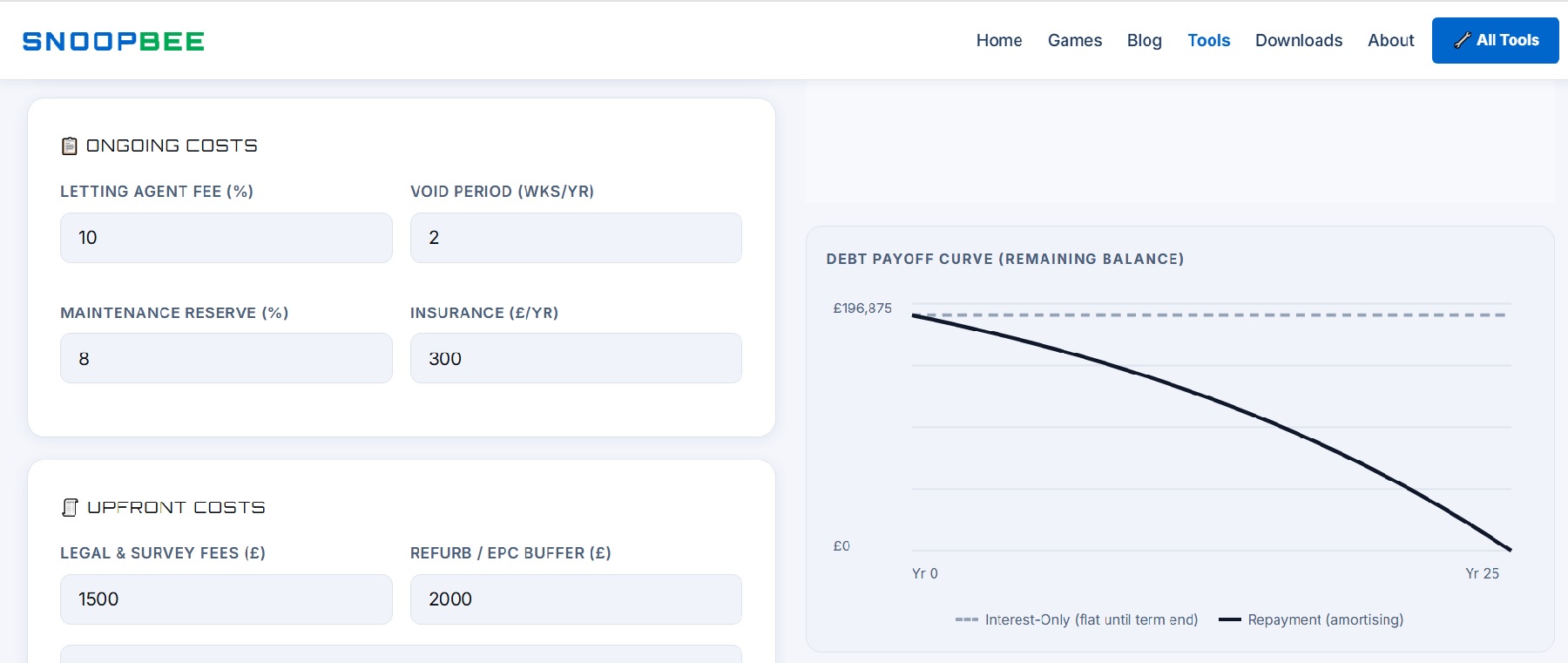
Neither is universally "better" — it depends on the strategy. Interest-only maximises monthly cash flow and capital efficiency for investors building a portfolio; repayment suits those prioritising debt-free ownership by a target date, such as before retirement.
Buy-to-Let Through Life: Student, Professional, Retiree
Students
If you're studying economics, business, or accounting, Buy-to-Let is a genuinely good real-world case study for how tax policy can reshape an entire industry's structure — Section 24 alone changed how tens of thousands of landlords legally organise their property holdings, purely because of how a tax deduction was redesigned.
Working Professionals
For anyone actively considering a first BTL purchase, the single most valuable habit is running the PRA stress test and the SDLT bill before falling in love with a specific property — a fantastic-looking rental yield is irrelevant if the numbers mean no lender will actually approve the loan you need.
Retirees
For retirees using property as an income-generating asset, Net Yield and Monthly Net Cash Flow matter far more than Gross Yield or long-run ROCE — the day-to-day, dependable rental income after real costs is usually the priority over maximising capital efficiency, which is a younger, portfolio-building investor's concern.
Frequently Asked Questions
What is Section 24 for landlords?
Section 24 removed a personal landlord's ability to deduct mortgage interest as an expense before calculating tax. Instead, tax is calculated on the full rental profit before interest, and a flat 20% tax credit is applied to the interest paid instead — which can significantly increase the effective tax rate for higher and additional rate taxpayers.
How does the PRA mortgage stress test work?
UK lenders must check that a property's rental income exceeds its mortgage interest by a safety margin even if rates rise, using a stress interest rate (typically 5.5%-8%) and an Interest Cover Ratio, usually 125% for basic-rate/Ltd Co borrowing or 145% for higher-rate personal borrowing. The maximum loan equals annual rent divided by the stress rate multiplied by the ICR.
How much is Stamp Duty on a Buy-to-Let property?
Buy-to-let and second-home purchases in England and Northern Ireland carry a 5 percentage point surcharge on top of standard Stamp Duty Land Tax bands, applied to the entire price rather than only above a threshold, producing effective rates of roughly 5%, 7%, 10%, 15% and 17% across the standard price bands.
What's the difference between Gross Yield, Net Yield and ROCE?
Gross Yield divides annual rent by purchase price and ignores costs. Net Yield subtracts realistic running costs first. ROCE divides annual cash profit by the actual cash invested (deposit, stamp duty, fees) rather than the full purchase price, which matters most when using mortgage leverage.
Is a Limited Company (SPV) always better than personal ownership?
Not necessarily. A Ltd Co keeps mortgage interest fully deductible against Corporation Tax, which is often more efficient for higher-rate taxpayers, but extracting profit from the company as dividends triggers further personal tax, and Ltd Co mortgage rates and product choice can be more limited. The right structure depends on individual circumstances and is worth discussing with an accountant.
Run Your Own Numbers With the Full Calculator
Open the UK BTL Mortgage Calculator →This article is for general educational purposes only and is not mortgage, tax, or investment advice. UK tax rates, SDLT bands, and lender criteria change and vary — confirm current figures with HMRC, the PRA, a mortgage broker, or a qualified accountant before making a property investment decision. Last updated: July 2026.
💬 Questions & Reader Comments
Ask a question about Buy-to-Let mortgages, Section 24, or SDLT, or share your own investing experience. (Max 200 words)