Why Your Super Balance Compounds Faster Than You Think
Superannuation (super) is Australia's compulsory retirement savings system. Money flows in from employer contributions, your own voluntary contributions, and investment earnings — then compounds inside a concessionally taxed environment for decades before you can access it.
The reason super outperforms an equivalent after-tax savings account isn't magic — it's two structural advantages working together. First, contributions tax inside super is capped at 15%, which is lower than the marginal tax rate most working Australians pay on their income. Second, investment earnings inside the fund are also taxed concessionally (generally up to 15%, and often less in practice), compared to your full marginal rate on earnings outside super. Compounded over a 30- or 40-year working life, that tax gap is the single biggest lever in most people's retirement outcome — bigger, for most people, than the difference between a mediocre and a great investment return.
That's also why how a calculator compounds your balance matters. A tool that credits an entire year's investment growth as a single lump sum at year-end will overstate your balance, because real contributions land throughout the year and only start earning returns from the date they're received. A calculator built on monthly (or more frequent) compounding gives a materially more realistic projection — which is exactly how this calculator's engine works internally.
It also helps to separate the three forces doing the work in any super projection: contributions (what goes in), tax (what's shaved off along the way), and investment growth (what compounds over time). Early in a career, contributions dominate — most of your balance growth in your 20s and 30s comes directly from SG and any voluntary amounts you add. By your 50s and 60s, the balance itself has usually grown large enough that investment returns on the existing pool contribute more to each year's growth than new contributions do. Understanding which force is currently dominant for you is useful: a 25-year-old chasing every extra percentage point of investment return is optimising the smaller lever, while a 55-year-old ignoring fees on a $400,000 balance is ignoring the bigger one.
How the Super Guarantee (SG) Works
The Superannuation Guarantee (SG) is the minimum percentage of your ordinary time earnings your employer is legally required to pay into your super fund, on top of your salary. It reached 12% on 1 July 2025 — the final step of a multi-year legislated schedule — and is currently the permanent ongoing rate for both 2025–26 and 2026–27.
SG is paid regardless of whether you're full-time, part-time, or casual, provided you meet basic eligibility rules, and from 1 July 2026 it is required to be paid alongside your regular pay cycle under the "Payday Super" reforms rather than quarterly — a significant administrative shift for employers, though it doesn't change the 12% rate itself. There is also a cap on how much salary SG applies to in any year: the maximum contribution base, which sits at $270,830 annually for 2026–27. Above that level, employers aren't required to pay SG on the excess, though some do voluntarily under an enterprise agreement.
Worth checking: confirm your payslips actually show 12% SG, not an outdated 11.5% figure — some payroll systems lag legislated increases by a pay cycle or two at the start of a new financial year.
Concessional vs Non-Concessional Contributions & Current Caps
Every dollar that goes into your super fund falls into one of two categories, and the distinction drives almost every strategic decision in this space.
- Concessional (before-tax) contributions: employer SG, salary sacrifice, and personal contributions you claim as a tax deduction. These are taxed at 15% inside the fund instead of your marginal income tax rate.
- Non-concessional (after-tax) contributions: money you contribute from your take-home pay or savings, which has already been taxed at your marginal rate. It enters the fund with no further contributions tax.
| Cap Type | 2025–26 | 2026–27 |
|---|---|---|
| Concessional (before-tax) cap | $30,000/yr | $32,500/yr |
| Non-concessional (after-tax) cap | $120,000/yr | $130,000/yr |
| Non-concessional bring-forward (3 years) | $360,000 | $390,000 |
| Division 293 income threshold | $250,000 | $250,000 |
| General transfer balance cap | $2.0 million | $2.1 million |
The non-concessional cap is always set at four times the concessional cap. If your total super balance is at or above the general transfer balance cap at the end of the previous financial year, your non-concessional cap drops to nil for the current year — a rule aimed at very large balances, not typical savers.
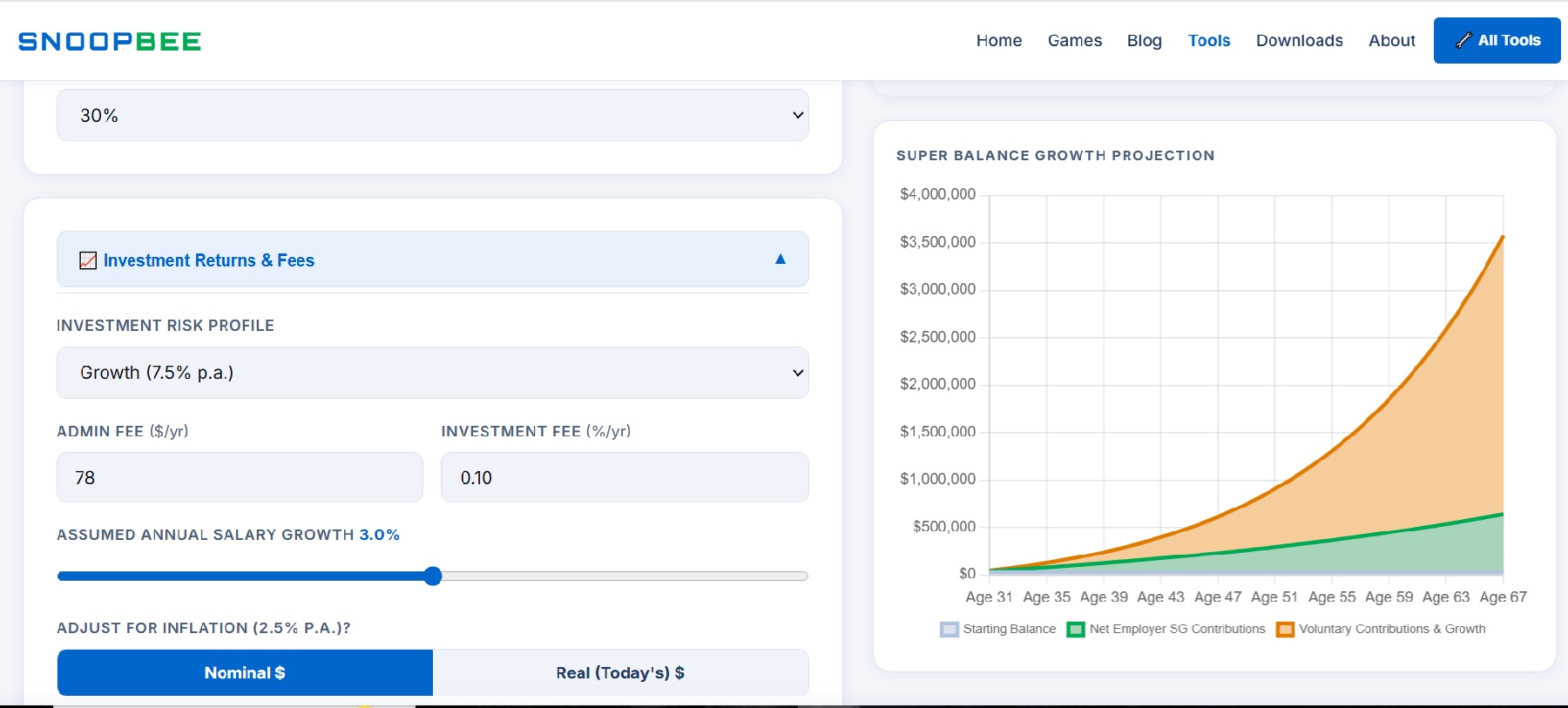
Over a full career, compound investment growth typically becomes the single largest contributor to the final balance.
Key Superannuation Formulas
Verified example: a $90,000 salary at 12% SG generates $10,800/yr in gross SG. After the 15% contributions tax, $9,180 is added to the fund balance — before any investment growth for the period.
Salary Sacrifice — The Tax Arbitrage Explained
Salary sacrifice is a formal arrangement with your employer to redirect part of your pre-tax salary into super instead of taking it as cash. It counts as a concessional contribution, so it's taxed at 15% instead of your marginal income tax rate.
The arithmetic is straightforward: if your marginal rate is 30%, every $100 you sacrifice only reduces your take-home pay by $70 (since you'd otherwise have paid 30% tax on it anyway), but the full $100 enters your fund and is taxed at just 15%, adding $85 to your balance. Compare that to taking the $100 as cash, paying 30% tax, and investing the remaining $70 outside super where earnings are taxed at your full marginal rate going forward — the gap compounds significantly over decades.
| Marginal Rate | $100 Sacrificed Costs You (Take-Home) | Net Amount Added to Super |
|---|---|---|
| 30% | $70 | $85 |
| 37% | $63 | $85 |
| 45% | $55 | $85 |
Cap discipline matters: employer SG and salary sacrifice share the same concessional cap ($32,500 for 2026–27). If your combined SG and sacrifice exceeds the cap, the excess is included in your assessable income and taxed at your marginal rate (with a 15% offset for the contributions tax already paid) — so check your SG amount before setting a sacrifice figure.
Division 293 & the Carry-Forward Rule
Division 293 is an additional 15% tax targeted at high-income earners, applying when your income plus concessional contributions exceed $250,000. It's charged on the lesser of your concessional contributions or the amount by which you exceed the threshold — meaning it doesn't wipe out the tax benefit of super for high earners, just reduces it from a 15%-vs-marginal-rate gap to something smaller.
Separately, if you haven't used your full concessional cap in a previous year and your total super balance is below $500,000, you may be able to carry forward up to five years of unused cap space to make a larger concessional contribution in a single year — useful after a career break, a lower-income year, or when you receive a windfall like an inheritance or asset sale and want to shelter more into super at once.
Government Co-Contribution & LISTO
Two separate government payments support lower and middle-income earners:
- Government Co-Contribution: if you earn under roughly $64,293 (2026–27) and make personal after-tax (non-concessional) contributions, the government matches up to 50 cents per dollar you contribute, to a maximum of $500 per year. The match phases out as your income rises toward the upper threshold.
- Low Income Super Tax Offset (LISTO): for eligible earners with adjusted taxable income of $37,000 or less, the ATO automatically refunds the 15% contributions tax paid on concessional contributions, capped at $500 per year — ensuring low-income earners don't pay more tax on their super contributions than on their take-home pay.
Neither payment requires a separate application for LISTO — the ATO calculates and pays it automatically based on your tax return and contribution information. The Government Co-Contribution does require you to have made an eligible personal contribution during the year.
Investment Options & Fees — What Actually Moves the Needle
Most funds offer a small set of standard investment options, typically ranging from Conservative to High Growth:
| Investment Option | Typical Long-Term Return (p.a.) | Typical Volatility |
|---|---|---|
| High Growth | ~8.5% | High |
| Growth | ~7.5% | Medium-High |
| Balanced | ~6.5% | Medium |
| Conservative | ~4.5% | Low |
These are long-term averages, not guarantees — actual annual returns vary considerably, including negative years. Fees matter more than most people expect: a fund charging 1% more per year in fees than another, compounded over a 35-year career, can reduce a final balance by well over 20%. This calculator lets you separate a flat annual admin fee from a percentage-based investment fee so you can see both effects on your specific projection.
A practical habit worth building: review your super fund's fees and investment option at least once every year or two, particularly after a job change (which sometimes creates a second, forgotten account with its own set of fees) or a major life event. Consolidating multiple accounts into one active fund avoids paying duplicate flat admin fees and duplicate insurance premiums — a surprisingly common and avoidable drag on long-term balances. Before consolidating, always check whether any account holds insurance cover (life, total and permanent disability, or income protection) you'd lose by closing it, since that cover can be difficult or expensive to replace later in life.
Preservation Age, Age Pension & Drawing Down Your Super
Your preservation age — the earliest age you can generally access your super, provided you meet a condition of release such as retirement — is 60 for anyone born after 30 June 1964. This is entirely separate from the Age Pension qualifying age of 67, a means-tested Centrelink payment that most people become eligible for years after they could first access their super.
Once you start an account-based pension from your super, the ATO sets a minimum drawdown rate — a percentage of your balance you must withdraw each year, increasing with age to ensure super is used for retirement income rather than as a tax-effective estate-planning vehicle.
| Age | Minimum Annual Drawdown |
|---|---|
| Under 65 | 4% |
| 65–74 | 5% |
| 75–79 | 6% |
| 80–84 | 7% |
| 85–89 | 9% |
| 90–94 | 11% |
| 95+ | 14% |
There's no maximum withdrawal for a standard account-based pension — only a minimum — so you can always draw more if you need it. This calculator estimates your retirement income by applying the minimum drawdown percentage for your chosen retirement age to your projected balance, which gives a useful, ATO-grounded baseline rather than an arbitrary "4% rule" borrowed from other countries' retirement norms.
Verified Worked Examples
Example 1: $90,000 Salary, Age 30, $30,000 Current Balance
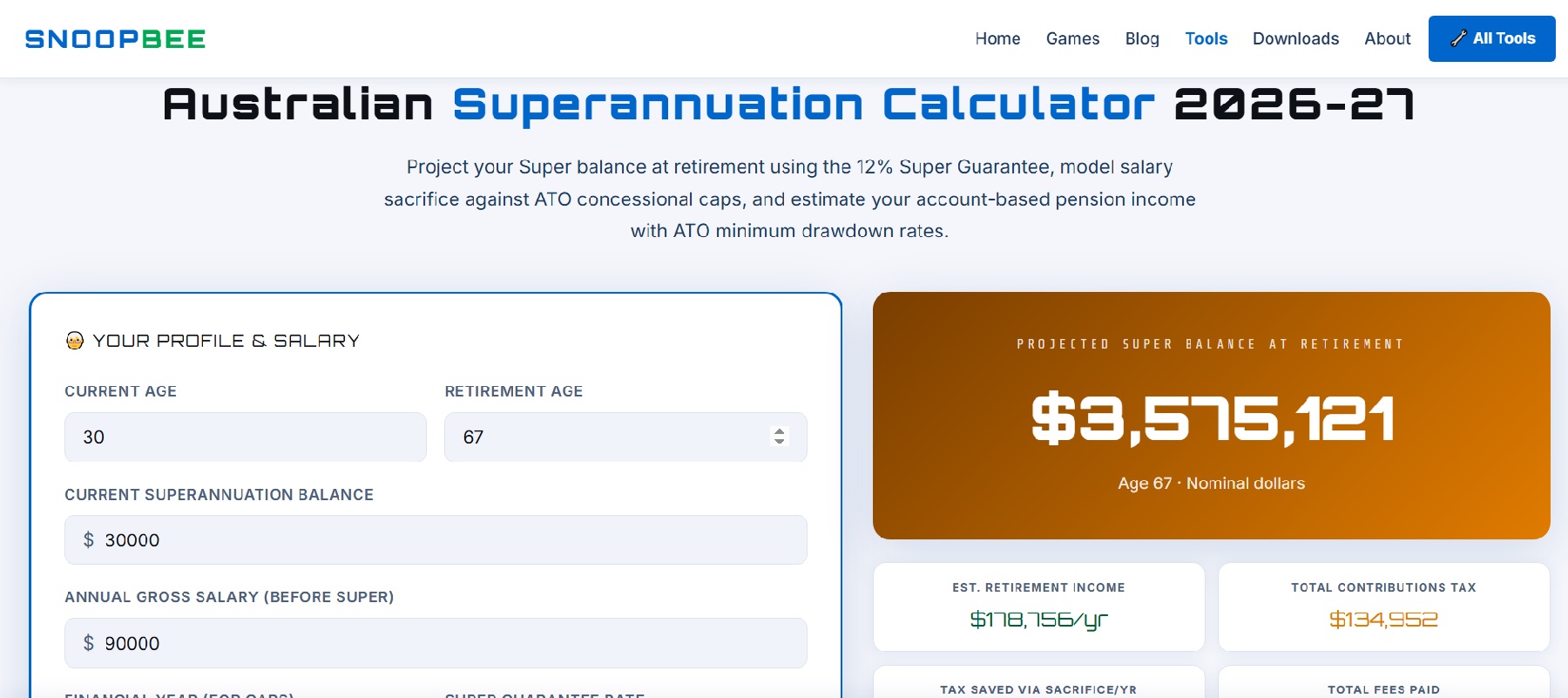
With 12% SG, no voluntary contributions, a Growth investment option (7.5% p.a.), typical fees, and 3% p.a. salary growth, monthly-step compounding projects a balance of roughly $3.0–3.6 million (nominal) by age 67, depending on the exact fee and growth assumptions used — illustrating just how much four decades of compounding can achieve, even before adjusting for inflation.
Example 2: Salary Sacrificing $200/Month at a 30% Marginal Rate
Sacrificing $200/month ($2,400/yr) at a 30% marginal rate reduces take-home pay by only $140/month, while $170/month (after the 15% contributions tax) is added to super. Modelled in isolation over 30 years at a 7.5% return, that single ongoing sacrifice can compound to a meaningfully large addition to a final balance — the calculator's Salary Sacrifice Optimizer tab shows this exact trade-off for your own numbers.
Frequently Asked Questions
Is 12% the final Super Guarantee rate, or will it rise again?
12% has been the legislated final step since 1 July 2025 and is the current ongoing rate. Always check the ATO for the latest confirmed rate, as legislation can change in future budgets.
Can I withdraw my super before preservation age in an emergency?
Early access is tightly restricted to specific compassionate grounds, severe financial hardship, or terminal illness provisions administered by the ATO — it isn't a general-purpose emergency fund.
Does salary sacrifice reduce my take-home pay dollar-for-dollar?
No — because the sacrificed amount would otherwise have been taxed at your marginal rate, the actual reduction in your take-home pay is smaller than the sacrifice amount itself, as shown in the table above.
This article is for general educational purposes only and is not financial, tax, or retirement advice. Figures reflect currently legislated and ATO/APRA-indexed rates as at July 2026 and may be updated by future budgets or indexation. Always confirm your specific circumstances with the ATO, your super fund, or a licensed financial adviser.
Try the Free Superannuation Calculator
Project your balance at retirement, test salary sacrifice, and check your contribution caps in seconds.
Open the Calculator →
Comments