Why Borrowing Power Isn't Just "Income Divided by Something"
Borrowing power (also called borrowing capacity) is the maximum amount a bank calculates it will lend you for a home loan, based on your income, expenses, existing debts, and a mandatory interest rate stress test. It is not simply a multiple of your salary — two people earning identical incomes can have wildly different borrowing power depending on their expenses, debts, and dependents.
A common myth is that banks lend "five times your income" or some similar rule of thumb. In reality, Australian lenders run a detailed cash-flow calculation for every applicant: what comes in, what regularly goes out, and — critically — what would happen to your ability to repay if interest rates rose significantly from today's level. That last part, mandated by the banking regulator, is often the single biggest factor separating what you think you can borrow from what a bank will actually approve.
This matters for far more than first home buyers. Anyone refinancing, upgrading, building an investment property portfolio, or simply budgeting for a future purchase benefits from understanding these mechanics — a student planning ahead, a young professional saving a deposit, or a retiree considering downsizing all run into the same underlying rules, just applied to different numbers.
It also helps to separate two very different questions that people often blur together: "how much could I theoretically borrow?" and "how much should I borrow?" This guide — and the calculator behind it — focuses mainly on the first question, because that's the one governed by fixed rules a bank must follow. The second question is personal: it depends on your job security, how comfortable you are with debt, whether your income might change, and what else you want your money to do. A bank's maximum approved loan is a ceiling, not a target, and plenty of experienced borrowers deliberately borrow well under their calculated capacity to keep a comfortable buffer for life's inevitable surprises.
The APRA 3% Serviceability Buffer Explained
The Australian Prudential Regulation Authority (APRA) is the regulator that sets safety standards for Australian banks. Its serviceability buffer requires every lender to test whether you could still afford your mortgage repayments if your interest rate were 3 percentage points higher than what you'd actually pay — currently testing a 6.10% loan as if it were 9.10%.
The buffer has sat at 3 percentage points since October 2021, up from 2.5% before that, and APRA has reaffirmed it multiple times since — most recently confirming no change in mid-2026 — despite repeated calls from mortgage brokers and industry bodies to ease it. The regulator's reasoning is straightforward: Australian households carry historically high levels of debt, and a buffer that feels overly conservative when rates are low becomes a genuine safety margin if rates rise later, protecting both borrowers and the broader financial system from a wave of defaults.
Why this catches people off guard: a rate cut from your bank doesn't just lower your repayments — it also lowers the "stressed" rate used to test your borrowing capacity, which is why borrowing power can shift noticeably even when your income hasn't changed at all.
How Banks Calculate Your Net Serviceable Income
Before a bank applies the buffer, it needs a realistic monthly cash-flow figure. That involves subtracting several categories from your net (after-tax) income:
- Living expenses: lenders use either your declared expenses or a benchmark figure — commonly informed by the Household Expenditure Measure (HEM), an index derived from ABS spending data — whichever is higher. HEM varies by income level, location, and family size, and is deliberately conservative; if your genuine expenses are higher than the benchmark, a responsible lender should use the higher, real figure.
- Credit card limits: lenders assess 3% of your total credit limit per month as a liability — not your actual balance, not your minimum payment. A card you never use still counts fully against you.
- Other debts: car loans, personal loans, and "buy now, pay later" facilities are counted at their actual repayment amount.
- HECS/HELP: if you carry a study loan, your compulsory repayment (calculated on the ATO's marginal repayment system) reduces the income available for a mortgage.
Practical tip: before applying for a home loan, consider closing credit cards you don't actively use and paying down or consolidating other debts — the impact on your borrowing power is often larger than people expect.
From Serviceable Income to Maximum Loan: The Formula
Once a lender has your monthly serviceable amount, it works backwards using a standard loan formula — effectively asking "what loan size would this monthly amount just cover, at the stressed interest rate, over the loan term?" This is a reverse annuity calculation, the same maths used forwards to calculate a regular mortgage repayment, just solved for the loan amount instead of the repayment.
Where r is the stressed monthly interest rate and n is the number of monthly repayments over the loan term (30 years = 360 months). This is the standard present-value-of-an-annuity formula, just applied to lending rather than investing.
Stamp Duty Across Australia & First Home Buyer Concessions
Stamp duty (officially "transfer duty" in most states) is a state government tax charged when you buy property, calculated on a progressive scale — the more expensive the property, the higher the rate on the portion above each threshold. Every state and territory also offers some form of relief for eligible first home buyers, though the thresholds and generosity vary enormously.
| State | First Home Buyer Concession (indicative) |
|---|---|
| NSW | Full exemption up to $800,000; sliding concession to $1,000,000 |
| VIC | Full exemption up to $600,000; sliding concession to $750,000 |
| QLD | Concession for properties up to $550,000 |
| WA | Full exemption up to $430,000; sliding concession to $530,000 |
| SA | Full exemption for new homes (no price cap); no general concession on established homes |
| TAS | A temporary full exemption (up to $750,000) applied through 30 June 2026 — check current status, as this measure was time-limited |
| ACT | Full exemption for eligible first home buyers, historically income- and price-tested; recent reforms have moved toward removing those caps entirely — confirm the current settings with the ACT Revenue Office |
| NT | No general first home buyer duty concession, but a separate house-and-land package exemption and cash grant may apply |
These thresholds change often. State governments regularly index, extend, tighten, or abolish these concessions, sometimes with only weeks of notice. Treat the table above as a starting point for your own research, not a final answer — always confirm current thresholds with your state or territory revenue office before budgeting around a concession.
LVR, Lenders Mortgage Insurance & the First Home Guarantee
Loan-to-Value Ratio (LVR) is your loan amount as a percentage of the property's value. A $500,000 loan on a $600,000 property is an LVR of 83.3%. Once LVR exceeds 80% — meaning your deposit is under 20% — lenders typically require Lenders Mortgage Insurance (LMI), a one-off premium that protects the lender (not you) if you default and the sale proceeds don't cover the loan.
LMI premiums rise steeply as LVR increases, and can add anywhere from roughly 1% to over 3% of the loan amount depending on how far above 80% you are and the total loan size. This is exactly why "save a 20% deposit" is such persistent advice — it isn't arbitrary, it's the specific threshold that avoids this cost entirely.
The federal First Home Guarantee (Home Guarantee Scheme) offers an alternative path: eligible first home buyers can purchase with as little as a 5% deposit while the government guarantees a portion of the loan, allowing the bank to waive LMI entirely. Since October 2025, this scheme removed its previous income caps and annual place limits, making it accessible to a much wider range of buyers — though property price caps by region still apply, so check current eligibility before relying on it.
Principal & Interest vs Interest-Only
Principal & Interest (P&I) repayments — the default for most owner-occupiers — pay down both the interest charged and a portion of the loan balance every month, so the debt steadily shrinks. Interest-Only (IO) repayments, more common among property investors, cover only the interest for a set period (commonly one to five years), leaving the loan balance unchanged during that time.
Because IO repayments don't reduce the balance, and the loan must still be fully repaid within the original term once the IO period ends, lenders generally assess IO applications more conservatively — often reducing the maximum borrowing capacity compared to an equivalent P&I loan, since the same loan balance must be serviced by fewer years of actual principal repayment once IO ends.
Investors often choose IO deliberately: it maximises cash flow during the period they hold the property, and interest on an investment loan can be tax-deductible, unlike interest on an owner-occupied home. Owner-occupiers considering IO for cash-flow relief should weigh that benefit against the reality that the loan balance isn't shrinking during that period — meaning total interest paid over the life of the loan will typically be higher than an equivalent P&I loan started at the same time.
Extra Repayments: The Fastest Way to Cut Years Off Your Loan
Once you have a loan, the most direct lever for reducing total interest is simple: pay more than the minimum whenever you can. Extra repayments go straight toward the principal, which reduces the interest charged on every subsequent repayment for the remaining life of the loan — a compounding effect in your favour.
Verified example: on a $472,000 loan at 6.0% over 30 years, an extra $500 per month cuts the loan term from 30 years to roughly 20.7 years and reduces total interest paid from approximately $546,800 to $351,500 — a saving of around $195,000, without refinancing or changing the interest rate at all.
Most Australian variable-rate home loans allow unlimited extra repayments without penalty, and many also offer a linked offset account, which achieves a similar interest-reduction effect while keeping the extra funds accessible — worth comparing against a straight extra repayment depending on how much flexibility you want to retain.
Verified Worked Examples
Example 1: $120,000 Salary, Single Applicant, No Dependents
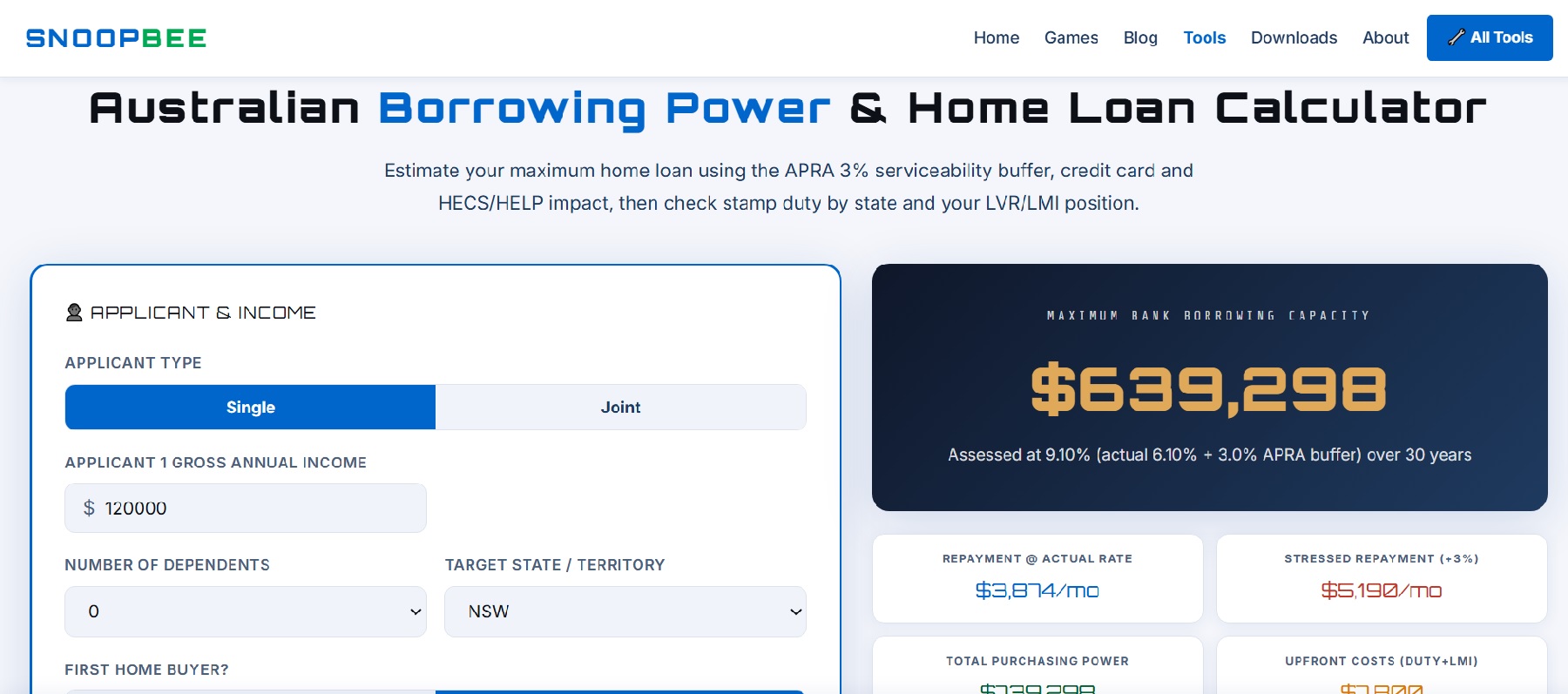
Net monthly income of approximately $7,590 (after 2026–27 income tax and the Medicare Levy), less $2,100 in living expenses and $300 in credit card liability (a $10,000 limit), leaves roughly $5,190 serviceable per month. Stress-tested at 9.10% (a 6.10% actual rate plus the 3.0% APRA buffer) over 30 years, that supports a maximum borrowing capacity of approximately $645,000.
Example 2: Same Applicant, First Home Buyer in NSW, $750,000 Property
Under the NSW First Home Buyers Assistance Scheme, a $750,000 purchase falls under the $800,000 full exemption threshold — stamp duty payable is $0, compared to roughly $28,000 in standard duty for a non-first-home-buyer at the same price. Combined with a 5% deposit under the First Home Guarantee, this buyer could avoid both stamp duty and LMI on the same purchase.
Frequently Asked Questions
Why did my borrowing power drop when interest rates fell?
It shouldn't — a rate cut lowers both your actual rate and the stressed rate used for assessment, which should increase borrowing power, all else being equal. If your borrowing power dropped despite falling rates, the cause is more likely a change in your income, expenses, or existing debts, or a lender's individual policy change.
Can I improve my borrowing power quickly?
The fastest, most reliable levers are reducing or closing unused credit cards, paying down existing debts, and trimming discretionary living expenses in the months before applying — all of which a lender can verify from recent bank statements.
Is the figure from this calculator exactly what a bank will offer me?
No — every lender applies its own credit policy, exact HEM figures, and risk appetite on top of the same broad APRA framework, so actual offers vary between banks. Treat this calculator as a realistic starting estimate, not a loan pre-approval.
This article is for general educational purposes only and is not financial or lending advice. Figures reflect currently available ATO, APRA, and state revenue office information as at July 2026 and may be updated by future policy changes or indexation. Stamp duty and first home buyer scheme details in particular change frequently — always confirm current figures with your state revenue office, a bank, or a licensed mortgage broker before making purchase decisions.
Try the Free Borrowing Power Calculator
Estimate your maximum loan, stamp duty, and LVR position in seconds.
Open the Calculator →
Comments