Gross Pay vs Net Pay Under PAYG
Gross pay is your salary before any tax or contributions are taken out. Net pay (take-home pay) is what actually lands in your bank account after PAYG income tax, the Medicare Levy, and any HECS/HELP repayment are withheld. Superannuation is usually paid separately by your employer on top of your salary, so it's not "deducted" from your take-home pay in the same way — it's an additional entitlement.
The gap between gross and net is not waste; it funds the tax system that pays for Medicare, infrastructure and social services. Understanding each component is the first step to knowing exactly what to expect on payday and to legally structuring your income — for example, through salary sacrifice — to keep more of what you earn.
Your pay frequency — weekly, fortnightly, or monthly — determines how your annual PAYG figures are split per pay cycle. Most Australian award and enterprise agreements pay fortnightly, so a lot of payslip confusion comes from converting annual tax-table figures into a fortnightly number. This calculator does that conversion automatically across all four common frequencies.
It helps to think of every payslip as answering four questions in sequence. First, what did you actually earn this period (gross pay, including any overtime or allowances)? Second, how much superannuation must your employer pay on that amount? Third, how much PAYG tax, Medicare Levy, and — if applicable — HECS/HELP repayment must be withheld this period? Finally, what's left over as net pay? Superannuation is calculated on your ordinary time earnings before tax, while PAYG withholding, Medicare and HECS are all calculated on your taxable income for the period, which is lower again if you salary sacrifice.
For payroll teams, this distinction explains most employee questions. Someone comparing this fortnight's payslip to last fortnight's may notice a different net amount on an unchanged salary — usually explained by a public holiday shifting rostered hours, a bonus briefly pushing that period's withholding into a higher bracket, or an annual leave loading payment. None of these change the underlying annual tax calculation; they simply shift when the tax is actually withheld.
How Australian Income Tax Brackets Work
The most common misconception in Australian tax: being "in the 30% bracket" does not mean you pay 30% of your entire income. Australia uses a progressive system — each rate applies only to the slice of income within that specific band.
| 2026-27 Bracket (Resident) | Rate | Base Tax at Bracket Start |
|---|---|---|
| $0 – $18,200 | 0% | $0 |
| $18,201 – $45,000 | 15% | $0 |
| $45,001 – $135,000 | 30% | $4,020 |
| $135,001 – $190,000 | 37% | $31,020 |
| Over $190,000 | 45% | $51,370 |
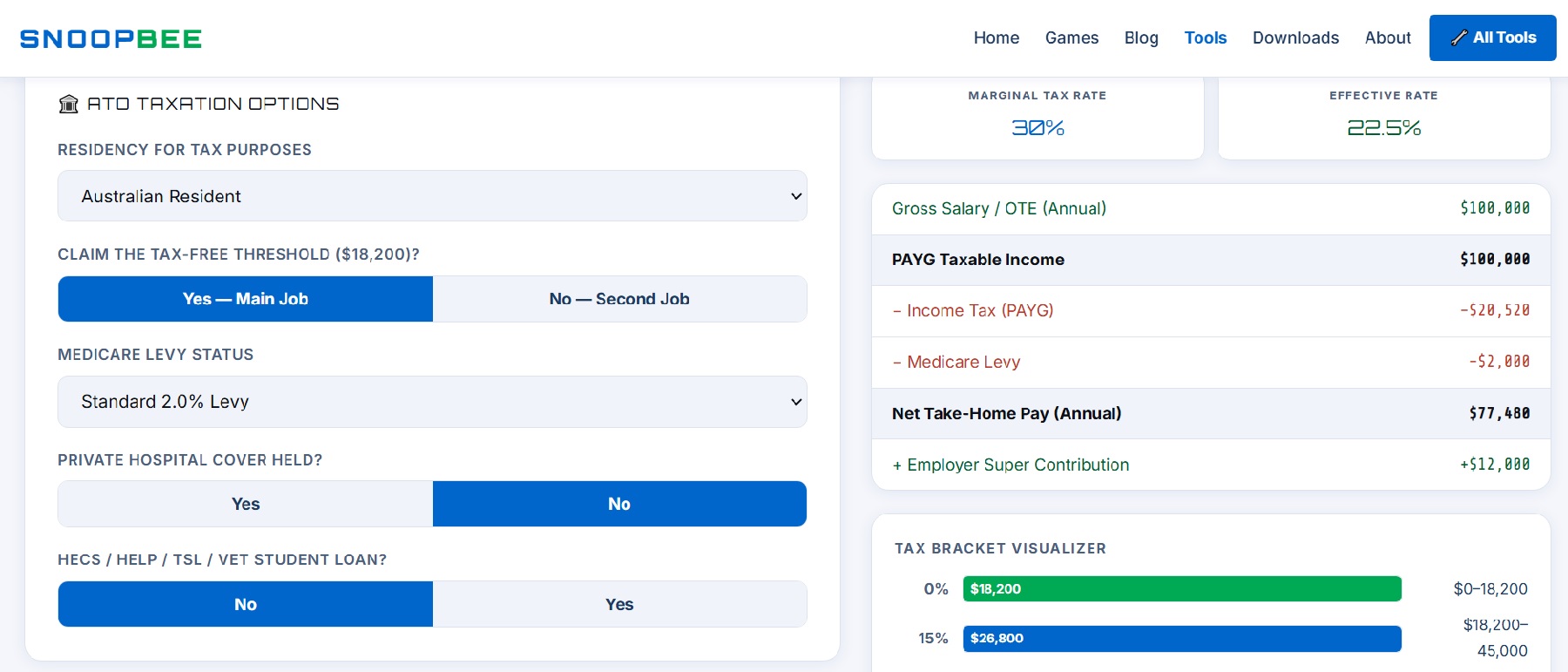
Verified example: on $100,000 of taxable income in 2026-27, income tax = $4,020 + 30% × ($100,000 − $45,000) = $4,020 + $16,500 = $20,520. Add the 2% Medicare Levy of $2,000 and the total tax is $22,520 — an average (effective) rate of 22.5%, even though the marginal rate on the next dollar earned is 30% (32% including Medicare).
Australian Income Tax Brackets — Resident, 2026–27
| Taxable Income | Tax Rate |
|---|---|
| $0 – $18,200 | Nil |
| $18,201 – $45,000 | 15% of amount over $18,200 |
| $45,001 – $135,000 | $4,020 + 30% of amount over $45,000 |
| $135,001 – $190,000 | $31,020 + 37% of amount over $135,000 |
| $190,001+ | $51,370 + 45% of amount over $190,000 |
For 2025–26 the second bracket is 16% (base amounts $4,288 / $31,288 / $51,638 respectively). The Medicare Levy (2% of taxable income) applies separately and is not included above.
Key PAYG Formulas
Superannuation Guarantee & Salary Packaging
The Superannuation Guarantee (SG) is the compulsory contribution your employer must pay into your super fund. It has been 12% of your ordinary time earnings since 1 July 2025 — the final step of a multi-year legislated increase, and currently the permanent rate.
How this 12% interacts with your quoted salary depends entirely on how your employment contract is worded:
- "Salary + Super" (exclusive): your quoted salary is what you're taxed on, and your employer pays 12% super on top. A $100,000 salary means $100,000 of taxable income plus a separate $12,000 employer super contribution.
- "Total Package Inclusive of Super": the quoted figure already includes the 12% super. Your actual cash salary (and therefore your taxable income) is lower — a $100,000 inclusive package works out to roughly $89,286 in cash salary, with $10,714 diverted to super.
Always check your contract wording carefully. "Total remuneration package" language almost always means inclusive of super, while award and enterprise-agreement rates are almost always exclusive. The calculator's super structure toggle lets you model both scenarios instantly.
There's also a ceiling on how much of your earnings SG applies to in any given quarter — the maximum super contribution base. For 2026-27 this annualises to roughly $270,830; above that, your employer isn't required to pay SG on the excess (though many still do voluntarily, or via an enterprise agreement). This mostly affects very high income earners and isn't relevant to the majority of PAYG employees.
Medicare Levy & Medicare Levy Surcharge
The Medicare Levy is a flat 2% of your taxable income, funding Australia's public healthcare system. Lower-income earners get a reduction or full exemption: below roughly $28,000 (single, 2026-27) no levy applies, and a reduced shade-in rate applies up to around $35,000.
Separate from the standard levy is the Medicare Levy Surcharge (MLS) — an extra 1% to 1.5% charge that applies if you earn above roughly $105,000 (single, 2026-27) and do not hold private hospital cover. The MLS is a deliberate incentive: for many people around this income level, the cost of a basic hospital policy is cheaper than the surcharge itself.
| Income Tier (Single, 2026-27) | MLS Rate (no hospital cover) |
|---|---|
| Up to $105,000 | 0% (standard 2% levy only) |
| $105,001 – $123,000 | +1.0% |
| $123,001 – $164,000 | +1.25% |
| Over $164,000 | +1.5% |
HECS/HELP — The New Marginal Repayment System
HECS-HELP is the loan scheme that covers university tuition, repaid automatically through the tax system once your income passes a minimum threshold. Since 1 July 2025, repayments switched from a flat percentage of your entire income to a marginal system — the same logic as income tax brackets.
Under the old system, crossing a threshold by even $1 could add hundreds of dollars to your annual repayment — the notorious "cliff effect." The marginal system removes that cliff: you only repay the applicable rate on the income that falls within each band.
| 2026-27 Repayment Income | Marginal Rate |
|---|---|
| Up to $69,528 | 0% — no compulsory repayment |
| $69,529 – $129,717 | 15% of the amount above $69,528 |
| $129,718 – $186,050 | $9,028 + 17% of the amount above $129,717 |
| Over $186,050 | 10% of total repayment income |
Verified example: on $100,000 of repayment income in 2026-27: repayment = $9,028 is not yet reached (income is below $129,717), so it's 15% × ($100,000 − $69,528) = 15% × $30,472 = $4,571 — a modest amount compared to the old flat-rate system, which would have taxed the entire $100,000 at a single percentage.
Note: "repayment income" is broader than taxable income — it adds back reportable fringe benefits, reportable super contributions, and net investment losses, so two people with the same take-home pay can have different HECS repayments.
Should You Claim the Tax-Free Threshold on a Second Job?
The $18,200 tax-free threshold can only effectively apply once across all your income for the year. If you claim it with every employer, each one withholds tax as though that job is your only income — under-withholding across the board and leaving you with a tax bill (plus, potentially, the Medicare Levy and HECS/HELP shortfall) when you lodge your return.
Rule of thumb: claim the threshold only with your highest-paying or primary employer. Tick "no" on the Tax File Number declaration for every other job. You'll see slightly less in each second-job paycheck, but you avoid a nasty surprise at tax time.
Salary Sacrifice & Concessional Contribution Caps
Salary sacrifice lets you redirect part of your pre-tax salary into superannuation instead of taking it as cash. Inside the fund, that money is taxed at just 15% (or 30% if you're a high earner subject to Division 293) instead of your marginal income tax rate — which can be 30%, 37%, or 45%.
For someone on a 30% marginal rate, sacrificing $10,000 saves roughly $1,500 in tax compared to taking it as cash and then investing it outside super, purely from the tax-rate differential — before accounting for super's concessional investment-earnings tax rate.
Concessional cap warning: employer SG contributions and salary sacrifice together count toward the concessional contributions cap — $32,500 for 2026-27. Exceeding it means the excess is taxed at your marginal rate plus an interest charge, so check your combined SG + sacrifice amount before committing to a large salary-sacrifice arrangement.
Foreign Residents & Working Holiday Makers
Foreign residents (non-residents for tax purposes) don't get the $18,200 tax-free threshold or the Low Income Tax Offset — they're taxed at 30% from the first dollar up to $135,000, then 37% and 45% at the same thresholds as residents. They also don't pay the Medicare Levy.
Working holiday makers (visa subclasses 417 and 462) sit under their own schedule: 15% on the first $45,000 of Australian income, then the standard 30%/37%/45% resident rates above that.
Verified Worked Examples
Example 1: $100,000 Salary + Super, Fortnightly, 2026-27
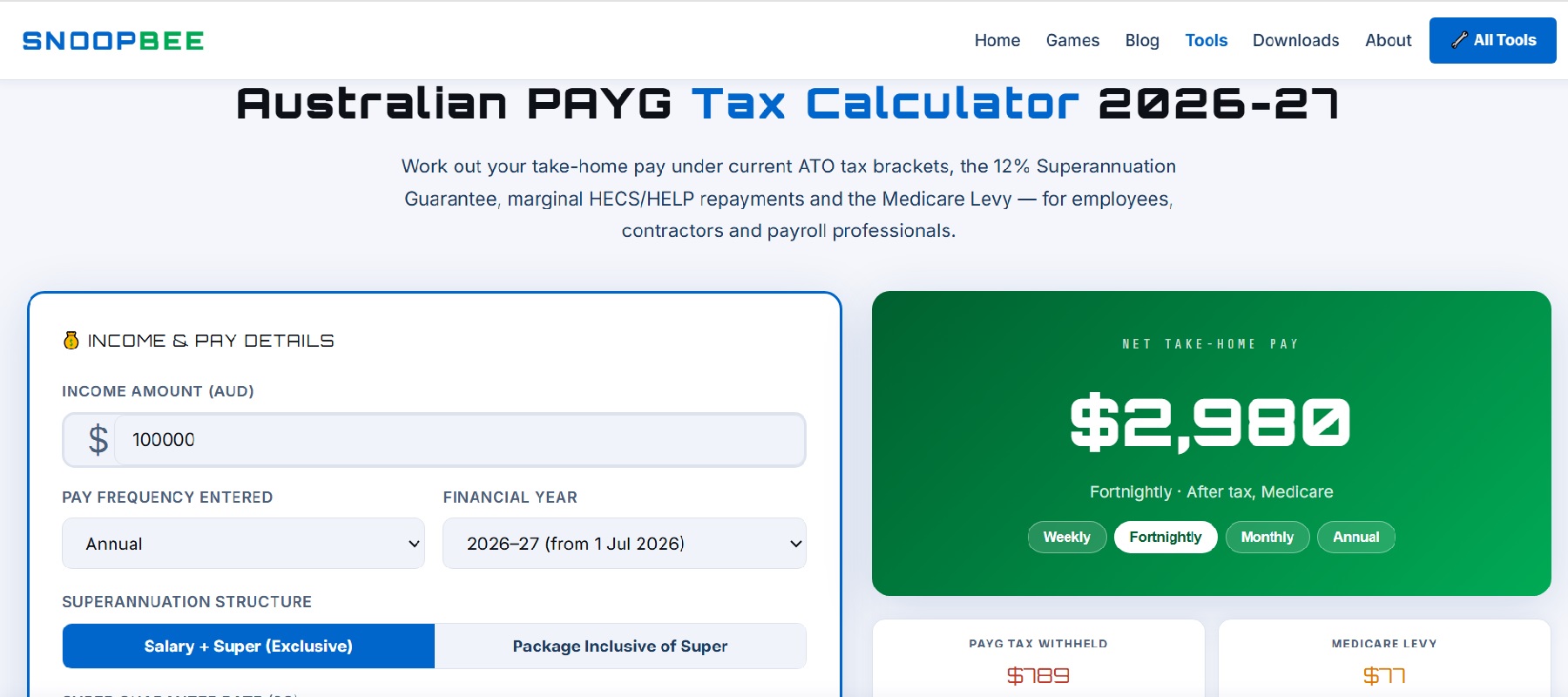
Claiming the tax-free threshold, no HECS debt, private hospital cover held: income tax $20,520, Medicare Levy $2,000, total tax $22,520. Net annual take-home = $100,000 − $22,520 = $77,480, or $2,980 per fortnight. The employer separately contributes 12% × $100,000 = $12,000 to super for the year.
Example 2: $75,000 Salary Package Inclusive of Super, with HECS, 2025-26
Cash salary = $75,000 ÷ 1.12 = $66,964; super = $8,036. Using 2025-26 brackets (16% second bracket): income tax = 16% × ($66,964 − $18,200) = $7,802. Medicare Levy = 2% × $66,964 ≈ $1,339. HECS repayment (2025-26 threshold $67,000) = $0, since $66,964 sits just under the threshold. Net annual pay ≈ $57,823.
How to Maximise Your Take-Home Pay Legally
- Claim the tax-free threshold correctly — with your main job only, to avoid over- or under-withholding.
- Use salary sacrifice deliberately — especially once you're comfortably above the 30% bracket, where the tax-rate gap into super is largest.
- Weigh private hospital cover against the MLS — for higher earners without cover, a basic hospital policy is often cheaper than the surcharge.
- Track your concessional cap — unused cap space from the past five years can sometimes be "carried forward" if your total super balance is under the relevant limit; check current ATO rules before relying on this.
- Model both super structures before accepting a job offer quoted as a "total package" — know your actual cash salary before you negotiate.
- Review your HECS/HELP withholding at the start of each financial year — your employer's payroll software should be using the newly indexed threshold from 1 July, and an outdated table can mean over- or under-withholding across the year.
- Consider timing large bonuses or one-off payments where you have flexibility, since a single large payment processed in one pay cycle can be withheld at a higher rate than your true annual average, even though it reconciles correctly at tax time.
For payroll and HR professionals, the practical takeaway is to keep an eye on three dates each year: 1 July, when new tax brackets, the SG rate, and indexed thresholds for Medicare, MLS and HECS/HELP take effect; the May federal Budget, which frequently previews changes taking effect the following 1 July; and 30 June, the cut-off for salary sacrifice arrangements and voluntary super contributions intended to count toward the current financial year's concessional cap.
Frequently Asked Questions
What is PAYG withholding?
It's how your employer collects an estimate of your annual income tax liability from each pay cycle and remits it to the ATO, smoothing your tax obligation across the year instead of one lump sum.
Is the Superannuation Guarantee rate going up again?
No — 12% has been the legislated final step since 1 July 2025 and is currently the permanent ongoing rate under the existing schedule. Always confirm the current rate with the ATO, as legislation can change.
Does HECS/HELP charge interest?
No. HECS/HELP debts aren't charged interest, but they are indexed annually (capped at the lower of CPI or the Wage Price Index) to keep pace with the cost of living.
This article is for general educational purposes only and is not tax, legal, or financial advice. Figures reflect currently legislated and ATO-indexed rates as at July 2026 and may be updated by future budgets or indexation. Always confirm your specific circumstances with the ATO or a registered tax agent.
Try the Free PAYG Tax Calculator
Model your exact take-home pay, super, HECS repayment and salary sacrifice savings in seconds.
Open the Calculator →
Comments