What Actually Happens in a Sleep Cycle
A sleep cycle is one complete pass through the stages of sleep — from light sleep, into deep sleep, and back out through REM (rapid eye movement) sleep — before the brain either wakes briefly or rolls into the next cycle. On average, one full cycle takes about 90 minutes, though it can range from roughly 70 to 120 minutes depending on the person and the point in the night.
Across a typical night, an adult moves through this cycle somewhere between four and six times, and the cycles aren't identical to one another. Early in the night, cycles are weighted more heavily toward deep, slow-wave sleep — the physically restorative kind. As the night goes on, each successive cycle shifts to include proportionally more REM sleep, the stage most associated with dreaming, memory consolidation, and emotional processing. This is one reason the last couple of hours before a normal wake-up time feel dream-heavy: your body has structured the night to save more REM for later.
This structure isn't arbitrary. It reflects something researchers call sleep architecture — the predictable, layered pattern the brain follows across a night, refined over the course of human evolution to balance physical repair, memory processing, and the practical need to periodically surface into lighter sleep, where waking (if needed, for safety reasons in an ancestral environment) was less disorienting than waking from deep sleep would have been.
It's worth briefly distinguishing sleep cycles from the related but separate concept of your circadian rhythm. The circadian rhythm is your roughly 24-hour internal body clock, driven largely by light exposure, that governs when you feel sleepy versus alert across the day and helps set your overall sleep window. Sleep cycles, by contrast, are the roughly 90-minute pattern that repeats within that window once you're actually asleep. Circadian rhythm determines roughly when you sleep; sleep cycle structure determines the texture of what happens once you're under. Both matter for feeling rested, and both are reasons a consistent daily schedule tends to outperform an irregular one — a well-aligned circadian rhythm makes it easier to fall asleep close to your planned buffer, while stable cycle timing makes each individual wake-up easier once you're there.
The Four Stages, One by One
Modern sleep science, based on decades of polysomnography research (overnight sleep studies that track brain waves, eye movement, and muscle activity), breaks each 90-minute cycle into four distinct stages, often labeled N1 through N3 plus REM.
| Stage | Also Called | What's Happening |
|---|---|---|
| N1 | Light sleep / dozing off | The brief transition from wakefulness to sleep, lasting a few minutes; easy to wake from, muscles begin to relax. |
| N2 | Light sleep proper | Heart rate and body temperature drop; makes up the largest share of total sleep time across the night. |
| N3 | Deep sleep / slow-wave sleep | The hardest stage to wake from; associated with physical repair, tissue growth, and immune function. Concentrated in the earlier cycles of the night. |
| REM | Rapid eye movement sleep | Brain activity resembles wakefulness; most vivid dreaming occurs here; linked to memory consolidation and emotional regulation. Lengthens with each successive cycle. |
A useful mental model is to picture each 90-minute cycle as descending a staircase into deep sleep and then climbing back out through REM before briefly touching light sleep again — the natural "surface point" where a person can wake feeling reasonably alert, or roll straight into the next descent without ever fully waking.
Worth knowing: everyone briefly wakes several times a night at the boundary between cycles, usually for a matter of seconds, and most people have no memory of it at all the next morning. This is completely normal and not itself a sign of a sleep problem.
Why Waking Mid-Cycle Feels So Bad
The unpleasant, foggy feeling of being woken abruptly — often called sleep inertia — is far stronger when an alarm interrupts deep sleep (N3) than when it catches someone during the light-sleep surface point between cycles. This is the entire logic behind cycle-based wake timing: it isn't about sleeping less, it's about timing the interruption for the point in the cycle where the brain is already closest to a natural waking state.
This also explains a pattern many people have noticed but couldn't quite name: a 20-minute difference in wake-up time — say, 6:00 a.m. instead of 6:20 a.m. — can be the entire difference between a rough, disoriented morning and a genuinely easy one, even though the difference in total sleep is trivial. If 6:20 lands you at the end of a complete cycle and 6:00 catches you mid-descent into deep sleep, the 20 "extra" minutes of sleep you'd lose by waking later are more than offset by avoiding a deep-sleep interruption.
Sleep inertia typically fades within 15 to 60 minutes of waking regardless of when in the cycle you woke, but the intensity of that initial grogginess — and how much it affects reaction time, mood, and decision-making in the first half hour — is measurably worse after a deep-sleep interruption in multiple studies on the topic.
What Changes Your Cycle Length
The 90-minute figure used throughout this guide and built into the calculator is a population average, not a fixed constant, and several everyday factors can shift an individual's actual cycle length shorter or longer on any given night.
- Age. Cycle length generally increases from infancy through adulthood. Newborns cycle through sleep stages roughly every 50–60 minutes, gradually lengthening toward the adult 90-minute average by the teenage years, then sometimes shortening slightly again in older adulthood alongside lighter, more fragmented sleep overall.
- Alcohol. Alcohol can help people fall asleep faster but tends to suppress REM sleep in the first half of the night and fragment the second half, disrupting the normal cycle pattern rather than simply shortening or lengthening it uniformly.
- Stress and cortisol. Elevated stress hormones can reduce time spent in deep sleep and increase the number of brief awakenings between cycles, even if total sleep time looks adequate on paper.
- Room temperature. A room that's too warm is one of the more common disruptors of deep sleep specifically, since the body's core temperature needs to drop for deep sleep to initiate properly.
- Exercise timing. Regular exercise is well-supported for improving overall sleep quality, though vigorous exercise very close to bedtime can delay sleep onset for some people, effectively pushing the whole cycle sequence later.
- Illness and fever. Being unwell often increases the proportion of deep sleep the body prioritizes, sometimes lengthening early cycles as part of the immune response — one reason people "sleep like the dead" when fighting an infection.
None of this means the 90-minute figure is unreliable — it remains the best available population-level estimate and the basis most sleep researchers and clinicians work from — but it explains why the calculator's output is a well-grounded estimate to build a routine around, not a laboratory-precise personal measurement.
How Many Cycles Do You Actually Need?
Since each cycle averages roughly 90 minutes, the standard general sleep-duration recommendations for adults — 7 to 9 hours per night — map fairly cleanly onto whole numbers of cycles:
| Cycles | Approx. Duration | General Guidance |
|---|---|---|
| 3 | 4.5 hours | Well below recommended range — short-term/emergency use only, not a target |
| 4 | 6 hours | Below the typical recommended range for most adults; acceptable occasionally, not ideal as a routine |
| 5 | 7.5 hours | Within the recommended range; a solid, realistic everyday target for most adults |
| 6 | 9 hours | Top of the typical adult recommended range; ideal for recovery, illness, or heavier training loads |
This is exactly why the calculator on this page works in whole cycles rather than arbitrary hour totals: aiming for "5 cycles" rather than "roughly 7 and a bit hours" builds the mid-cycle-avoidance logic directly into the number you're targeting.
Sleep Needs By Age
Total sleep need — and by extension, the practical cycle count worth targeting — changes substantially across the lifespan. These are general population guidelines from major sleep and pediatric health organizations, not individually prescriptive figures.
| Age Group | Recommended Sleep | Approx. Cycles |
|---|---|---|
| Newborns (0–3 months) | 14–17 hours (fragmented, not continuous) | Cycle structure differs substantially from adults |
| Infants (4–11 months) | 12–15 hours | Cycle structure still maturing |
| Toddlers (1–2 years) | 11–14 hours | ~7–9 |
| Preschoolers (3–5 years) | 10–13 hours | ~7–8 |
| School-age (6–13 years) | 9–11 hours | ~6–7 |
| Teenagers (14–17 years) | 8–10 hours | ~5–6 |
| Adults (18–64 years) | 7–9 hours | ~5–6 |
| Older adults (65+) | 7–8 hours | ~5 |
Note that very young children don't follow the same clean 90-minute adult cycle structure — their sleep architecture is still maturing, cycles are shorter, and a much larger proportion of total sleep is spent in REM-equivalent stages critical for early brain development. The calculator on this page is calibrated for the adult 90-minute cycle model and is most accurate for teenagers and adults.
Naps and the 90-Minute Rule
The same cycle logic that governs overnight sleep applies to naps, and understanding it explains why some naps leave people refreshed while others leave them worse off than before they lay down.
| Nap Length | What It Targets | Result |
|---|---|---|
| 10–20 minutes | Light sleep only (before deep sleep begins) | A genuine "power nap" — quick alertness boost, minimal grogginess on waking |
| 30–60 minutes | Partial entry into deep sleep | High risk of waking mid-deep-sleep — often the grogginest nap length |
| 90 minutes | One full cycle | Wakes at the natural surface point — refreshing, though can affect nighttime sleep onset if taken too late in the day |
The practical takeaway: if you only have 20 minutes, take it — a short power nap avoids deep sleep entirely and tends to be genuinely restorative. If you have real time to spare, a full 90-minute nap is usually a better choice than something in between, precisely because "in between" is where the mid-cycle grogginess problem shows up most reliably.
How to Use the Sleep Cycle Calculator
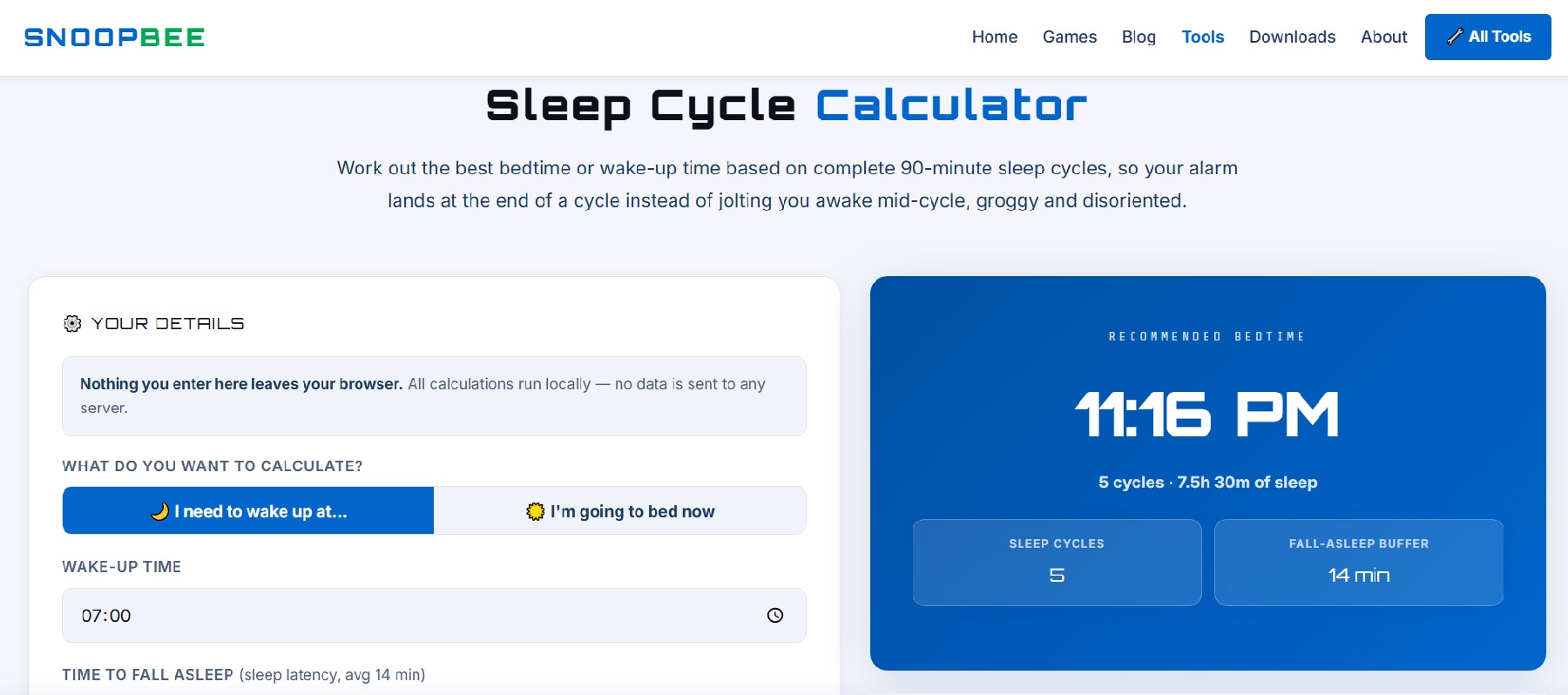
The Sleep Cycle Calculator above works backward or forward from a single anchor time, using the 90-minute cycle math explained above.
- Pick your mode. Choose "I need to wake up at…" if you have a fixed morning commitment (work, school, a flight), or "I'm going to bed now" if you're heading to bed and want to know your best wake-up options.
- Enter your time. In wake-up mode, enter the time you need to be awake. In bedtime mode, enter your current or planned bedtime.
- Set your fall-asleep buffer. Most people take somewhere around 10 to 20 minutes to actually fall asleep after getting into bed — this is called sleep latency. The calculator defaults to 14 minutes, a commonly cited population average, but adjust it if you know your own typical latency runs faster or slower.
- Read the cycle table. The calculator instantly generates four options — 3, 4, 5, and 6 complete cycles — each showing the resulting bedtime or wake-up time and total sleep duration, with the 5-cycle (7.5-hour) option highlighted as the general everyday recommendation.
The forward calculation (bedtime mode) simply runs the same formula in reverse: Wake-Up Time = Bedtime + Sleep Latency + (Cycles × 90 min).
Two Full Worked Examples
Example 1: Working backward from a wake-up time
Say you need to be up at 6:30 a.m. for an early meeting, and your typical fall-asleep buffer is the default 14 minutes. Working backward through each cycle option:
| Cycles | Sleep Duration | Bedtime |
|---|---|---|
| 6 (Ideal) | 9.0 h | 9:16 p.m. |
| 5 (Recommended) | 7.5 h | 10:46 p.m. |
| 4 (Minimum) | 6.0 h | 12:16 a.m. |
| 3 (Short) | 4.5 h | 1:46 a.m. |
Rather than aiming vaguely for "around 11-ish," you now have four concrete, cycle-aligned bedtime options and can pick whichever realistically fits your evening — knowing that any of these four specific times, not the ones in between, gives you the best shot at waking up at the lighter surface point of a completed cycle rather than mid-descent into deep sleep.
Example 2: Working forward from bedtime, with a slower fall-asleep buffer
Now say it's 11:15 p.m., you're heading to bed right now, and you know from experience that you tend to take closer to 20 minutes to actually fall asleep rather than the 14-minute default. Switching the calculator to "I'm going to bed now" mode and adjusting the buffer to 20 minutes gives:
| Cycles | Sleep Duration | Wake-Up Time |
|---|---|---|
| 6 (Ideal) | 9.0 h | 8:35 a.m. |
| 5 (Recommended) | 7.5 h | 7:05 a.m. |
| 4 (Minimum) | 6.0 h | 5:35 a.m. |
| 3 (Short) | 4.5 h | 4:05 a.m. |
If your alarm is currently set for 7:00 a.m., this example shows exactly why you might want to nudge it to 7:05 — five minutes can be the difference between catching the light-sleep surface point at the end of the 5th cycle and cutting into the start of REM in the 6th.
Sleep Debt and Why You Can't Just "Catch Up"
Sleep debt is the cumulative shortfall between the sleep you actually got and the sleep your body needed, and it genuinely does accumulate — a pattern of 6-hour nights across a workweek doesn't simply reset with one long weekend sleep-in. Research on chronic partial sleep restriction has found that cognitive performance, reaction time, and metabolic markers can remain measurably impaired even after several nights of "recovery" sleep, and that a single extended sleep-in tends to address subjective sleepiness faster than it addresses the underlying cognitive and metabolic deficits.
Practical takeaway: a cycle-aligned wake-up time makes each individual morning feel easier, but it doesn't substitute for consistently getting the recommended 7 to 9 hours (5 to 6 cycles) most nights. Think of this calculator as optimizing the timing of the sleep you get, not as a way to sleep less without consequence.
Should You Trust a Wearable's Sleep-Stage Reading?
Many smartwatches and fitness trackers now report detailed sleep-stage breakdowns — minutes of light, deep, and REM sleep — based on a combination of movement (accelerometer data) and, on higher-end devices, heart rate variability. It's worth understanding both what these devices do well and where their limits are before treating their output as clinical fact.
Consumer wearables are reasonably good at the basic task of distinguishing sleep from wakefulness, and validation studies generally show decent agreement with polysomnography (the gold-standard lab sleep study) on total sleep time and overall sleep efficiency. Stage-by-stage accuracy — correctly distinguishing light sleep from deep sleep from REM, minute by minute — is considerably less reliable, with most consumer devices showing meaningfully lower agreement with lab-grade equipment on this specific task, particularly for deep sleep, which movement-based sensors can struggle to distinguish from light sleep.
Practical framing: use a wearable's total sleep time and consistency trends as generally useful, and treat the specific stage percentages as a rough directional estimate rather than a precise clinical reading. The 90-minute cycle math this calculator uses is grounded in decades of polysomnography research across large populations — a more reliable foundation for planning your bedtime than any single night's device-reported stage breakdown.
Practical Tips For Better Cycle Timing
- Keep a consistent bedtime and wake-up time, including on weekends where realistic — an irregular schedule shifts your natural cycle timing around and makes any fixed calculation less reliable night to night.
- Track your actual fall-asleep time for a week and update the calculator's default 14-minute buffer with your real number for more accurate results.
- Avoid caffeine within roughly 6–8 hours of your target bedtime, since caffeine's half-life can delay sleep onset and shift your actual cycle timing later than planned.
- Dim lights and screens in the hour before bed, supporting the melatonin release that helps you fall asleep close to your planned buffer window rather than significantly later.
- Treat the 5-cycle (7.5-hour) option as your realistic everyday baseline, and reserve 6 cycles (9 hours) for recovery nights, illness, or heavy training days when your body genuinely needs more.
- If you consistently need an alarm to wake and still feel exhausted at 6 cycles, that's worth discussing with a doctor rather than adjusting the calculator further — it can be a sign of an underlying sleep disorder rather than a timing problem.
Frequently Asked Questions
How long is one sleep cycle?
About 90 minutes on average, though it can range from roughly 70 to 120 minutes and varies somewhat from person to person and across the night.
How many sleep cycles should I get per night?
Most adults do best with 5 to 6 complete cycles, working out to roughly 7.5 to 9 hours of sleep.
Why do I feel groggy even after 8 hours of sleep?
You likely woke up mid-cycle, during deep sleep or REM, rather than at the lighter transition point between cycles — a phenomenon called sleep inertia.
Can I catch up on sleep debt on the weekend?
Partially, but not fully. Extra weekend sleep reduces some acute effects, but research suggests it doesn't fully reverse the metabolic and cognitive costs of chronic short sleep.
Is it better to sleep for 6 hours or 7.5 hours?
7.5 hours (5 complete cycles) is generally better for most adults, since 6 hours falls short of the recommended 7–9 hour range.
Does everyone's sleep cycle really last exactly 90 minutes?
No — 90 minutes is a population average. Individual cycles commonly range from about 70 to 120 minutes and can vary somewhat across a single night for the same person, which is why the calculator's output should be treated as a well-grounded estimate rather than an exact personal figure.
Is a 90-minute nap actually better than a 30-minute nap?
For different goals, yes: a 10–20 minute nap avoids deep sleep entirely and tends to be the least groggy option for a quick boost, while a full 90-minute nap completes an entire cycle and can also feel refreshing; naps in the 30–60 minute range carry the highest risk of waking mid-deep-sleep and often feel the worst.
Can I use this calculator for children?
The 90-minute model is calibrated for teenagers and adults. Young children have shorter, still-maturing sleep cycles and different total sleep needs by age, so this specific calculator is less precise for that age group.
Find Your Best Bedtime or Wake-Up Time Right Now
Open the Sleep Cycle Calculator →This article is for general educational purposes only and is not medical advice. Sleep cycle length and structure vary between individuals, and 90 minutes is a population average rather than an exact personal figure. If you experience chronic insomnia, excessive daytime sleepiness, loud snoring, or suspect a sleep disorder such as sleep apnea, consult a doctor or sleep specialist. Last updated: August 2026.
💬 Questions & Reader Comments
Ask a question about sleep cycles, or share what bedtime worked best for you. (Max 200 words)