Compound Interest: The Real Engine
Compound interest is often called the eighth wonder of the world, and the idea is simple: you earn interest on your money, and then you earn interest on that interest too. Invest $1,000 at an 8% annual return, and you have $1,080 after year one. In year two, you don't just earn 8% on your original $1,000 — you earn it on the full $1,080, bringing you to $1,166.40. Leave that same $1,000 alone for 40 years at 8%, and it grows to about $21,725 — without you ever adding another dollar.
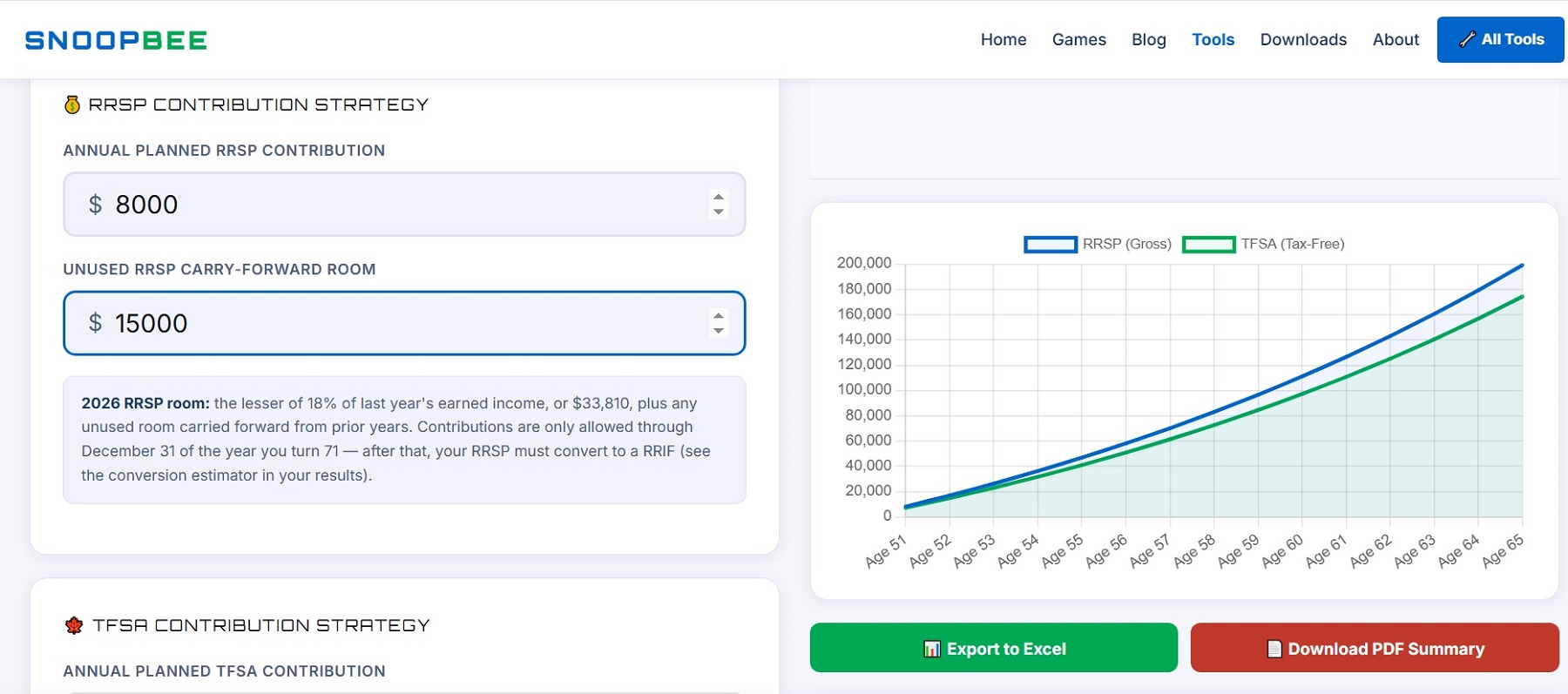
The gap between your current age and your target retirement age is your investment horizon. The longer that horizon, the less money you actually need to save out of pocket, because compounding does more and more of the heavy lifting the longer it runs. This is exactly why our calculator's year-by-year chart shows growth accelerating later on — your contributions stay flat, but the interest-on-interest effect keeps snowballing.
Understanding Canada's 2026 Tax Brackets
A common misconception is that landing in a certain tax bracket means your entire income gets taxed at that rate. That's not how it works. Your income is divided into buckets, and you only pay each bucket's rate on the dollars that fall inside it. Your marginal tax rate is simply the rate you'd pay on your very next dollar earned.
For 2026, the federal government cut the lowest bracket from 15% to 14% as part of a middle-class tax cut, and the brackets were also adjusted upward for inflation:
| 2026 Federal Bracket | Rate |
|---|---|
| Up to $58,523 | 14% |
| $58,524 – $117,045 | 20.5% |
| $117,046 – $181,440 | 26% |
| $181,441 – $258,482 | 29% |
| Over $258,482 | 33% |
Your province adds its own bracket structure on top of these federal numbers — Ontario, Alberta, and Quebec, for example, all have meaningfully different combined rates, and your combined federal + provincial marginal rate (not the federal rate alone) is what our calculator's "Current Marginal Tax Rate" field is asking for. As a reference point, the combined federal + Ontario top marginal rate for 2026 is about 53.53%.
Why this matters for RRSP vs. TFSA: the entire mathematical case for choosing an RRSP over a TFSA rests on the gap between your current marginal rate and your expected retirement marginal rate. The bigger that gap in your favor, the stronger the case for RRSP.
RRSP vs. TFSA: The Core Tradeoff
Both accounts shelter your investments from tax while they grow — the difference is entirely about when you pay tax.
- RRSP (Registered Retirement Savings Plan), introduced in 1957: your contribution is deducted from your taxable income today, generating an immediate refund at your marginal rate. But the entire withdrawal — your original contribution and every dollar of growth — is taxed as ordinary income when you take it out.
- TFSA (Tax-Free Savings Account), introduced in 2009: you contribute with already-taxed money, so there's no deduction today. But every dollar that comes out, including decades of growth, is completely tax-free, forever.
Rule of thumb: if you expect a lower tax rate in retirement than today, RRSP tends to win, especially once you reinvest the refund it generates. If you expect a similar or higher rate in retirement — common for students and early-career workers already in a low bracket — TFSA is usually the better choice, since it locks in tax-free growth while your rate is already low.
A Worked Example — Both Ways, Honestly
Say you can set aside $8,000 a year for 30 years at a 6.5% average annual return — matching this calculator's own defaults. That grows to a future value of about $711,351 either way; the market doesn't care which account label is on the money.
Compare the same $8,000 contributed to either account (today's combined marginal rate 30.5%, expected retirement rate 20%):
- RRSP: $711,351 taxed at 20% on withdrawal → $569,081 spendable.
- TFSA: $711,351, completely tax-free → $711,351 spendable.
Looked at this way, TFSA appears to win outright — and in raw future dollars, for the same contribution, it usually does, since it avoids tax entirely while the RRSP still owes some. But that's not quite a fair fight, because contributing $8,000 to an RRSP only costs you $5,560 out of your paycheck today (thanks to the $2,440 refund at 30.5%), while contributing $8,000 to a TFSA costs you the full $8,000, since it's already-taxed money.
Compare them at equal true cost to you today instead: if you only put the same $5,560-a-year "paycheck hit" into a TFSA, it grows to just $494,389 — tax-free, but on a smaller base. Now the RRSP's $569,081 wins, because your expected retirement rate (20%) is lower than today's rate (30.5%). This is the classic, correct rule of thumb in action: expect a lower future rate → RRSP wins; expect a similar or higher future rate → TFSA wins — once you properly account for what today's refund is actually worth to you.
Provincial Tax Rates Vary Significantly
Because your combined marginal rate depends heavily on your province, the exact math above will shift depending on where you live. As a rough illustration at similar income levels, Alberta's provincial rates run noticeably lower than Ontario's or Quebec's, meaning an Albertan and an Ontarian earning identical salaries can face meaningfully different combined marginal rates — and therefore different RRSP refund sizes and different break-even points between the two accounts. Always use your own province's actual combined rate, from a recent tax return or a current bracket table, rather than a generic assumption.
The RRSP Tax Refund, Worked Out
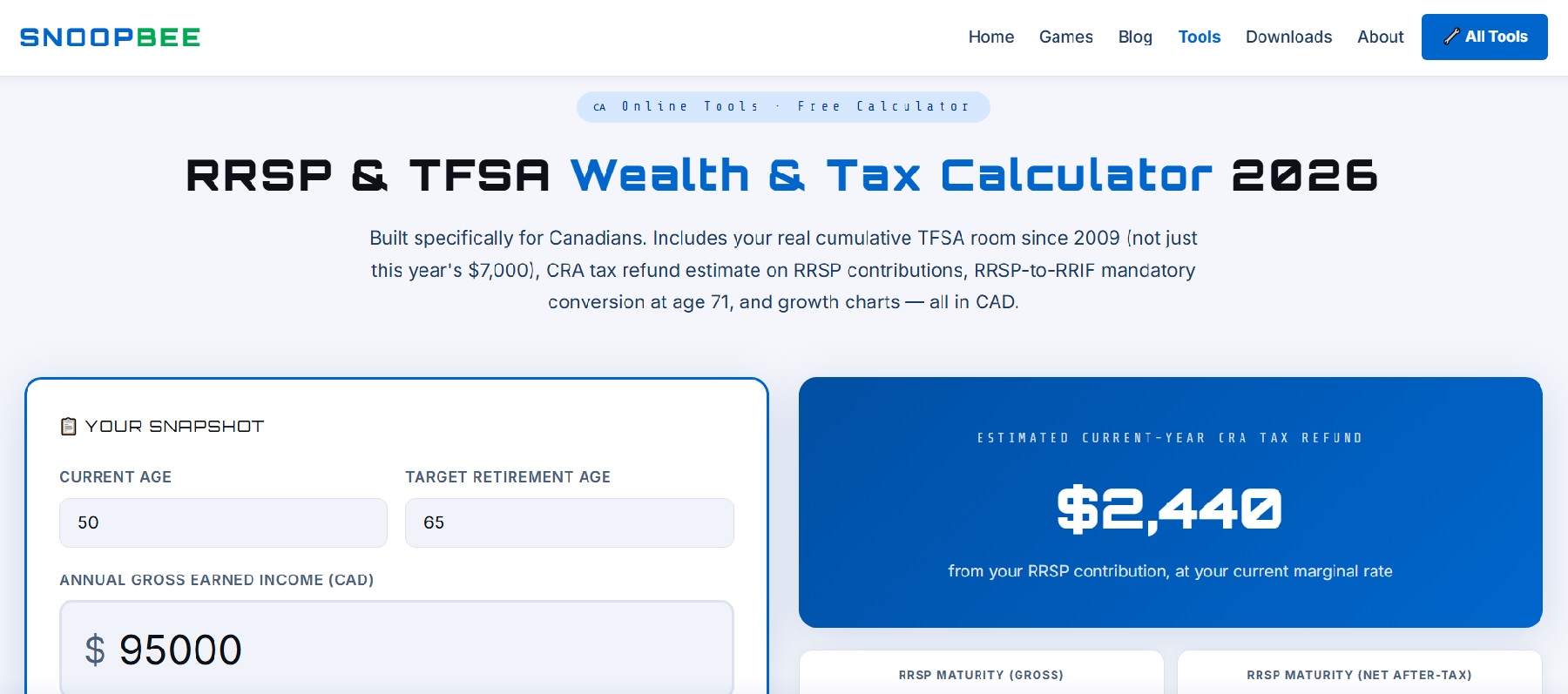
When you contribute a dollar to your RRSP, the CRA treats it as if you never earned that dollar in the first place. Worked example: a professional earning $95,000 a year, with a combined federal + provincial marginal rate of 30.5%, contributes $8,000 to their RRSP. Their taxable income effectively drops to $87,000. Since their employer already withheld tax on the full $95,000 throughout the year, they've now overpaid — and the CRA refunds the difference:
That's why our calculator puts an "Estimated Current-Year CRA Refund" front and center — it's real, immediate cash-back liquidity, not just a future projection.
Understanding Your Real TFSA Room (Since 2009)
This is the single most misunderstood part of the TFSA. The annual limit announced each year isn't the only room you have — unused room has been accumulating every year since 2009 (or since you turned 18, if later), and it never expires. If you were 18 or older in 2009 and have never contributed, your real 2026 cumulative room is $109,000, not $7,000.
| Years | Annual TFSA Limit |
|---|---|
| 2009 – 2012 | $5,000/year |
| 2013 – 2014 | $5,500/year |
| 2015 | $10,000 |
| 2016 – 2018 | $5,500/year |
| 2019 – 2022 | $6,000/year |
| 2023 | $6,500 |
| 2024 – 2026 | $7,000/year |
Withdrawals get added back to your room too — but not until January 1 of the following year, so withdrawing and re-contributing within the same calendar year can trigger an over-contribution penalty (1% per month on the excess) if you're not careful.
RRSP Contribution Room: The 18% Rule
Your annual RRSP room is the lesser of 18% of your previous year's earned income, or a fixed dollar ceiling — $33,810 for 2026 — plus any room you didn't use in prior years, which carries forward indefinitely. "Earned income" here generally means employment and self-employment income, not investment income, EI, or pension income.
RRSP → RRIF: The Mandatory Conversion at Age 71
Unlike a TFSA, an RRSP can't stay an RRSP forever. By December 31 of the year you turn 71, it must convert into a Registered Retirement Income Fund (RRIF), an annuity, or be cashed out entirely (usually the worst option tax-wise). No further contributions are allowed after conversion. Starting the year after conversion, at age 72, the CRA requires a minimum withdrawal each year — roughly 5.40% of the balance at 72, climbing to about 6.82% at 80, 11.92% at 90, and a flat 20% from 95 onward. These withdrawals are fully taxable as ordinary income, whether you need the cash that year or not — which is exactly why the "Preservation and Liquidation" phase of retirement planning is about managing your bracket, not just your balance.
The Home Buyers' Plan & FHSA
Two other major programs interact closely with these accounts. The Home Buyers' Plan (HBP) lets first-time buyers withdraw up to $60,000 tax-free from an existing RRSP toward a home purchase, which must be repaid over 15 years or the unpaid portion becomes taxable income. The First Home Savings Account (FHSA), launched in 2023, is arguably the best of both worlds: contributions are tax-deductible like an RRSP, but qualifying withdrawals toward a first home are completely tax-free like a TFSA — up to $8,000 a year and $40,000 over your lifetime, with no repayment required. If a home purchase is anywhere in your plans, the FHSA is usually worth prioritizing before either an RRSP or TFSA.
Strategy by Life Stage
Students (K-12 & College)
If you're working a part-time job, your income likely puts you in the lowest tax bracket already, so an RRSP contribution generates only a tiny refund — not worth much. Prioritize the TFSA instead. It shields your money early, lets it compound completely tax-free for decades, and stays flexible enough to withdraw penalty-free if you need it for tuition or a first car.
Working Professionals (Peak Earning Years)
As your income climbs into higher combined federal + provincial brackets, the RRSP starts to shine — you're deducting your highest-taxed dollars, generating real refunds. A powerful habit: take the refund the calculator shows you (say, that $2,440 from the example above) and immediately reinvest it into your TFSA, creating a compounding loop that supercharges both accounts at once.
Retirees (Preservation & Decumulation)
The game shifts from accumulation to careful withdrawal management. Pulling too much from your RRSP/RRIF in a single year can push you into a higher bracket and even trigger a clawback of Old Age Security (OAS) benefits. A healthy TFSA balance is valuable here precisely because withdrawing from it never counts as taxable income — it gives you liquidity without disturbing your reported income or OAS eligibility.
Frequently Asked Questions
Should I contribute to an RRSP or a TFSA?
Higher current tax rate than expected in retirement → RRSP tends to win, especially with the refund reinvested. Lower or similar current rate → TFSA is usually better.
How much TFSA room do I actually have in 2026?
It's cumulative since 2009 (or age 18) — up to $109,000 for anyone eligible the whole time, not just this year's $7,000.
What are the 2026 Canadian federal tax brackets?
14% up to $58,523, 20.5% to $117,045, 26% to $181,440, 29% to $258,482, and 33% above that.
What happens to my RRSP at age 71?
It must convert to a RRIF (or annuity) by December 31 of that year; mandatory minimum withdrawals begin the following year.
What is the difference between the Home Buyers' Plan and the FHSA?
HBP: withdraw up to $60,000 from an existing RRSP, must repay over 15 years. FHSA: a separate account, up to $8,000/year and $40,000 lifetime, no repayment required.
Run Your Own Numbers With the Full Calculator
Open the RRSP & TFSA Calculator →This article is for general educational purposes only and is not tax, legal, or financial advice. Tax brackets, contribution limits, and RRIF withdrawal factors reflect published 2026 CRA figures and may change — verify current numbers with the Canada Revenue Agency or a licensed financial advisor. Last updated: July 2026.
💬 Questions & Reader Comments
Ask a question about RRSPs, TFSAs, or your own scenario, or leave feedback. (Max 200 words)