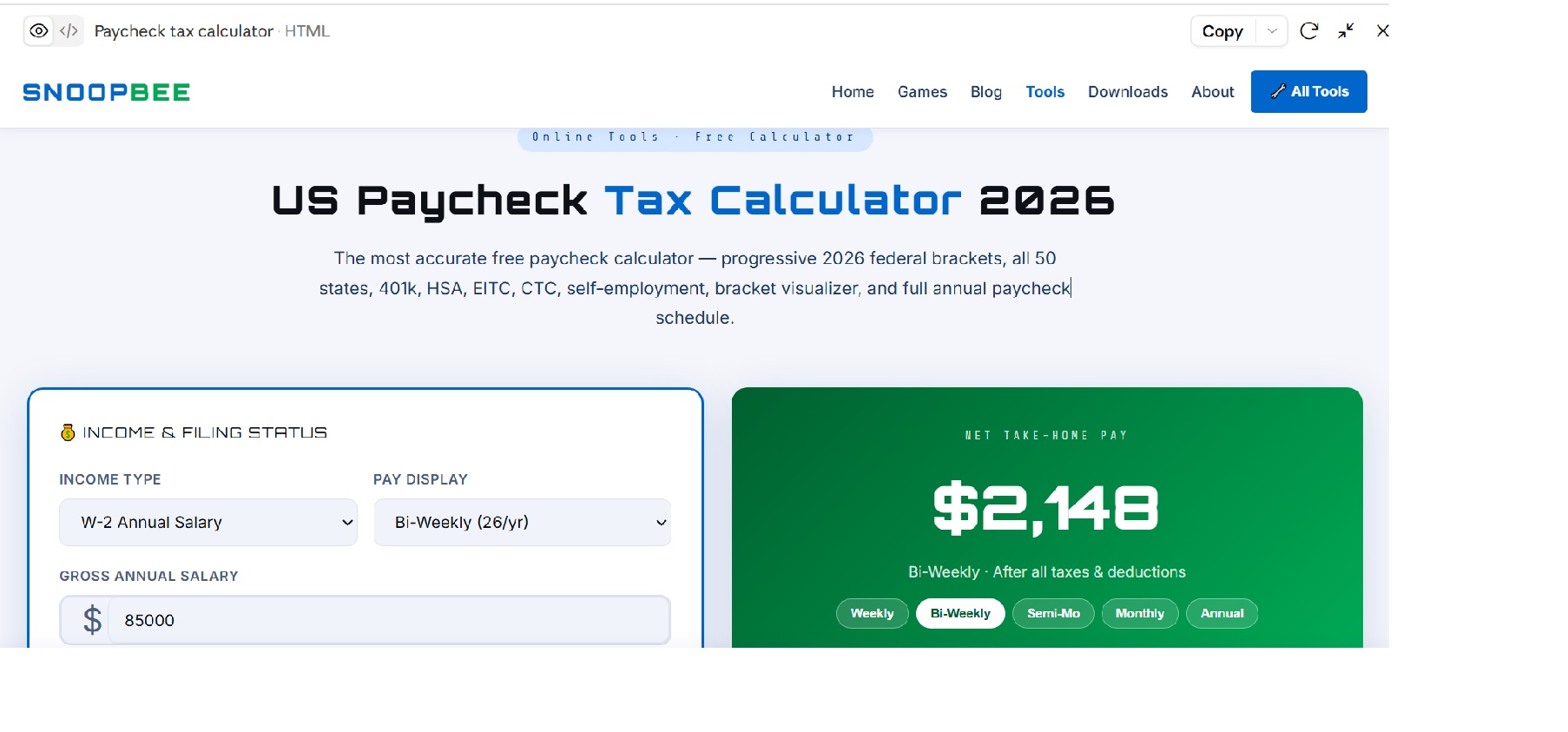
Gross Pay vs Net Pay — The Big Picture
Gross pay is the total your employer agrees to pay you before any deductions. If your offer letter says $85,000 a year, that is your gross pay. Net pay (take-home pay) is what actually lands in your bank account after federal income tax, FICA, state tax, retirement contributions, and insurance premiums are subtracted. For most Americans, net pay is 65–80% of gross pay.
The gap is not waste — it is taxes (mandatory) plus pre-tax benefits (voluntary and powerful). Understanding each component is the first step to legally shrinking the tax portion and growing the benefit portion. Your pay frequency — weekly (52 paychecks), bi-weekly (26), semi-monthly (24), or monthly (12) — determines how those annual amounts are split per paycheck. Bi-weekly employees receive three paychecks in two months each year, which is a useful bonus to plan around.
Federal Income Tax — Progressive Brackets Explained
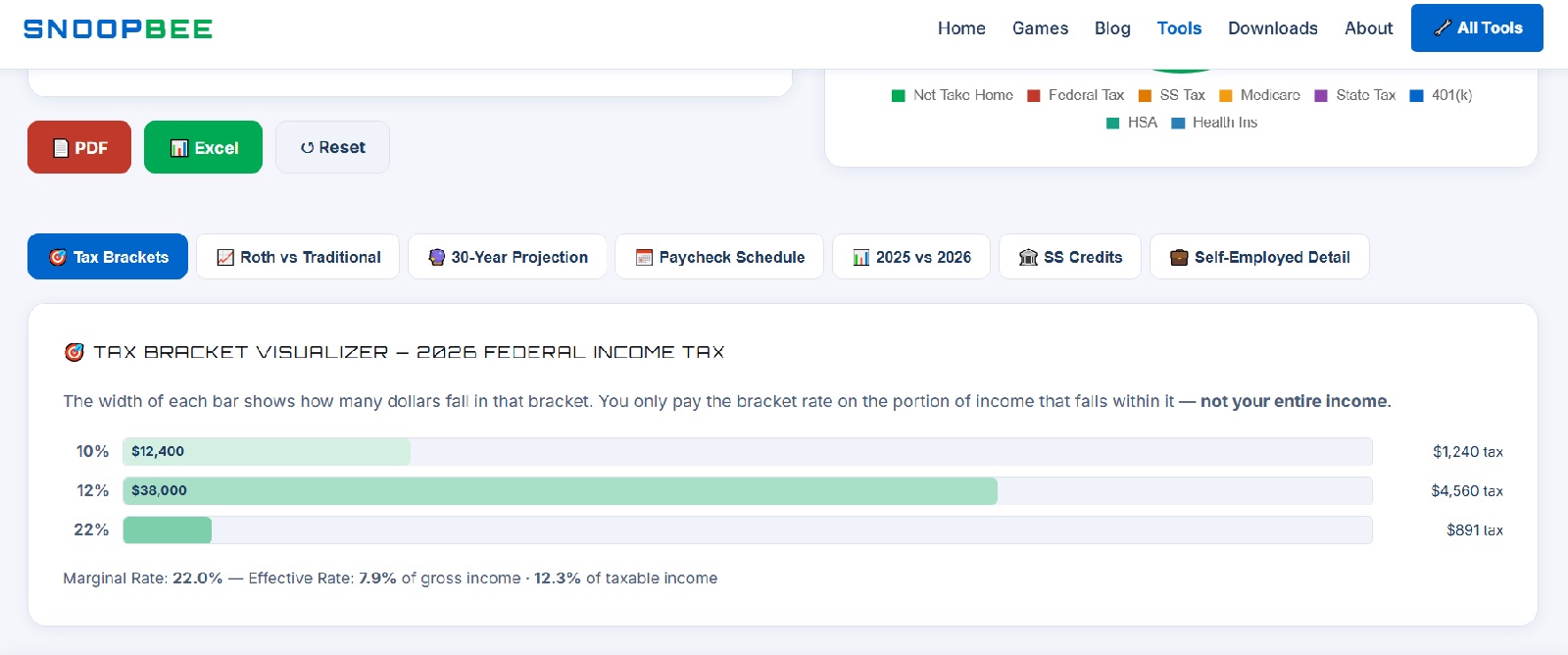
The most widespread misconception in US taxation: being in "the 22% bracket" does NOT mean you pay 22% of your entire income. The US uses a progressive system — each rate applies only to the slice of income within that specific range, after your standard deduction is subtracted.
| 2026 Bracket (Single) | Rate | Tax on That Slice |
|---|---|---|
| $0 – $12,400 | 10% | $1,240 max |
| $12,401 – $50,400 | 12% | Up to $4,560 |
| $50,401 – $105,700 | 22% | Only on portion above $50,400 |
| $105,701 – $201,775 | 24% | Only on portion in this range |
| $201,776 – $256,225 | 32% | Only on portion in this range |
| $256,226 – $640,600 | 35% | Only on portion in this range |
| Over $640,600 | 37% | Only on the amount above |
Verified example: for $57,450 of federal taxable income (single filer after deductions), federal tax = 10%×$12,400 + 12%×$38,000 + 22%×$7,050 = $1,240 + $4,560 + $1,551 = $7,351. If you applied a flat 22% to the whole amount you'd get $12,639 — over $5,000 too high. The bracket visualizer in the calculator shows this split graphically so the myth is eliminated visually.
FICA Taxes — Social Security and Medicare
FICA (Federal Insurance Contributions Act) consists of Social Security (6.2% on wages up to $184,500 in 2026) and Medicare (1.45% on all wages, plus 0.9% additional Medicare on wages above $200,000 for single filers / $250,000 for MFJ).
A critical rule that most paycheck calculators get wrong: Traditional 401k contributions do NOT reduce your FICA base. Only Section 125 "cafeteria plan" items — HSA, health/dental/vision premiums, FSA, and commuter benefits — reduce both federal taxable income AND your FICA base simultaneously. The calculator enforces this correctly.
Social Security withholding stops mid-year once your cumulative earnings hit the $184,500 wage base. For a $200,000 earner paid bi-weekly, SS withholding stops around paycheck 24 — those final paychecks of the year are noticeably larger. The annual paycheck schedule panel in the calculator shows exactly which pay period your SS withholding stops.
Standard Deduction vs Itemized — 2026 Figures
Before bracket math applies, every taxpayer subtracts a deduction from their income. The standard deduction for 2026 (IRS Rev. Proc. 2025-32):
- Single / Married Filing Separately: $16,100
- Married Filing Jointly: $32,200
- Head of Household: $24,150
- Age 65+ additional: +$2,050 (Single), +$1,650 per qualifying spouse (MFJ)
Itemize only if your total deductible expenses exceed your standard deduction. Under the 2026 OBBBA, the SALT cap was raised to $40,400 (MFJ) / $20,200 (Single), which makes itemizing significantly more attractive for homeowners in high-tax states. The calculator's itemized section includes mortgage interest, charitable gifts, SALT, and medical expenses above 7.5% of AGI.
Traditional vs Roth 401(k) — The Definitive Comparison
Named after Subsection 401(k) of the Internal Revenue Code, the 401k is the primary retirement vehicle for most American workers. The 2026 contribution limits confirmed by IRS Rev. Proc. 2025-32:
- Under age 50: $23,500
- Age 50–59 or 64+: $31,000 (catch-up)
- Age 60–63: $34,750 (SECURE 2.0 super catch-up)
Accuracy note: Some AI-generated sources state the 2026 401k limit as $24,500. The IRS-confirmed 2026 limit is $23,500, per IRS Rev. Proc. 2025-32. This calculator uses the correct figure.
| Feature | Traditional 401(k) | Roth 401(k) |
|---|---|---|
| Tax treatment now | Pre-tax: reduces taxable income today | After-tax: no reduction in taxable income now |
| Take-home impact | Higher take-home (taxes reduced by contribution × marginal rate) | Lower take-home (full taxes still paid) |
| Growth | Tax-deferred (no annual tax on gains) | Tax-free (no annual tax on gains) |
| Retirement withdrawals | Taxed as ordinary income | 100% tax-free if qualified |
| Reduces FICA base? | No | No |
| Best for | Peak earners who expect a lower bracket at retirement | Early career; expect same or higher bracket at retirement |
Roth wins by $123,649 when retirement tax rate = current rate. Traditional wins only if your retirement tax rate is substantially lower than today's rate.
HSA — The Only Triple Tax Advantage in the US Tax Code
A Health Savings Account (HSA) is available only to people enrolled in a High-Deductible Health Plan (HDHP). It is the only account in the US tax code with three simultaneous tax advantages: contributions are pre-tax AND reduce FICA, growth is tax-free, and qualified withdrawals are tax-free.
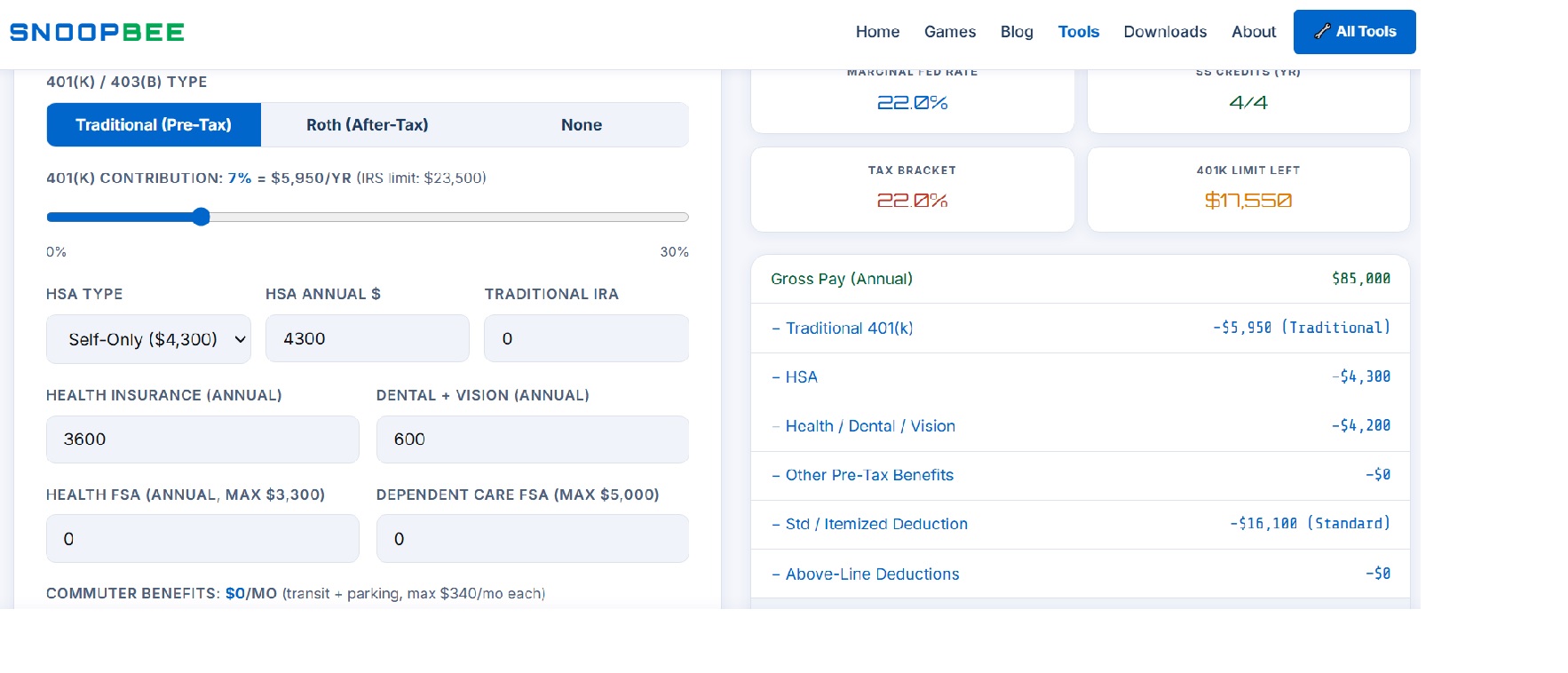
- Layer 1 — Contributions reduce income AND FICA: on a $4,300 HSA contribution, a single 22%-bracket worker in Pennsylvania saves approximately $946 federal tax + $329 FICA + $132 state = $1,407 total savings. That $4,300 contribution only costs $2,893 in reduced take-home.
- Layer 2 — Tax-free growth: funds invested inside the HSA in mutual funds or ETFs compound without any annual tax drag.
- Layer 3 — Tax-free qualified withdrawals: prescriptions, doctor visits, dental, vision, mental health — all completely tax-free at any age.
2026 HSA limits: $4,300 (self-only), $8,550 (family), plus $1,000 catch-up if age 55+. After age 65 you cannot contribute but can use accumulated funds indefinitely — and can withdraw for any purpose (taxed as ordinary income, same as a Traditional IRA).
Long-term strategy: pay current medical expenses out-of-pocket and let your HSA compound untouched for decades. It becomes the most tax-efficient retirement account you have — even better than a Roth IRA for healthcare costs.
Other Pre-Tax Benefits That Multiply Your Take-Home
Beyond 401k and HSA, these Section 125 items each reduce both federal taxable income and FICA — giving them a "double-tax" benefit that plain salary reductions do not:
- Health/Dental/Vision premiums: employer-sponsored premiums deducted pre-tax reduce both federal income tax and FICA base.
- Health FSA: up to $3,300/yr pre-tax for medical expenses. Use-it-or-lose-it with small rollover exception.
- Dependent Care FSA: up to $5,000/household pre-tax for childcare or eldercare. Reduces both taxes and FICA.
- Commuter benefits: up to $340/month pre-tax each for transit passes and parking in 2026 — significant for urban workers.
2026 OBBBA — New Tip and Overtime Deductions
The One Big Beautiful Bill Act (signed 2025, effective 2026) created two brand-new "above-the-line" deductions:
- Qualifying Tip Deduction: workers in traditionally tipped occupations can deduct qualifying tips from federal taxable income, up to $25,000/year. FICA still applies to tips — only federal income tax is reduced.
- Qualifying Overtime Deduction: non-exempt (hourly) employees can deduct qualifying overtime pay (over 40 hrs/week) from federal taxable income, with no stated dollar cap. FICA still applies.
These are above-the-line deductions — they reduce AGI before the standard deduction is applied, so they benefit everyone who qualifies, including those who take the standard deduction. Enter these in the "2026 OBBBA Deductions" section of the calculator.
Tax Credits — Worth More Than Deductions
A deduction reduces taxable income; a credit reduces your actual tax bill dollar-for-dollar. A $2,000 credit saves exactly $2,000 regardless of your bracket. A $2,000 deduction saves only $440 in the 22% bracket. Credits are almost always more powerful.
Child Tax Credit (CTC) — 2026
$2,000 per qualifying child under age 17. Phases out at $200,000 AGI (single) / $400,000 (MFJ), reducing by $50 per $1,000 above the threshold. Up to $1,700 per child is refundable (Additional Child Tax Credit), meaning it can generate a refund even if you owe no federal tax.
Accuracy correction: Some AI-generated content states the 2026 CTC is $2,200 per child. The confirmed 2026 amount is $2,000 per qualifying child under current law. The calculator uses the correct figure.
Earned Income Tax Credit (EITC)
One of the most valuable but under-claimed credits — worth up to $8,231 for families with 3+ children in 2026. Fully refundable. The calculator flags your eligibility automatically and displays the estimated EITC as an on-screen alert.
| Children | Max EITC 2026 | Income Limit (Single) |
|---|---|---|
| 0 | $664 | ~$19,110 |
| 1 | $4,469 | ~$50,115 |
| 2 | $7,389 | ~$56,790 |
| 3+ | $8,231 | ~$60,820 |
Child and Dependent Care Credit
20–35% of eligible childcare expenses (up to $3,000 for one child, $6,000 for two or more). Cannot double-count expenses already paid through a Dependent Care FSA.
Self-Employment and Side Hustle Income
With no employer splitting the FICA cost, self-employed workers and 1099 contractors face four distinct tax mechanics:
- Self-Employment Tax: 15.3% on net SE income up to the SS wage base, 2.9% above — paying both employer and employee shares.
- 50% SE Tax Deduction: the IRS lets you deduct half your SE tax from AGI, partially offsetting the burden.
- QBI Deduction: up to 20% of net business income deductible from taxable income (subject to income limitations).
- SEP-IRA / Solo 401k: self-employed workers can shelter up to $70,000 per year in retirement accounts — far above the W-2 limit of $23,500.
The calculator's self-employment section computes SE tax, the 50% deduction, QBI, and estimated quarterly payment amounts (roughly total annual tax ÷ 4, due April 15, June 16, September 15, January 15).
State Income Tax — The Variable That Changes Everything
State income tax adds 0–13.3% to your total burden. The calculator includes pre-set rates for all 50 states and DC, plus local city tax for NYC, Philadelphia, Detroit, Baltimore, and other cities with municipal income taxes.
| Category | Examples | Approx. Rate |
|---|---|---|
| No income tax | TX, FL, NV, WA, WY, SD, AK, TN, NH | 0% |
| Low | AZ 2.5%, PA 3.07%, IN 3.05%, ND 2.5% | 2–4% |
| Moderate | CO 4.4%, IL 4.95%, GA 5.49%, VA 5.75% | 4–6% |
| High | MN 7.85%, OR 9%, CA 9.3%+, NY 6.85%+ | 7–13%+ |
Verified Worked Examples
Example 1: Single Professional, $85,000 Salary
Traditional 401k 7% ($5,950), HSA self-only ($4,300), student loan interest ($1,200), state: Pennsylvania (3.07%).
- AGI: $85,000 − $5,950 − $4,300 − $1,200 = $73,550
- Federal taxable income: $73,550 − $16,100 = $57,450
- Federal tax (progressive): $1,240 + $4,560 + $1,551 = $7,351
- FICA base: $85,000 − $4,300 = $80,700 → SS $4,803 + Medicare $1,170 = $5,973
- State (3.07% × $73,550): $2,258
- Annual net: $85,000 − $5,950 − $4,300 − $7,351 − $5,973 − $2,258 = $59,168
- Bi-weekly: $2,276 | Monthly: $4,931
Example 2: Married Filing Jointly, $145,000 + $15,000 Side Hustle
2 qualifying children, mortgage interest $9,500, state: Pennsylvania.
- SE tax on $15,000: $15,000 × 0.9235 × 0.153 = $2,121 → SE deduction $1,061 | QBI $3,000
- AGI: $160,000 − $1,061 − $3,000 = $155,939
- Standard ($32,200) beats itemized ($9,500 mortgage) → use standard
- Federal taxable: $155,939 − $32,200 = $123,739
- Federal tax (MFJ brackets): $2,480 + $9,120 + $5,047 = $16,647
- Child Tax Credit: 2 × $2,000 = $4,000 → Federal after CTC: $12,647
- SE tax: $2,121 | FICA on $145,000: $11,093 | State (3.07%): $4,787
- Annual net: $160,000 − $12,647 − $2,121 − $11,093 − $4,787 = $129,352
- Monthly: $10,779
How to Maximize Your Take-Home Pay in 2026
- Max out Section 125 contributions first — HSA, health premiums, FSA, and commuter benefits reduce both income tax AND FICA. This double savings makes them the highest-efficiency shelter available.
- Always capture the full 401k employer match — a 50% or 100% employer match is an immediate guaranteed return that no investment can beat.
- Stack above-the-line deductions — student loan interest, educator expenses, IRA contributions, OBBBA tip/overtime deductions all reduce your AGI before the standard deduction applies.
- Re-evaluate itemizing — with the SALT cap raised to $40,400 MFJ under OBBBA, homeowners in high-tax states should recalculate whether itemizing now beats their standard deduction.
- Review your W-4 — consistent large refunds mean you're giving the IRS an interest-free loan. Adjust withholding to keep more money in your pocket each paycheck.
- Watch the SS cutoff in the paycheck schedule — high earners get a meaningful paycheck increase once the $184,500 SS wage base is hit. Plan your year-end cash flow around it.
Put These Numbers to Work With Your Own Salary
Open the US Paycheck Tax Calculator →This article is for general educational purposes only and is not tax advice. Figures are verified against IRS Rev. Proc. 2025-32 and OBBBA provisions for tax year 2026. Consult a licensed CPA for your specific circumstances. Last updated: July 2026.
💬 Questions & Reader Comments
Ask a question about your paycheck, share your own scenario, or leave feedback. (Max 200 words)