What Is PPF, in Plain English?
PPF (Public Provident Fund) is a long-term savings scheme run directly by the Government of India, open to any resident Indian citizen — not just salaried employees. You deposit anywhere from ₹500 to ₹1,50,000 per financial year into a PPF account (at a post office or bank), and the government pays a fixed, periodically-revised interest rate on the balance, currently 7.1% per annum.
Unlike a fixed deposit, PPF has a mandatory 15-year lock-in — you cannot simply withdraw whenever you like, though partial withdrawals and loans against the balance become available after certain years. In exchange for this lock-in, PPF offers something few other instruments do: complete tax-free status on every part of the transaction, which we'll cover in detail shortly.
The PPF 5th-of-the-Month Rule
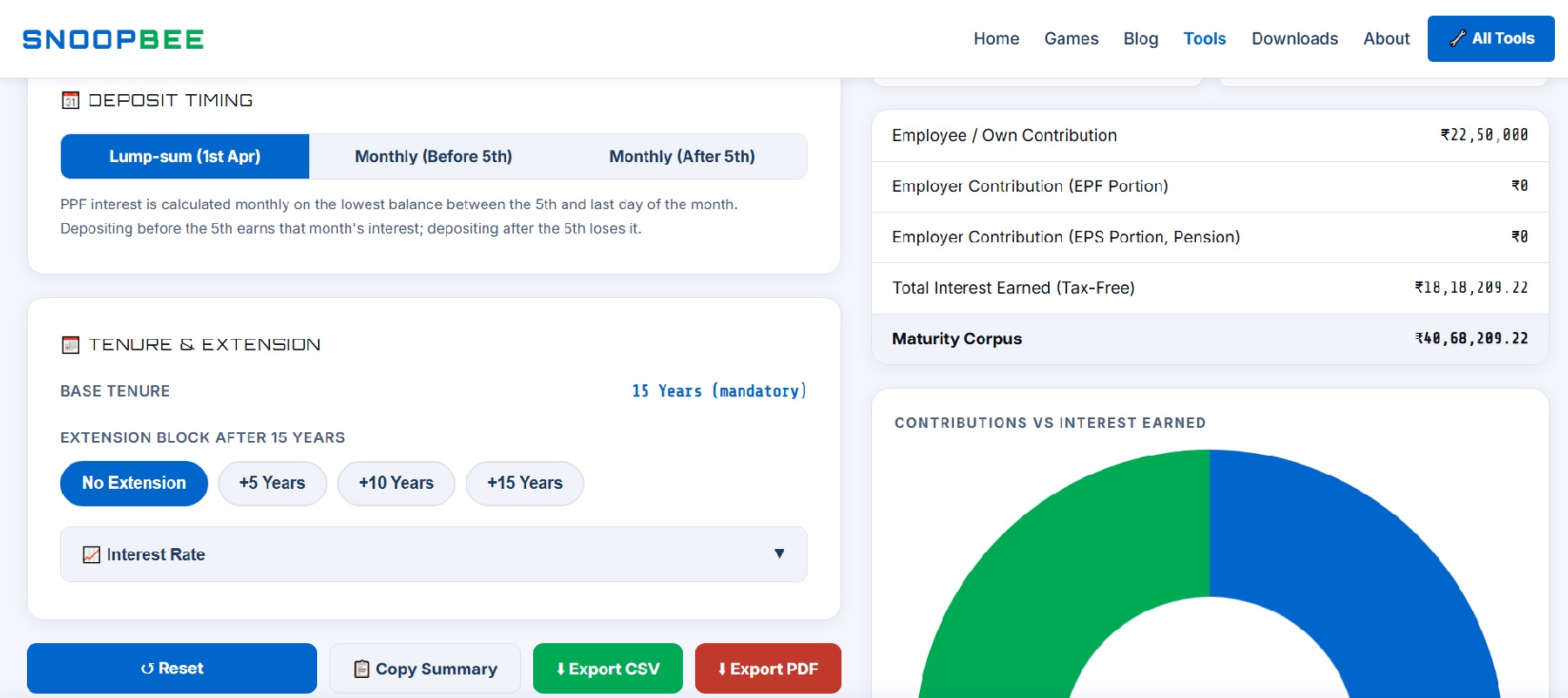
Here's a detail that trips up almost everyone new to PPF: interest is calculated monthly on the lowest balance in your account between the 5th of the month and the last day of that month — not on your average balance, and not on your balance at any other point in the month.
What this means practically: If you deposit your monthly contribution on the 3rd, it counts toward that month's minimum balance, and you earn interest on it for the full month. If you deposit on the 8th, it arrived too late for that month's minimum-balance calculation — you lose that entire month's interest on the amount you just deposited, even though you only "missed" a few days.
This is why the single best PPF habit is depositing either as one lump sum at the very start of the financial year (on or before 5th April) or, if you prefer monthly contributions, always before the 5th of each month. The difference sounds small on any one month, but compounded over 15 years, consistently depositing after the 5th can cost you a noticeably smaller maturity corpus.
The PPF Maturity Formula, Explained
When you deposit your full yearly contribution as a lump sum early in the financial year (so it earns interest for all 12 months, every year), the PPF maturity value follows the same annuity-due compounding formula used for other yearly-contribution instruments:
- P — your yearly contribution
- r — the annual PPF interest rate (as a decimal)
- n — number of years (15, or more with extension)
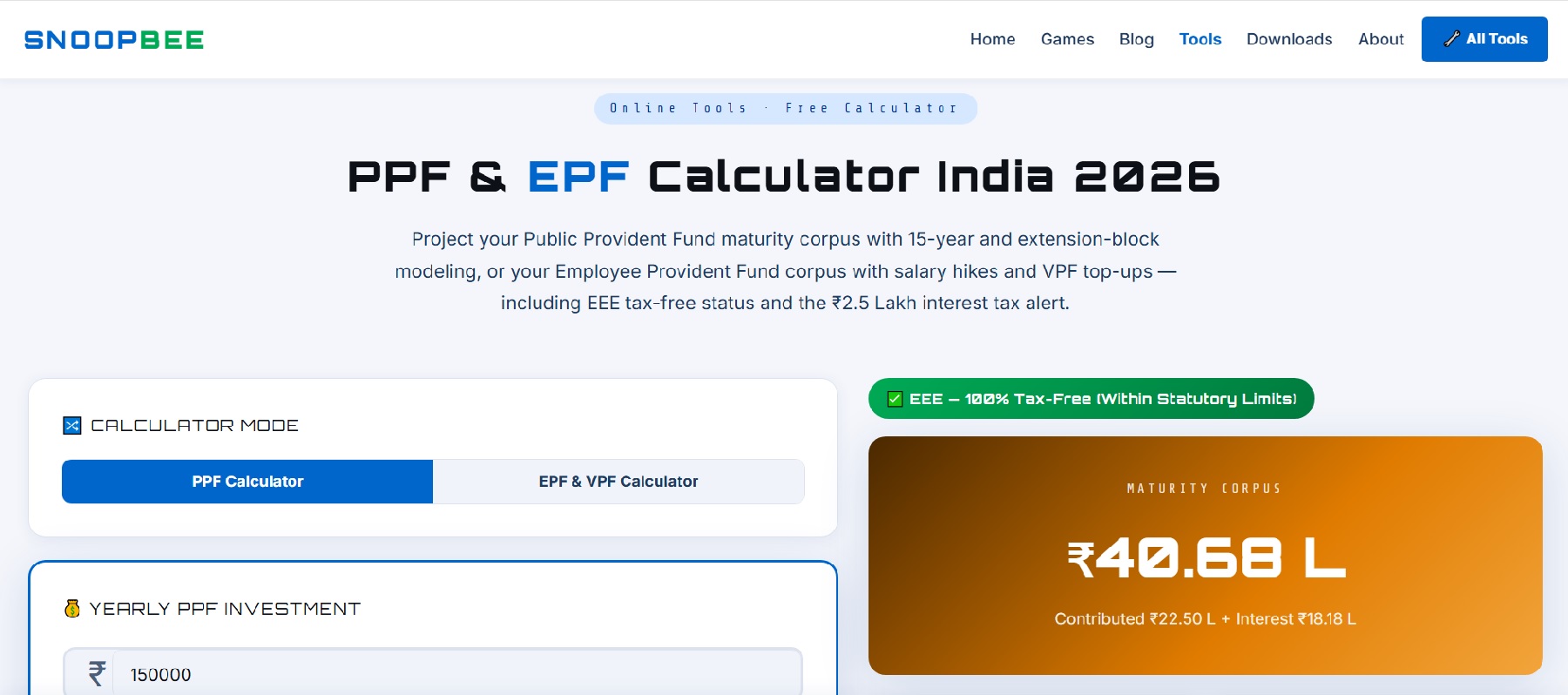
Worked example: Maximum yearly contribution of ₹1,50,000, at 7.1% interest, for the full 15-year term.
- FV = 1,50,000 × [(1.07115 − 1) ÷ 0.071] × 1.071 ≈ ₹40.68 Lakh
- Total Contribution = 1,50,000 × 15 = ₹22.5 Lakh
- Total Interest (entirely tax-free) = 40.68L − 22.5L ≈ ₹18.18 Lakh
PPF Extension — What Happens After 15 Years?
The mandatory PPF term is 15 years, but the account doesn't have to end there. You can extend it in blocks of 5 years at a time, indefinitely, choosing between two modes each time you extend:
- Extension with fresh contributions — you keep depositing every year during the extension block, and your balance continues compounding exactly as before.
- Extension without fresh contributions — you stop depositing, but your existing balance still earns interest every year (one withdrawal per year is permitted in this mode, subject to conditions).
Choosing to extend with contributions for another 5 or 10 years after the initial 15 can meaningfully grow your final corpus, since the account keeps compounding at the same rate — this is a popular strategy for people who want a large tax-free lump sum closer to retirement.
What Is EPF, in Plain English?
EPF (Employee Provident Fund) is a retirement savings scheme specifically for salaried employees in eligible organisations. Every month, a percentage of your Basic salary + Dearness Allowance (DA) is deducted and deposited into your EPF account, and your employer adds a matching contribution on top — both earning a government-notified interest rate, currently 8.25% per annum, until you retire or withdraw.
Unlike PPF, EPF is largely automatic once you're employed — the deduction happens directly from your salary every month without you needing to actively "deposit" anything, which is exactly why so many salaried employees don't fully understand where that monthly deduction goes or how it grows.
The EPF/EPS Contribution Split
Here's the part that confuses most employees: your employer's contribution doesn't all go into the same growing EPF balance you see reflected in your passbook.
| Contributor | Rate | Goes To |
|---|---|---|
| Employee | 12% of Basic + DA | EPF (compounding balance) |
| Employer | 3.67% of Basic + DA | EPF (compounding balance) |
| Employer | 8.33% of Basic + DA, capped at 8.33% of ₹15,000 | EPS (pension pool — does not compound like EPF) |
The EPS (Employee Pension Scheme) cap is based on a statutory wage ceiling of ₹15,000/month — meaning the pension contribution never exceeds roughly ₹1,250/month, no matter how high your actual Basic salary is. Any employer contribution beyond that capped EPS amount is redirected back into your regular EPF balance instead, where it compounds along with your own 12%.
Why this matters: The EPS portion isn't "lost" — it funds a defined monthly pension after retirement, calculated using a separate formula based on your pensionable salary and years of service. But it's a fundamentally different type of benefit from your EPF balance, which is why your EPF passbook doesn't show it growing the same way.
VPF — Investing More Through Your Employer
VPF (Voluntary Provident Fund) lets you contribute more than the mandatory 12% — up to 100% of your Basic + DA — directly through the same payroll deduction mechanism, earning the same EPF interest rate.
VPF is one of the most underused tax-efficient savings tools available to salaried employees, largely because it requires simply informing your HR/payroll department rather than opening any new account. Since it earns the same rate as EPF and enjoys the same EEE tax treatment (up to the statutory limits covered below), it's often a compelling option for employees who have already maxed out their PPF and want another safe, government-backed avenue for additional savings.
EEE Tax Status — What It Really Means
Both PPF and EPF (including VPF) enjoy what's called EEE — Exempt, Exempt, Exempt — status, one of the most tax-friendly classifications available in India:
- Exempt on Contribution: Your contribution (up to ₹1.5 Lakh combined limit under Section 80C) reduces your taxable income.
- Exempt on Interest: Interest earned is not taxed as it accrues, unlike a Fixed Deposit where interest is taxed every year.
- Exempt on Maturity/Withdrawal: The final amount you withdraw (subject to conditions like PPF's 15-year term or EPF's 5-year continuous service rule) is not taxed either.
This triple exemption is what makes PPF and EPF so attractive compared to many other savings instruments, where at least one of these three stages is typically taxed.
The ₹2.5 Lakh EPF Interest Tax Threshold
EEE status for EPF isn't entirely unlimited. Since a 2021 amendment to the Income Tax Act (Section 10(11)/10(12), often referenced alongside Section 208), if your own contribution to EPF and VPF combined exceeds ₹2.5 Lakh in a single financial year, the interest earned on the portion above that threshold becomes taxable at your income tax slab rate.
Worked example: An employee's own EPF contribution (12% + VPF) exceeds ₹2.5 Lakh/year once their Basic + DA crosses roughly ₹1,73,611/month.
- 12% × ₹1,73,611 × 12 months ≈ ₹2,50,000/year — right at the threshold
Who this actually affects: This rule was specifically introduced to target high-earning employees making very large voluntary (VPF) top-ups to shelter income from tax — it does not affect the vast majority of salaried employees whose Basic salary keeps their 12% contribution well under ₹2.5 Lakh/year. It becomes relevant mainly for high-Basic-salary employees or anyone making a substantial VPF top-up.
PPF vs EPF — How They Differ
| Feature | PPF | EPF |
|---|---|---|
| Who can open one | Any resident Indian | Salaried employees at eligible organisations |
| Contribution | Self-directed, ₹500–₹1.5L/year | Automatic payroll deduction, 12% of Basic + DA |
| Employer match | None (self-funded only) | Yes — employer contributes too |
| Lock-in | 15 years (extendable) | Until retirement or job change/withdrawal |
| Current interest rate | 7.1% p.a. | 8.25% p.a. |
| Tax status | EEE (fully tax-free) | EEE up to ₹2.5L/year own contribution |
Many financially disciplined Indians use both simultaneously — EPF running automatically through their employer, and a separate PPF account for additional self-directed, tax-free savings, especially useful for self-employed individuals or those wanting extra 80C headroom beyond their EPF contribution.
Everyday Scenarios
A Student Learning About Government Savings Schemes
Understanding PPF and EPF is a practical, real-world application of compound interest — the same formula taught in school, applied to an actual government scheme most Indians will encounter in their working lives.
A Private Sector Employee Reviewing Their EPF Passbook
An employee confused about why their EPF balance seems smaller than "12% + 12% of my salary every month" can now understand that a portion of the employer's share (the EPS 8.33%) goes to a separate pension pool, not the visible EPF balance.
A Self-Employed Professional Opening a PPF Account
Since self-employed individuals don't have EPF, PPF is often their primary tax-free, government-backed savings vehicle — understanding the 5th-of-the-month rule directly affects how they should time their contributions.
A Retiree Deciding Whether to Extend Their PPF Account
A retiree approaching the 15-year PPF maturity mark can use the extension-block calculator mode to compare the outcome of withdrawing everything now versus extending for another 5 years, with or without further contributions.
Common Mistakes to Avoid
Depositing After the 5th, Repeatedly
As covered above, this quietly erodes your interest earnings every single month it happens, compounding into a real difference over 15 years.
Assuming the Employer's Full 12% Match Grows in Your EPF Balance
As explained in the EPF/EPS split section, roughly 8.33 percentage points of the employer's share usually goes to the separate EPS pension pool, not your compounding EPF balance.
Not Considering VPF When You Have Spare 80C Room
Employees who've already maxed their 80C limit elsewhere sometimes overlook VPF as a simple, high-safety, tax-efficient way to save more directly from their salary.
Forgetting the ₹2.5 Lakh Threshold When Making Large VPF Top-Ups
High earners making aggressive VPF contributions should check this calculator's tax alert, since interest above the threshold is no longer tax-free.
Provident Funds Beyond India
The core idea behind PPF and EPF — a government-backed, tax-advantaged, employer-and-employee-funded retirement savings scheme — exists across much of South and Southeast Asia under different names: the Central Provident Fund (CPF) in Singapore, the Employees Provident Fund (EPF) in Malaysia (administered separately from India's scheme but conceptually similar), and Jamsostek/BPJS Ketenagakerjaan in Indonesia. The underlying principles — compulsory contributions, employer matching, and long-term compounding — are broadly similar, though contribution rates, tax treatment, and withdrawal rules differ by country.
Frequently Asked Questions
What is PPF in simple terms?
PPF is a long-term Government of India savings scheme with a 15-year lock-in, offering a fixed, government-notified interest rate and full tax-free status on contributions, interest, and maturity proceeds.
What is EPF in simple terms?
EPF is a retirement savings scheme for salaried employees where both the employee and employer contribute a percentage of Basic salary every month, earning a government-notified interest rate until retirement or withdrawal.
What is EEE tax status?
EEE stands for Exempt-Exempt-Exempt, meaning the contribution qualifies for a tax deduction, the interest earned is tax-exempt, and the maturity or withdrawal amount is also tax-exempt, subject to applicable statutory limits and conditions.
What is the PPF 5th-of-the-month rule?
PPF interest is calculated monthly on the lowest account balance between the 5th and the last day of the month, so depositing before the 5th earns that month's interest while depositing after the 5th means missing out on interest for that month.
When does EPF interest become taxable?
If an employee's own contribution to EPF and VPF combined exceeds ₹2.5 Lakh in a financial year, the interest earned on the portion of contributions above that threshold becomes taxable at the employee's income tax slab rate.
Project Your Own PPF or EPF Corpus With the Free Calculator
Open the PPF & EPF Calculator →This article is for general educational purposes only and is not tax or financial advice. PPF and EPF interest rates are set by the Government of India and EPFO respectively and are revised periodically; contribution rules, wage ceilings, and tax thresholds are governed by statute and may change. Please consult a Chartered Accountant or your official PPF/EPFO account statements before making financial decisions. Last updated: August 2026.
💬 Questions & Reader Comments
Ask a question about PPF or EPF, share your own example, or leave feedback. (Max 200 words)