What Is a SIP, in Plain English?
A SIP (Systematic Investment Plan) is simply a standing instruction to invest a fixed amount of money into a mutual fund every month, automatically, instead of investing one large amount all at once. Think of it like a recurring deposit, except instead of a fixed bank interest rate, your money buys units of a mutual fund whose value moves with the stock or bond market.
Imagine two friends. One saves up for years and finally invests ₹5 lakh in one shot. The other invests ₹5,000 every month, automatically, without thinking about whether the market is "up" or "down" that day. The second approach — the SIP approach — removes the stressful guesswork of "is now a good time to invest?" and replaces it with a simple habit. Over long periods, that habit, combined with compounding, is what builds serious wealth for millions of ordinary Indian investors.
SIPs are offered by mutual fund houses (AMCs) and can be started with amounts as low as ₹100–₹500 per month in many schemes, which is exactly why they're accessible to students and first-time earners, not just high-income professionals.
Why Compounding Is Called the "Eighth Wonder"
Albert Einstein is often (perhaps apocryphally) credited with calling compound interest the eighth wonder of the world. Whether or not he actually said it, the idea holds up: compounding means your returns start earning their own returns.
Picture a snowball rolling down a snowy hill. At first it's small and grows slowly. But as it grows bigger, it picks up more snow with every rotation, and the growth accelerates. Money invested through a SIP behaves the same way: your early monthly investments have decades to grow, and the "growth on growth" effect means the last few years of a long SIP often add more wealth than the first several years combined — purely because there's simply more money compounding by then.
Why starting early matters more than investing more: A 25-year-old investing ₹5,000/month for 30 years at 12% builds a dramatically larger corpus than a 35-year-old investing ₹10,000/month for 20 years — even though the second person invests more money in total — simply because the first person's money compounds for an extra decade.
The SIP Future Value Formula, Explained
Here is the exact formula behind every SIP calculator, including the one on this site:
- FV — the Future Value, or final corpus, at the end of your investment period
- P — your fixed monthly investment amount
- i — the monthly rate of return (annual expected return ÷ 12 ÷ 100)
- n — the total number of months you invest (years × 12)
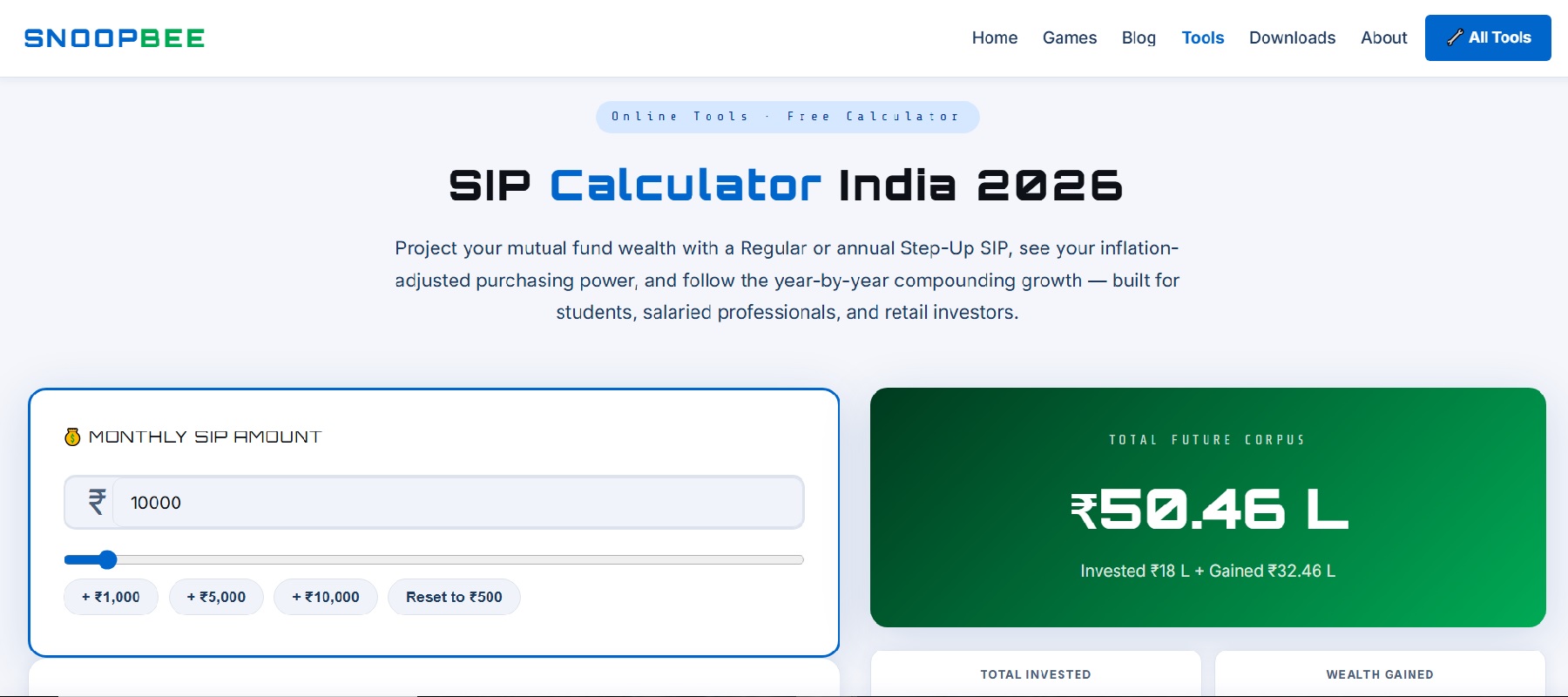
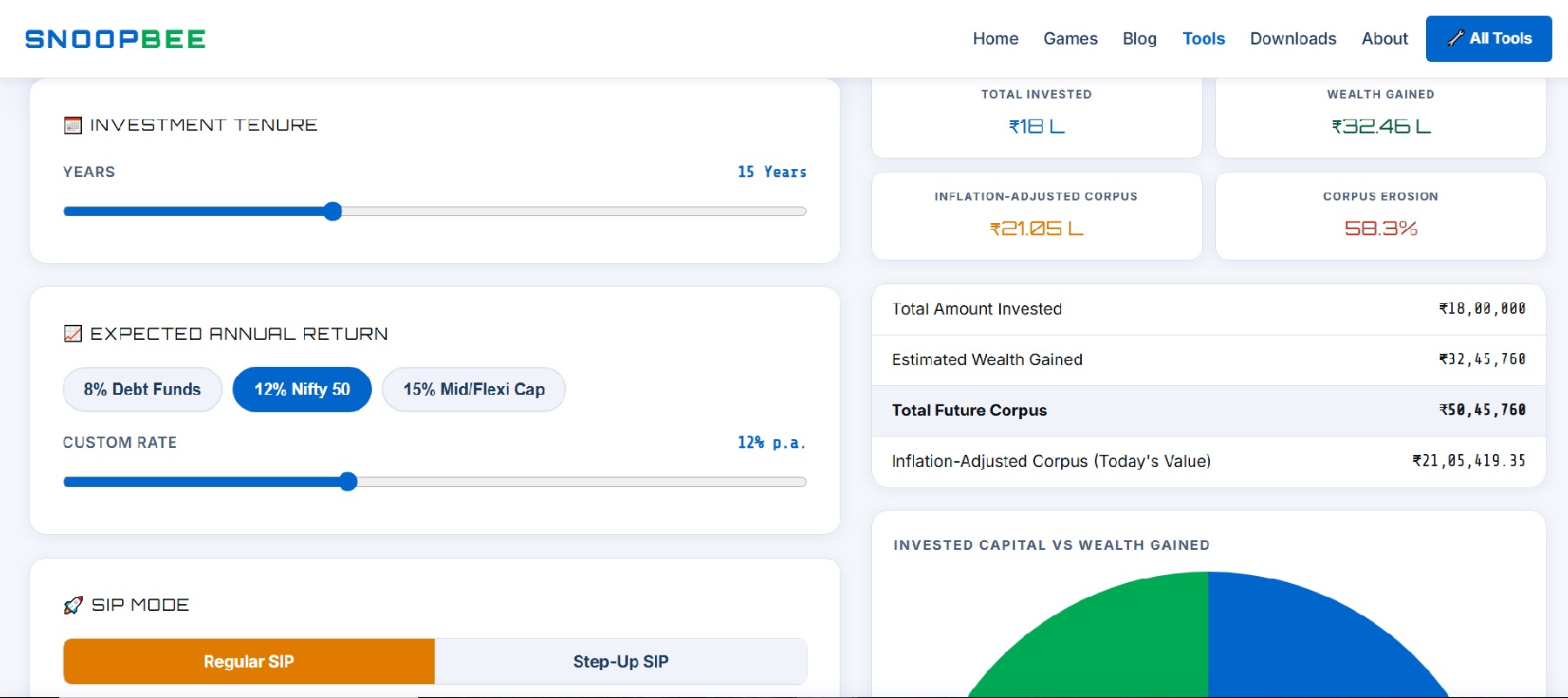
Worked example: ₹10,000 per month, at 12% expected annual return, for 15 years.
- i = 12 ÷ 1200 = 0.01 (1% per month)
- n = 15 × 12 = 180 months
- FV = 10,000 × [(1.01180 − 1) ÷ 0.01] × 1.01 ≈ ₹50.5 Lakhs
Of that ₹50.5 Lakh corpus, only ₹18 Lakh (10,000 × 180 months) was actually invested out of your own pocket — the remaining ₹32.5 Lakh is pure compounding growth. That gap between what you put in and what you end up with is the entire point of investing early and staying invested long.
Step-Up (Top-Up) SIP — Investing More As You Earn More
A Step-Up SIP (also called a Top-up SIP) automatically increases your monthly investment amount by a fixed percentage every year — commonly matching an annual salary hike or appraisal — instead of keeping the same monthly amount for the entire tenure.
Most salaried professionals get an annual increment of somewhere between 5% and 15%. A flat SIP ignores that rising income entirely; a Step-Up SIP captures it. Since your monthly contribution in year 10 or year 20 is meaningfully larger than in year 1, and that larger contribution still has years left to compound, a Step-Up SIP can produce a substantially larger final corpus than a flat SIP of the same starting amount — without ever feeling like a bigger sacrifice, since the increase mirrors money you're already earning.
Worked example: Starting at ₹10,000/month with a 10% annual step-up: Year 1 invests ₹10,000/month, Year 2 invests ₹11,000/month, Year 3 invests ₹12,100/month, and so on — each year's contribution then compounds monthly at your expected return rate, exactly like a regular SIP, until the end of your tenure.
The Power of Stepping Up — A Side-by-Side Comparison
Over a 15-year investment horizon at 12% expected return, starting at ₹10,000/month:
| Approach | Total Invested | Approx. Final Corpus |
|---|---|---|
| Regular SIP (flat ₹10,000/month) | ₹18.0 Lakh | ≈ ₹50.5 Lakh |
| Step-Up SIP (+10% every year) | ≈ ₹38.1 Lakh | ≈ ₹87 Lakh |
Notice the Step-Up investor puts in roughly twice as much money over 15 years — but because a large share of that extra money is invested in the later, more heavily-compounded years, the corpus doesn't merely double; it grows disproportionately, ending up nearly 70% higher than the flat SIP. This is the core insight behind Step-Up SIPs: they let your investing habit grow in step with your income, without requiring painful budget cuts early in your career.
A note on precision: Step-Up SIP corpus figures vary meaningfully between calculators depending on exactly how and when the annual increase is compounded. The figures here use standard monthly compounding with the increase applied at the start of each new year — always treat Step-Up SIP projections (from any calculator, including ours) as an approximate illustration of the concept rather than a precise guarantee.
Inflation & Real Purchasing Power
A future corpus that looks impressive on paper can buy less than you'd expect, because prices rise over time. ₹1 Crore twenty years from now will not have the same purchasing power as ₹1 Crore today — it will buy noticeably less, because the cost of goods and services keeps climbing in the meantime.
Worked example: A future corpus of ₹1 Crore, 20 years from now, assuming 6% average annual inflation.
- Real Value = 1,00,00,000 ÷ (1.06)20 ≈ ₹31.2 Lakh in today's purchasing power
That's a striking gap — the ₹1 Crore figure is real money you'll actually receive, but it will only feel like about ₹31 Lakh does today. This is precisely why serious financial planning (for retirement, a child's education, or any long-term goal) should always be done in "today's rupees," not just the impressive-looking future number.
SIP vs Lumpsum — Which Should You Choose?
If you already have a large sum of money sitting idle (say, an inheritance or a bonus), should you invest it all at once (lumpsum) or spread it out via SIP? There's no universally correct answer — it depends on market conditions and your comfort with risk.
- Lumpsum tends to perform better when markets rise steadily over your holding period, since your entire amount benefits from compounding from day one.
- SIP tends to reduce risk when markets are volatile or richly valued, since spreading purchases over time means you buy at a mix of prices — some high, some low — rather than risking your entire investment at a single, possibly unfavourable, entry point.
For most people, the real-world choice isn't actually "SIP vs Lumpsum" in the abstract — it's simply that a SIP matches how regular income actually arrives (a monthly paycheck), while lumpsum investing applies to windfalls. Many experienced investors use both: a SIP for their regular monthly savings, and a smaller lumpsum investment (sometimes spread over a few months, called "STP" or Systematic Transfer Plan) for any windfall amounts.
Choosing a Realistic Expected Return Rate
The return rate you assume changes your projected corpus dramatically, so it's worth understanding what's realistic rather than picking an optimistic number.
| Asset Class | Illustrative Long-Term Range | Risk Level |
|---|---|---|
| Debt Mutual Funds | ~6–8% p.a. | Lower risk, lower return |
| Nifty 50 Index Funds | ~10–12% p.a. (historical average) | Moderate — tracks the broad market |
| Flexi Cap / Mid Cap Equity Funds | ~12–15% p.a. (historical average, higher volatility) | Higher risk, higher potential return |
These ranges are illustrative and based on long-term historical averages — they are not guarantees. Equity markets can and do have multi-year periods of flat or negative returns, and past performance never guarantees future results. A commonly used rule of thumb among financial planners is to assume a conservative rate (rather than the best historical years) when projecting your own retirement or goal-based plans.
Rupee Cost Averaging — SIP's Quiet Superpower
Rupee cost averaging is what happens automatically when you invest the same fixed amount every month: when the market (and therefore the mutual fund's unit price, or NAV) is low, your fixed ₹10,000 buys more units; when the market is high, the same ₹10,000 buys fewer units. Over time, this averages out your purchase price, reducing the risk of accidentally investing your entire amount at a market peak.
This is one of the quiet reasons SIPs work so well psychologically: you don't need to correctly predict market highs and lows (something even professional fund managers struggle to do consistently) — you simply need to keep investing on schedule, through both good months and bad ones.
Common SIP Mistakes to Avoid
Stopping or Pausing SIPs During Market Dips
This is arguably the single most common and costly SIP mistake. A market downturn is exactly when your fixed SIP amount buys more mutual fund units at a lower price — pausing your SIP during a dip means missing out on buying at a discount, which undermines the entire rupee cost averaging benefit.
Assuming an Unrealistically High Return Rate
Projecting your retirement corpus at 18–20% because "that's what happened for a couple of years" can lead to significant under-saving. Using a more conservative, long-term average rate produces a plan you're less likely to fall short of.
Ignoring Inflation Entirely
As shown above, a headline corpus figure can be misleading without adjusting for inflation — always check the "real value" of your goal, not just the nominal future number.
Not Increasing SIP Amounts Over Time
Keeping your SIP flat for 20+ years while your income grows means your investing effort shrinks as a share of your income every year. A Step-Up SIP (or simply increasing your SIP manually every year) helps your investments keep pace with your earning potential.
Everyday SIP Scenarios
A College Student Starting Small
A student investing ₹500/month from age 20 benefits enormously from time — even a small amount compounding for 30–40 years can grow into a meaningful sum, illustrating why starting early matters more than starting big.
A Salaried Professional Using Step-Up SIP
An employee who gets a 10% annual increment can set their SIP to Step-Up by 10% each year, effectively investing a consistent proportion of their growing income without any separate manual effort.
A Parent Investing for a Child's Education
A 15–18 year SIP horizon (matching a newborn's path to college) can be planned using the inflation-adjusted real value feature, since education costs themselves tend to rise faster than general inflation in many cases.
A Retiree Exploring Safer Options
Retirees typically shift away from pure equity SIPs toward capital preservation, but many use SIPs in debt or hybrid funds for grandchildren's future goals, or continue a smaller equity SIP for a portion of their portfolio still aimed at long-term growth, depending on their personal risk capacity — a decision best made with a financial advisor.
A Quick Word on Taxation
Gains from equity mutual funds held for more than one year are classified as Long-Term Capital Gains (LTCG) and are taxed differently from gains realised within a year (Short-Term Capital Gains, or STCG), with debt fund taxation following separate rules altogether. Because tax rules and exemption limits are revised periodically by the government, this article intentionally avoids quoting specific rates or thresholds — always check the current LTCG/STCG rules on the Income Tax Department's website or with a tax professional before making investment decisions based on tax outcomes.
SIP-Style Investing Beyond India
The core idea behind a SIP — investing a fixed amount regularly rather than timing the market — isn't unique to India. Similar recurring investment plans exist across South and Southeast Asia under different names and structures, such as Regular Savings Plans (RSPs) in Singapore, unit trust monthly investment plans in Malaysia, and recurring mutual fund plans in Indonesia and Thailand. The underlying math — monthly compounding of a fixed contribution — works identically regardless of currency or country; only the local fund options, tax treatment, and typical return ranges differ.
Frequently Asked Questions
What is a SIP in simple terms?
A SIP is a way of investing a fixed amount into a mutual fund every month automatically, instead of investing a large sum all at once, so your money grows through regular investing and compounding over time.
What is the SIP future value formula?
FV = P × [((1 + i)^n − 1) / i] × (1 + i), where P is the monthly investment, i is the monthly rate of return, and n is the total number of months invested.
What is a Step-Up or Top-up SIP?
A Step-Up SIP automatically increases your monthly investment by a fixed percentage every year, typically matching an annual salary increment, which can meaningfully increase your final corpus compared to a flat monthly SIP.
Is SIP better than Lumpsum investing?
Neither is universally better — lumpsum can outperform when markets rise steadily, while SIP reduces timing risk by spreading purchases across market highs and lows, which suits most regular-income investors.
Why does inflation matter for SIP returns?
Inflation reduces the purchasing power of your future corpus, so a sum that looks large in the future may buy noticeably less than the same amount would today — which is why financial planning should consider inflation-adjusted, real returns.
Project Your Own SIP Wealth With the Free Calculator
Open the SIP Calculator →This article is for general educational purposes only and is not investment advice. Mutual fund investments are subject to market risk; the return rates and figures discussed here are illustrative, based on historical long-term averages, and are not guarantees of future performance. Please consult a SEBI-registered financial advisor before making investment decisions. Last updated: August 2026.
💬 Questions & Reader Comments
Ask a question about SIPs, share your own example, or leave feedback. (Max 200 words)