What a 1RM Actually Is
A one-rep max (1RM) is the maximum amount of weight a person can lift for a single complete repetition of a given exercise with proper technique. It's the standard reference point strength coaches and researchers use for comparing strength across people, tracking progress over time, and calculating training loads as a percentage of maximum capacity.
1RM is exercise-specific — a person's squat 1RM, bench press 1RM, and deadlift 1RM are three entirely separate numbers, each reflecting the particular muscle groups, joint angles, and movement patterns of that specific lift. There's no universal formula that converts a 1RM in one exercise to another, since strength in one movement pattern doesn't translate proportionally to a different one.
It's also worth distinguishing 1RM from related but different strength concepts sometimes used in training discussions. Relative strength expresses 1RM as a ratio to body weight, useful for comparing strength across lifters of different sizes. Strength endurance describes the ability to sustain repeated submaximal efforts, a related but distinct quality from peak single-rep strength. And power, the ability to generate force quickly, is again a related but separate physical quality — a lifter can have an impressive 1RM without necessarily being especially powerful in an explosive-movement sense, and vice versa. This guide and its accompanying calculator focus specifically on 1RM itself, the peak single-repetition strength metric.
Why Estimate Instead of Test Directly
Testing a true 1RM directly means attempting progressively heavier single lifts until reaching genuine failure — a process that carries real practical downsides for most lifters, most of the time.
- Injury risk. Attempting a true maximal single, especially without proper warm-up, technique refinement, and spotting, carries meaningfully higher injury risk than working with submaximal loads.
- Central nervous system fatigue. A genuine max-effort attempt is taxing on the nervous system in a way that can affect performance and recovery for days afterward, disrupting a normal training schedule.
- Time cost. Properly testing a true 1RM, including adequate warm-up sets working up to the attempt, takes considerably longer than a single submaximal set used for estimation.
- Technique breakdown under fatigue. Form often deteriorates as a lifter approaches genuine muscular failure, which is a particular concern for lifters who haven't specifically practiced technique under near-maximal load.
Estimating 1RM from a submaximal set — typically 3 to 10 reps taken close to, but not at, complete failure — largely avoids these downsides while still providing a useful, reasonably accurate number for programming purposes.
The Origins of Rep-Max Prediction
The idea that a lifter's performance on a submaximal set follows a predictable mathematical relationship to their true maximum dates back decades in exercise science literature. Early researchers observed that the number of reps a person could complete at a given percentage of their max followed fairly consistent patterns across many lifters, even though absolute strength varied enormously between individuals. This observation — that the relationship between load and rep count is more consistent than absolute strength itself — is the foundational insight underlying every rep-max prediction formula developed since, including the three covered in depth in this guide.
Different researchers, working with different data sets and different populations of lifters, arrived at different mathematical models to describe this relationship, which is exactly why multiple competing formulas exist today rather than one universally agreed-upon standard. Each formula essentially represents its author's best-fit mathematical curve through the specific data they collected, which is also why no single formula perfectly predicts every individual's true max in every situation.
This same body of research also underlies the percentage-based training charts covered later in this guide — the observed relationship between load, reps, and fatigue is what allows a coach to reasonably predict that, say, 80% of a lifter's max will typically permit somewhere around 7-8 reps before failure. It's the same underlying data and mathematical relationships driving both the 1RM estimation formulas and the percentage-to-reps training guidelines used throughout strength and conditioning programming today.
The Epley Formula
Developed by Boyd Epley, a strength coach widely credited as one of the pioneers of collegiate strength and conditioning programs in the United States, this formula is one of the most widely used 1RM estimation methods in gyms and training software today.
The Epley formula's straightforward linear structure — each additional rep adds a consistent fractional amount to the estimated max — makes it simple to calculate by hand and reasonably robust across a fairly wide rep range, which likely contributes to its broad adoption in commercial gym equipment displays and fitness apps.
The Brzycki Formula
Developed by Matt Brzycki, a strength and conditioning researcher, this formula takes a different mathematical shape than Epley's, and is often cited as particularly reliable for lower rep ranges.
Unlike Epley's linear structure, Brzycki's formula grows non-linearly as rep count increases, and mathematically approaches an undefined result as reps approach 37 — a limitation that doesn't cause practical issues within the formula's intended and more accurate range of roughly 1 to 10 reps, but is worth knowing if a calculator ever returns an unusually inflated number from an unusually high input rep count.
The Lombardi Formula
Developed by researcher Anthony Lombardi, this formula takes yet another distinct mathematical approach, using an exponential relationship between weight and reps.
The Lombardi formula tends to produce somewhat more conservative (lower) estimates than Epley or Brzycki at higher rep counts, which some coaches find useful as a lower-bound cross-check alongside the other two formulas, rather than relying on any single formula's output as an exact figure.
Other Notable Formulas
Beyond the three covered in depth on this page, exercise science literature includes several other rep-max prediction formulas that appear in various training programs and research studies, each reflecting a slightly different mathematical approach to the same underlying question.
| Formula | General Structure | Notable Characteristic |
|---|---|---|
| O'Conner | Weight × (1 + 0.025 × Reps) | A simpler linear model, similar in spirit to Epley but with a different coefficient |
| Mayhew et al. | Exponential decay-based model | Developed using a specific research sample; sometimes cited in academic strength research |
| Wathen | Percentage-based lookup model | Uses a fitted percentage table rather than a single continuous equation |
These additional formulas are included here mainly for context — the three primary formulas featured in the calculator above (Epley, Brzycki, and Lombardi) are among the most widely cited and commonly implemented in commercial gym equipment, fitness apps, and coaching software, which is why they form the core of this guide and the calculator itself.
Coaches and researchers sometimes debate the relative merits of these various formulas at academic conferences and in published studies, but for the practical purpose of programming everyday training, the differences between most established formulas are generally small enough that any of the well-validated options — Epley, Brzycki, Lombardi, or the others listed above — provide a reasonably useful working estimate, provided the underlying set was performed with good technique reasonably close to failure.
Which Formula Is Most Accurate, and When
Research comparing these and other 1RM prediction formulas against directly tested true 1RMs generally finds that no single formula is universally most accurate across every exercise, rep range, and individual. Some general patterns are worth knowing, though:
| Rep Range | General Pattern |
|---|---|
| 1-5 reps | All three formulas tend to produce fairly similar, generally reliable estimates |
| 6-10 reps | Estimates begin diverging somewhat more; comparing multiple formulas is useful here |
| 11-15 reps | Accuracy decreases further across all formulas; treat estimates as rougher approximations |
| 15+ reps | Generally not recommended for 1RM estimation; formulas weren't calibrated on this range |
Practical takeaway: rather than treating any single formula's output as an exact number, use the range across all three as a more honest picture of your likely true 1RM — if Epley, Brzycki, and Lombardi all land within a few percent of each other, that convergence itself is a useful signal of estimate reliability.
What Affects Estimate Accuracy Beyond Reps
Rep count is the primary input these formulas rely on, but several other factors influence how closely a submaximal-set estimate will track an individual's true 1RM in practice.
- Exercise type. Compound, multi-joint lifts like the squat, bench press, and deadlift tend to follow these formulas more predictably than smaller isolation exercises, where fatigue and stabilizer muscle involvement can behave somewhat differently.
- Training experience. More experienced lifters, who have practiced maintaining technique under heavier loads, often produce estimates that track true 1RM more closely than beginners still developing consistent form under load.
- Muscle fiber composition. Individuals with a higher proportion of fast-twitch muscle fibers, which fatigue more quickly under repeated submaximal effort, sometimes see their true 1RM run somewhat higher than rep-based formulas would predict from a higher-rep set, since these formulas were calibrated on population averages rather than individual fiber-type profiles.
- Effort and true proximity to failure. A set stopped several reps short of failure will understate 1RM far more than the formula's inherent margin of error, since the entire calculation depends on the assumption that the set was taken genuinely close to the lifter's limit.
- Fatigue from prior sets. A rep-max set performed after several other heavy sets in the same session will generally underestimate a lifter's true fresh 1RM, since accumulated fatigue reduces performance independent of true maximal capacity.
None of this means the formulas are unreliable — for most lifters, in most situations, they remain a genuinely useful and reasonably accurate tool. It simply means the resulting number is best understood as a well-informed estimate calibrated to typical conditions, not a laboratory-precision measurement immune to the specific context in which the set was performed.
Building a Training Percentage Chart
Once you have an estimated 1RM, many strength training programs are structured around lifting a specific percentage of that number for a given number of sets and reps, rather than an arbitrary weight — this is the basis of percentage-based programming, common in powerlifting, Olympic weightlifting, and many structured strength programs.
| % of 1RM | Typical Rep Range | Common Training Purpose |
|---|---|---|
| 90-100% | 1-3 reps | Maximal strength, peaking phases |
| 80-89% | 4-6 reps | Strength development |
| 70-79% | 7-10 reps | Strength-hypertrophy blend |
| 60-69% | 11-15 reps | Hypertrophy (muscle growth) |
| 50-59% | 16-25 reps | Muscular endurance |
These rep ranges and their associated training purposes are general guidelines drawn from decades of strength and conditioning research and coaching practice, not rigid boundaries — plenty of effective programs blend or deviate from these ranges. But they offer a useful starting framework for translating a single estimated 1RM number into an entire structured training plan.
How to Use the 1RM Calculator
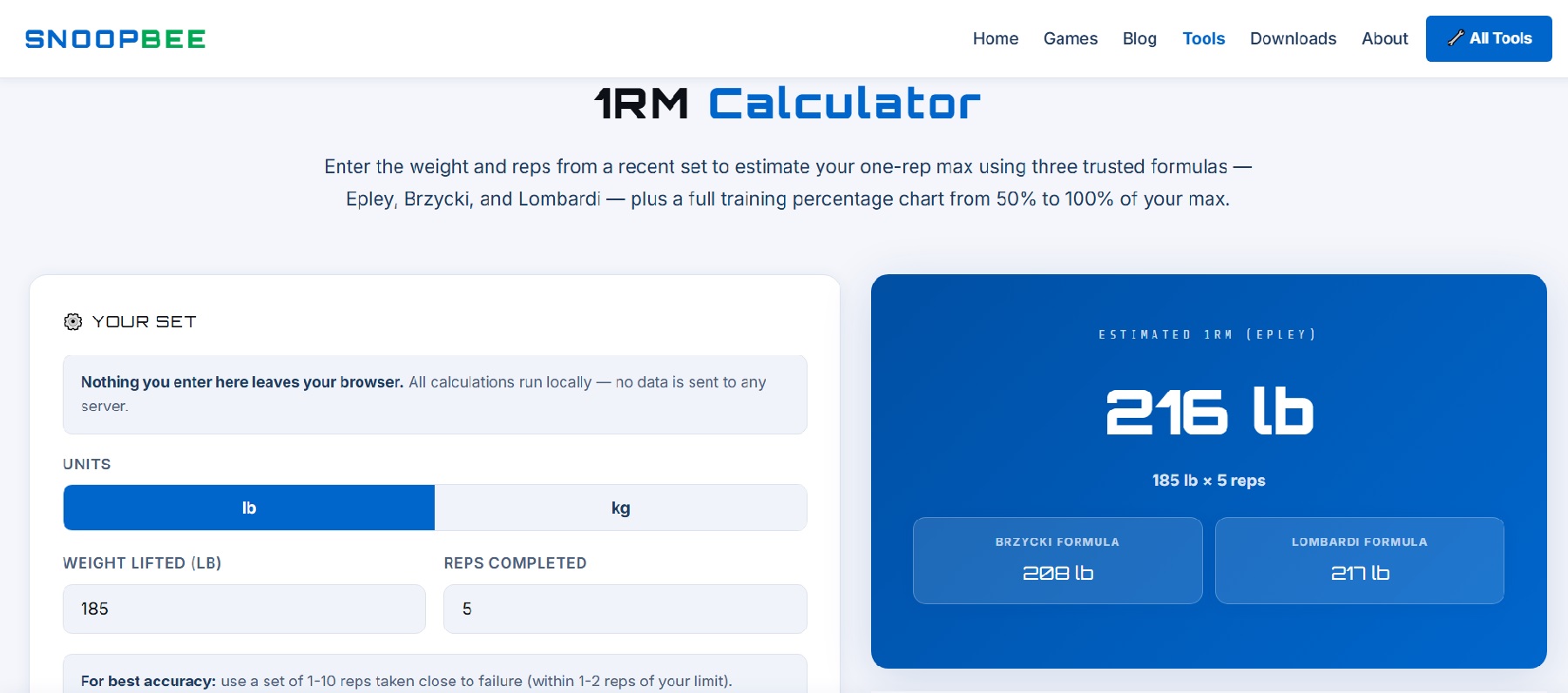
The 1RM Calculator above uses the exact three formulas explained above, plus generates a full percentage chart automatically.
- Choose your units — pounds or kilograms.
- Enter the weight you lifted in a recent set, ideally taken within 1-2 reps of failure.
- Enter the number of clean reps you completed with proper form.
- Read your results — the calculator shows all three formula estimates side by side, plus a full percentage-based training chart from 50% to 100% of your Epley-estimated max.
Two Full Worked Examples
Example 1: A moderate-rep set
A lifter completes 185 lb for 5 reps on the bench press, close to failure:
| Formula | Calculation | Result |
|---|---|---|
| Epley | 185 × (1 + 5/30) | ~215.8 lb |
| Brzycki | 185 × (36 / (37−5)) | ~208.1 lb |
| Lombardi | 185 × 5^0.10 | ~216.4 lb |
All three estimates land within about 8 pounds of each other — a tight cluster that suggests a reasonably reliable estimate somewhere in the 208-216 lb range, with Epley and Lombardi agreeing closely and Brzycki landing slightly more conservative.
Example 2: A higher-rep set
A lifter completes 135 lb for 12 reps on the same lift:
| Formula | Calculation | Result |
|---|---|---|
| Epley | 135 × (1 + 12/30) | ~189.0 lb |
| Brzycki | 135 × (36 / (37−12)) | ~194.4 lb |
| Lombardi | 135 × 12^0.10 | ~176.9 lb |
Notice the wider spread here — roughly 18 pounds between the highest and lowest estimate — illustrating exactly the accuracy pattern described above: at 12 reps, formulas diverge more, and this result should be treated as a rougher approximation than Example 1's tighter cluster.
Using 1RM Estimates to Track Progress Over Time
Beyond programming a single training block, tracking estimated 1RM across successive training cycles is one of the more straightforward ways to objectively measure whether a strength training program is actually working. Because a submaximal-set estimate avoids the injury risk and fatigue cost of a true max test, it can realistically be checked at the end of every training block — every 4 to 12 weeks, as covered in the retesting section below — without disrupting a normal training schedule the way repeated true max testing would.
A useful habit many lifters and coaches adopt is logging the same formula's estimate consistently over time — for instance, always using Epley for tracking purposes — rather than switching between formulas from one check-in to the next. Since each formula has its own systematic tendencies (Brzycki running slightly more conservative at higher reps, Lombardi more conservative still), comparing an Epley estimate from one month against a Brzycki estimate from the next introduces noise into the comparison that has nothing to do with actual strength change. Keeping the formula consistent isolates the one variable that actually matters: whether the lifter's true strength has increased.
It's also worth tracking the underlying set itself — the actual weight and rep count used for each estimate — alongside the calculated 1RM number, since a genuine strength increase should show up as either more weight for the same reps, more reps at the same weight, or some combination of both. If the calculated 1RM increases from one cycle to the next, retracing which of these actually changed provides more actionable coaching insight than the single output number in isolation.
Finally, it's worth setting realistic expectations for the pace of progress itself. Beginners in their first several months of consistent training often see relatively rapid estimated 1RM increases, sometimes called "newbie gains," reflecting a combination of genuine strength adaptation and rapid early improvements in technique and neuromuscular coordination. More experienced lifters typically see this rate of improvement slow considerably, with meaningful 1RM increases sometimes taking many months of consistent, well-programmed training to achieve — a normal and expected pattern, not a sign that a program has stopped working.
Safety Considerations for Testing and Training Near Max
Never attempt a heavy or maximal single without a spotter, safety bars/pins, or a qualified professional present, particularly on exercises like the barbell bench press or back squat, where a failed rep without adequate safety measures can result in serious injury.
- Warm up properly with progressively heavier submaximal sets before any set taken close to failure, rather than jumping straight to a heavy attempt from a cold start.
- Prioritize technique over the number. A technically breakdown-free set at slightly lower weight provides a more reliable estimate — and is considerably safer — than a technically poor set at a higher weight.
- Beginners generally shouldn't test a true 1RM at all. Most coaches recommend beginners rely on estimated 1RM from moderate-rep submaximal sets until technique is well-established, typically after several months of consistent, supervised training.
- Listen to joint and connective tissue signals, not just muscular fatigue — sharp or unusual joint pain during a heavy set is a signal to stop, distinct from normal muscular fatigue.
- Consider a training partner or coach for feedback, not just physical spotting — a second set of eyes on technique during heavier sets often catches form breakdown a lifter can't feel themselves in the moment.
- Recognize that pain is different from normal training discomfort. The burning sensation of muscular fatigue during a hard set is a normal part of training; sharp, localized, or joint-specific pain is not, and warrants stopping the set and, if persistent, consulting a doctor or physical therapist.
How Often to Retest
Meaningful strength gains generally take weeks, not days, to manifest as measurable changes in a submaximal set's performance, which is why most structured programs build in periodic reassessment — often every 4 to 12 weeks, frequently timed to coincide with the end of a training block or program cycle — rather than testing on a weekly basis.
A practical middle ground: rather than a dedicated "testing day," many lifters simply note their heaviest clean set at the end of each training cycle and run it through the calculator, letting the estimated 1RM update naturally as part of normal training rather than requiring a separate, higher-risk max-effort session purely for testing purposes.
Frequently Asked Questions
What is a 1RM?
A one-rep max (1RM) is the maximum weight a person can lift for a single complete repetition of a given exercise with proper form.
How accurate are 1RM formulas like Epley and Brzycki?
Generally reasonably accurate within roughly a 5 percent margin for sets of 1-10 reps taken close to failure, but accuracy decreases at higher rep ranges and can vary by exercise and individual.
Which 1RM formula is most accurate?
No single formula is universally most accurate. Epley works well across a broad rep range, Brzycki is often considered strong for lower reps, and comparing multiple formulas is generally more informative than relying on just one.
Should beginners test their true 1RM?
Most coaches recommend beginners use estimated 1RM from submaximal sets rather than attempting a true max test, since technique under near-maximal load takes time to develop.
How often should I retest my 1RM?
Many lifters reassess every 4 to 12 weeks, often at the end of a training cycle, rather than testing weekly.
Can I use these formulas for any exercise?
They tend to work most predictably for compound, multi-joint lifts like the squat, bench press, and deadlift. Smaller isolation exercises can behave somewhat less predictably due to differences in fatigue patterns and stabilizer muscle involvement.
Estimate Your One-Rep Max Right Now
Open the 1RM Calculator →This article is for general educational purposes only and is not medical or professional coaching advice. Estimated 1RM formulas are approximations and can vary from an individual's true one-rep max. Never attempt a heavy or maximal lift without a spotter, safety bars, or a qualified professional present, and consult a doctor before beginning any new strength training program. Last updated: August 2026.
💬 Questions & Reader Comments
Ask a question about 1RM estimation or training percentages, or share your own numbers. (Max 200 words)