What Systolic and Diastolic Actually Measure
Blood pressure is recorded as two numbers, written as systolic over diastolic (e.g., 120/80 mmHg). Systolic pressure is the pressure in your arteries at the moment your heart contracts and pushes blood out. Diastolic pressure is the pressure in your arteries during the brief moment your heart relaxes and refills between beats.
Both numbers are measured in millimeters of mercury (mmHg), a unit inherited from the original mercury column sphygmomanometers used to measure blood pressure, and both matter independently — systolic tends to draw more attention in general health messaging and rises more consistently with age, but diastolic pressure carries genuine clinical significance in its own right, particularly in younger adults, where elevated diastolic pressure is sometimes the earlier warning sign.
What neither number alone captures, though, is the shape of the pressure wave across a full heartbeat — and that's exactly the gap Mean Arterial Pressure and Pulse Pressure are designed to fill.
It's also worth understanding why blood pressure matters so much as a health metric in the first place. Chronically elevated blood pressure forces the heart to work harder with every beat and, over years, contributes to damage in the artery walls themselves — a process linked to increased risk of heart attack, stroke, kidney disease, and other cardiovascular complications. Because hypertension typically causes no noticeable symptoms until it's already caused significant damage, it's often called a "silent" risk factor, which is precisely why routine measurement — rather than waiting for symptoms — is the standard approach to catching it early.
Mean Arterial Pressure (MAP) Explained
Mean Arterial Pressure estimates the average pressure in your arteries across a complete cardiac cycle — not a simple average of systolic and diastolic, but one weighted toward diastole, since the heart spends roughly twice as long relaxed (diastole) as contracted (systole) during each beat.
This is why the formula weights diastolic more heavily: it's mathematically equivalent to diastolic plus one-third of the pulse pressure, reflecting that roughly two-thirds of the cardiac cycle is spent in diastole. MAP matters clinically because it's the pressure that actually determines whether your organs receive adequate blood flow — a MAP of roughly 70 to 100 mmHg is generally considered necessary to adequately perfuse major organs including the brain, kidneys, and heart itself, which is precisely why MAP, rather than systolic or diastolic individually, is the number most closely monitored in intensive care and anesthesia settings, where maintaining adequate organ perfusion is a moment-to-moment concern.
For a typical, healthy reading of 120/80, this works out to a MAP of approximately 93 mmHg — comfortably within the range organs need for adequate perfusion, and a useful sanity check that a normal-looking systolic/diastolic pair also produces a normal-looking MAP.
Why clinicians care about MAP specifically
In hospital settings — intensive care units, operating rooms, trauma bays — MAP is often the number displayed and tracked continuously, rather than systolic and diastolic individually, because it's the figure most directly tied to organ perfusion. A patient can have a systolic reading that looks acceptable while their MAP has dropped low enough to compromise blood flow to the kidneys or brain, particularly in situations involving significant blood loss, sepsis, or certain medications that affect blood vessel tone. This is also why MAP shows up prominently in critical care targets: for many critically ill patients, clinicians aim to keep MAP above roughly 65 mmHg specifically to protect kidney and brain perfusion, a target derived directly from the physiology this section describes.
For most people checking their blood pressure at home, MAP is less of an urgent moment-to-moment concern than it is in a hospital setting — but understanding what it represents still helps explain why a reading with a "normal-looking" systolic and diastolic number is genuinely reassuring from a whole-body-perfusion standpoint, not just because two numbers happen to fall in an acceptable range.
Pulse Pressure Explained
Pulse pressure is simply the difference between your systolic and diastolic readings — Systolic minus Diastolic — and it reflects the force your heart generates with each beat, along with the elasticity (or stiffness) of your major arteries.
A normal pulse pressure generally falls somewhere between about 40 and 60 mmHg, though this range shifts somewhat with age and individual physiology. A pulse pressure consistently above roughly 60 mmHg can indicate reduced arterial elasticity — arteries that have stiffened over time, a pattern that becomes more common with age and is associated with elevated cardiovascular risk. On the other end, an unusually narrow pulse pressure (well below 40 mmHg) can sometimes indicate reduced cardiac output and, in certain clinical contexts, warrants further evaluation.
Worth knowing: pulse pressure tends to widen naturally with age even in healthy individuals, primarily because systolic pressure rises more than diastolic pressure does as arteries gradually stiffen over a lifetime — part of why isolated systolic hypertension (elevated systolic with normal or even low diastolic) is a distinctly common pattern in older adults.
The AHA Blood Pressure Categories
The American Heart Association's current blood pressure categories, established in a 2017 guideline update, lowered the threshold for what counts as elevated and Stage 1 hypertension compared to older standards, reflecting a growing body of research linking even modestly elevated readings to long-term cardiovascular risk.
| Category | Systolic (mmHg) | Diastolic (mmHg) |
|---|---|---|
| Low (Hypotension) | Below 90 | Below 60 |
| Normal | Below 120 | Below 80 |
| Elevated | 120–129 | Below 80 |
| Hypertension Stage 1 | 130–139 | 80–89 |
| Hypertension Stage 2 | 140 or higher | 90 or higher |
| Hypertensive Crisis | Above 180 | Above 120 |
Note that a reading falls into a category if either number qualifies, not only if both do — a reading of 128/84, for example, lands in Stage 1 hypertension based on the diastolic number alone, despite a systolic reading that would otherwise sit comfortably in the Elevated category. This "either number counts" rule surprises many people checking their own readings for the first time.
How the Categories Have Changed Over Time
The current AHA categories, adopted in 2017, represent a meaningful shift from the guidelines used for roughly the previous decade and a half. Under the older framework, "prehypertension" covered a systolic range of 120-139 or diastolic 80-89, and a diagnosis of hypertension itself didn't begin until 140/90. The 2017 update split that older "prehypertension" band into two more specific categories — Elevated and Stage 1 hypertension — and lowered the Stage 1 threshold to 130/80, meaningfully reclassifying a substantial number of adults who would previously have been labeled merely "prehypertensive" as now falling within a formal hypertension category.
This wasn't a change made lightly. It reflected accumulating research, including large outcome studies, showing that cardiovascular risk begins rising at readings below the older 140/90 threshold, and that earlier lifestyle intervention at the 130/80 level was associated with meaningfully better long-term outcomes than waiting for a reading to cross the older threshold. It's worth knowing this history if you've been told at different points in your life that your blood pressure was "borderline" or "fine" — the definition of where those lines sit has itself moved, and a reading of 132/84 that might have drawn little comment under the older guidelines is now formally Stage 1 hypertension.
What Moves Your Reading Minute to Minute
Blood pressure is not a fixed number — it fluctuates continuously throughout the day in response to activity, emotion, posture, and time of day, which is exactly why a single reading is a snapshot rather than a diagnosis.
- Time of day. Blood pressure typically follows a natural daily rhythm, often lower during sleep, rising in the early morning, and fluctuating through the day — a pattern researchers call diurnal variation.
- Recent activity. Exercise, climbing stairs, or even a brisk walk to the exam room can temporarily elevate a reading well above your resting baseline.
- Caffeine and nicotine. Both can produce a temporary spike lasting roughly 30 minutes to a few hours, which is why accurate readings call for avoiding both beforehand.
- Posture and arm position. An unsupported arm, crossed legs, or an unsupported back can each meaningfully skew a reading, sometimes by several mmHg.
- Talking during measurement. Conversation during a reading is a commonly overlooked source of measurement error, and most clinical guidelines specifically call for silence during the reading.
- Cuff size. A cuff that's too small for the arm it's measuring tends to produce falsely high readings — worth checking if your home readings seem persistently higher than expected.
White Coat & Masked Hypertension
Two related but opposite phenomena are well documented in blood pressure research and worth understanding if your readings seem inconsistent between settings.
White coat hypertension describes readings that are elevated specifically in a clinical setting — driven by situational anxiety around the exam itself — while readings taken at home or via ambulatory monitoring remain normal. It's a genuinely common pattern, not a sign of a "fake" reading, and part of why many doctors now recommend home or 24-hour ambulatory monitoring to confirm an office-based hypertension diagnosis before starting treatment.
Masked hypertension is the inverse and, in some ways, more clinically concerning: normal readings in the office but elevated readings at home or during daily activity, meaning the condition can go undetected using office measurements alone. Both patterns are part of why guidelines increasingly emphasize confirming any diagnosis of hypertension with readings taken outside a single clinical visit.
How to Take an Accurate Reading at Home
Home blood pressure monitoring has become a standard part of managing and screening for hypertension, and getting a genuinely representative reading depends more on technique than most people expect.
- Choose the right device. An upper-arm cuff monitor is generally more accurate than a wrist or finger monitor; look for one that's been independently validated, and confirm the cuff size matches your arm circumference.
- Prepare properly. Empty your bladder, avoid caffeine, exercise, and smoking for at least 30 minutes beforehand, and sit quietly for a full 5 minutes before measuring.
- Position yourself correctly. Sit with your back supported, feet flat on the floor (not crossed), and your arm resting on a table at roughly heart height — an unsupported arm alone can meaningfully skew a reading.
- Stay silent and still. Don't talk during the measurement, and avoid checking your phone or moving around.
- Take multiple readings. Most guidelines recommend two to three readings, one minute apart, using the average rather than a single measurement.
- Track over time, not just once. A log of readings across days and weeks, taken at consistent times, gives a far more clinically useful picture than any single reading — and is exactly the kind of data many doctors now ask patients to bring to appointments.
How to Use the Blood Pressure Calculator
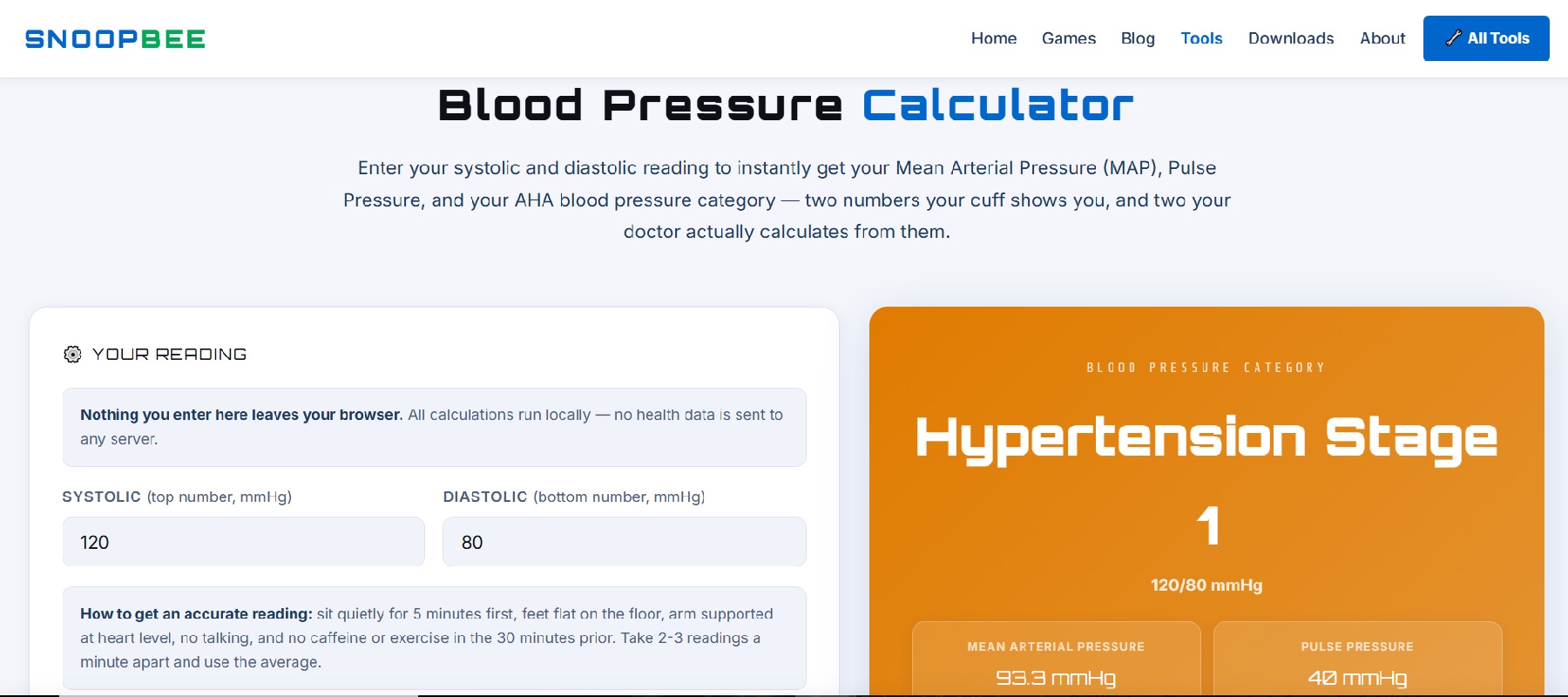
The Blood Pressure Calculator above takes your systolic and diastolic reading and instantly returns your MAP, Pulse Pressure, and AHA category, using the exact formulas explained above.
- Take an accurate reading first. Sit quietly for 5 minutes, feet flat, arm supported at heart level, no talking, and avoid caffeine or exercise for 30 minutes beforehand. Ideally, take 2-3 readings a minute apart and average them.
- Enter your systolic number — the top number on your cuff's display.
- Enter your diastolic number — the bottom number.
- Read your results. The calculator instantly shows your MAP, Pulse Pressure, and which AHA category your reading falls into, with the reference table highlighting exactly where you land relative to all six categories.
Two Full Worked Examples
Example 1: A textbook-normal reading
Systolic 118, Diastolic 76:
| Metric | Calculation | Result |
|---|---|---|
| Pulse Pressure | 118 − 76 | 42 mmHg |
| MAP | 76 + (118−76)/3 | ~90.0 mmHg |
| AHA Category | Both numbers below 120/80 | Normal |
Both the pulse pressure and MAP fall comfortably within typical healthy ranges here, consistent with the Normal category classification.
Example 2: A reading with a wide pulse pressure
Systolic 148, Diastolic 68 — a pattern more common in older adults with some arterial stiffening:
| Metric | Calculation | Result |
|---|---|---|
| Pulse Pressure | 148 − 68 | 80 mmHg |
| MAP | 68 + (148−68)/3 | ~94.7 mmHg |
| AHA Category | Systolic 140+ | Hypertension Stage 2 |
This example illustrates something a systolic/diastolic reading alone can obscure: despite a MAP that still looks reasonably close to Example 1's, the 80 mmHg pulse pressure — well above the roughly 40-60 mmHg typical range — flags a distinct underlying pattern (isolated systolic elevation with a wide pulse pressure) worth discussing with a doctor, separate from the Stage 2 classification itself.
Lifestyle Factors That Move the Needle
- Sodium intake. Reducing dietary sodium is one of the most consistently evidence-supported ways to lower blood pressure for many people, particularly those who are salt-sensitive.
- Regular aerobic activity. Consistent cardiovascular exercise, of the kind our companion heart rate zone guide covers in detail, is well-supported for meaningfully lowering resting blood pressure over time.
- Weight management. Even modest weight loss is associated with measurable blood pressure reductions in individuals carrying excess weight.
- Alcohol moderation. Higher alcohol intake is associated with elevated blood pressure; reducing intake is a well-supported lever for many people.
- Stress management and sleep. Chronic stress and poor sleep, covered in depth in our companion sleep cycle guide, are both associated with elevated blood pressure over time.
- Medication adherence. For those prescribed antihypertensive medication, consistent adherence is straightforwardly one of the most effective levers available — more effective than any single lifestyle change alone for many people with diagnosed hypertension.
- The DASH-style eating pattern. Diets emphasizing vegetables, fruit, whole grains, and low-fat dairy while limiting sodium and saturated fat have substantial research support specifically for lowering blood pressure, independent of weight loss alone.
- Potassium intake. Adequate dietary potassium, from sources like leafy greens, bananas, and beans, is associated with lower blood pressure and can help offset some of sodium's effects, though people with kidney disease should discuss potassium intake with a doctor first.
When to Seek Emergency Care
A reading in the Hypertensive Crisis range (above 180 systolic and/or above 120 diastolic), especially alongside symptoms like chest pain, shortness of breath, severe headache, vision changes, numbness, weakness, difficulty speaking, or confusion, is a medical emergency. Seek emergency medical care immediately rather than waiting to see if the reading comes back down on its own.
Even a Hypertensive Crisis-range reading without accompanying symptoms still warrants prompt medical attention rather than a wait-and-see approach, since it can indicate a hypertensive emergency in progress before symptoms become obvious.
When High Blood Pressure Has an Identifiable Cause
Most hypertension is what's called "primary" or "essential" hypertension — meaning no single identifiable cause, but rather a combination of genetics, age, and lifestyle factors accumulating over time. A smaller share of cases, though, are "secondary" hypertension, where an underlying, identifiable condition is directly driving elevated readings, and treating that underlying condition can significantly improve or even resolve the blood pressure issue itself.
- Kidney disease. Since the kidneys play a central role in regulating blood volume and pressure, kidney disease is one of the more common identifiable causes of secondary hypertension.
- Sleep apnea. As covered in our companion sleep-related guides, obstructive sleep apnea has a well-documented association with elevated blood pressure, partly through the repeated oxygen drops and stress-hormone spikes it causes overnight.
- Certain hormonal conditions. Thyroid disorders and some adrenal gland conditions can drive secondary hypertension, and are generally identified through blood tests when hypertension appears at an unusually young age or resists typical treatment.
- Certain medications. Some over-the-counter and prescription medications, including certain decongestants, NSAIDs, and hormonal medications, can raise blood pressure as a side effect.
Secondary hypertension is generally suspected when high readings appear suddenly, at a young age, resist typical treatment, or come with other unusual symptoms — in which case a doctor may investigate for an underlying cause rather than treating it purely as primary hypertension from the outset.
Regardless of whether hypertension turns out to be primary or secondary, the practical starting point is the same: consistent, correctly-measured readings over time. That's exactly what the calculator, table, and step-by-step measurement guidance in this article are designed to support — turning two numbers on a cuff display into a fuller, clinically-grounded picture you can track, discuss meaningfully with a doctor, and act on with real information rather than a vague sense of "probably fine" or "probably not."
Frequently Asked Questions
What is a normal blood pressure reading?
Under current AHA guidelines, normal blood pressure is below 120 systolic and below 80 diastolic.
What does Mean Arterial Pressure (MAP) actually measure?
MAP estimates the average pressure in your arteries across a full heartbeat cycle, weighted toward diastole. A MAP of roughly 70 to 100 mmHg is generally considered necessary to adequately perfuse major organs.
What does a high pulse pressure mean?
A pulse pressure consistently above roughly 60 mmHg can indicate reduced arterial elasticity, often associated with arterial stiffening that becomes more common with age.
Why is my blood pressure higher at the doctor's office than at home?
This is a well-documented phenomenon called white coat hypertension, caused by situational anxiety in a clinical setting.
Can one high blood pressure reading mean I have hypertension?
No. Hypertension is generally diagnosed based on the average of multiple readings on separate occasions, not a single measurement.
Does everyone need to treat Elevated blood pressure with medication?
Not necessarily. Elevated and Stage 1 hypertension are often managed first with lifestyle changes — diet, exercise, sodium reduction, and weight management — before medication is considered, particularly in the absence of other cardiovascular risk factors; a doctor is best placed to weigh this specific to an individual's full risk profile.
Check Your MAP, Pulse Pressure & AHA Category Right Now
Open the Blood Pressure Calculator →This article is for general educational purposes only and is not medical advice. It does not diagnose hypertension, hypotension, or any other condition. A single reading is not a substitute for clinical evaluation. If your reading is in the hypertensive crisis range, or you have symptoms such as chest pain, shortness of breath, or severe headache, seek emergency medical care immediately. Last updated: August 2026.
💬 Questions & Reader Comments
Ask a question about blood pressure, MAP, or pulse pressure, or share your own experience. (Max 200 words)