The "8 Glasses a Day" Myth: Where It Actually Came From
The "8x8 rule" — eight 8-ounce glasses of water per day, roughly 1.9 liters — is one of the most widely repeated pieces of health advice in the world, despite having no solid scientific origin as a personalized recommendation.
Here's a story that surprises most people the first time they hear it: the "8 glasses a day" rule is widely believed to trace back to a 1945 US Food and Nutrition Board recommendation that adults consume approximately 2.5 liters of fluid daily — but that same document also explicitly noted that most of this amount is normally contained in prepared foods, not consumed as plain drinking water separately. Over the following decades, as the advice was repeated and simplified in popular media, that crucial second sentence about food's contribution was gradually dropped, leaving behind a much simpler, catchier, but scientifically incomplete rule: just drink eight glasses of water.
A frequently cited 2002 academic review examined the scientific evidence behind the 8x8 rule directly and found no controlled studies supporting it as a genuine, universally applicable recommendation. This doesn't mean drinking roughly that amount of water is harmful — for many sedentary adults in a mild climate, it happens to land in a reasonable range — but it does mean the number was never derived from personalized science in the first place. It's a memorable rule of thumb that gained cultural authority through repetition, not through rigorous, individualized research.
Why this matters practically: a 50 kg office worker in a cool climate and a 100 kg construction worker in a hot, humid climate have genuinely different fluid needs — potentially more than double the difference — yet the 8x8 rule gives them the identical target. This is exactly the gap a bodyweight-and-activity-adjusted formula, like the one this calculator uses, is designed to close.
It's worth noting that other commonly cited guidelines exist alongside the 8x8 rule, adding to the general public confusion around this topic. The U.S. National Academies of Sciences, Engineering, and Medicine publish separate general reference intakes of roughly 3.7 liters of total water per day for adult men and 2.7 liters for adult women — figures that notably include water from all sources, food and beverages combined, not beverages alone. The gap between these different reference numbers, and the informal 8x8 rule, is itself a useful illustration of why "how much water should I drink" doesn't have one single universally agreed-upon answer — it depends heavily on which specific guideline you're referencing, what it's actually measuring (total water versus beverages alone), and how well it accounts for individual factors like bodyweight, activity, and climate.
Why Your Body Needs Water: The Physiology
Water makes up roughly 50–60% of adult total bodyweight, and it's involved in nearly every major bodily function: regulating body temperature through sweat, transporting nutrients and oxygen through blood plasma (which is about 90% water), cushioning joints and organs, flushing waste through the kidneys, and enabling the countless chemical reactions that keep cells functioning. Losing even a small percentage of total body water — as little as 1-2% — has been shown in research to measurably impair concentration, mood, and physical performance, well before the more familiar sensation of intense thirst sets in.
This is a key reason hydration guidance has shifted, in modern nutrition science, away from waiting for thirst as the primary signal and toward proactive, planned fluid intake throughout the day — by the time thirst becomes strong and obvious, a meaningful fluid deficit has typically already developed.
The cognitive performance research on mild dehydration is genuinely striking and worth understanding in a bit more depth. Multiple controlled studies have found that fluid losses of just 1-2% of bodyweight — an amount that can occur simply from a few hours without drinking in a warm room, well before any noticeable thirst — are associated with measurable declines in short-term memory, attention, and reaction time, alongside increased perceived difficulty of tasks and, in some studies, worsened mood and increased headache frequency. Because 1-2% of bodyweight is a genuinely small amount of fluid loss — roughly 700ml to 1.4 liters for a 70kg adult — this research is a strong part of the scientific case for proactive, scheduled hydration throughout the day, particularly during demanding cognitive work like studying, exams, or focused professional tasks, rather than treating water intake as an afterthought.
Building a Personalized Formula: Bodyweight as the Baseline
This calculator's baseline uses a widely cited general clinical guideline of approximately 33 ml of water per kilogram of bodyweight per day — a formula commonly referenced in clinical nutrition and dietetics resources as a reasonable starting point for adults, roughly in the middle of the broader 30–40 ml/kg range sometimes cited across different sources.
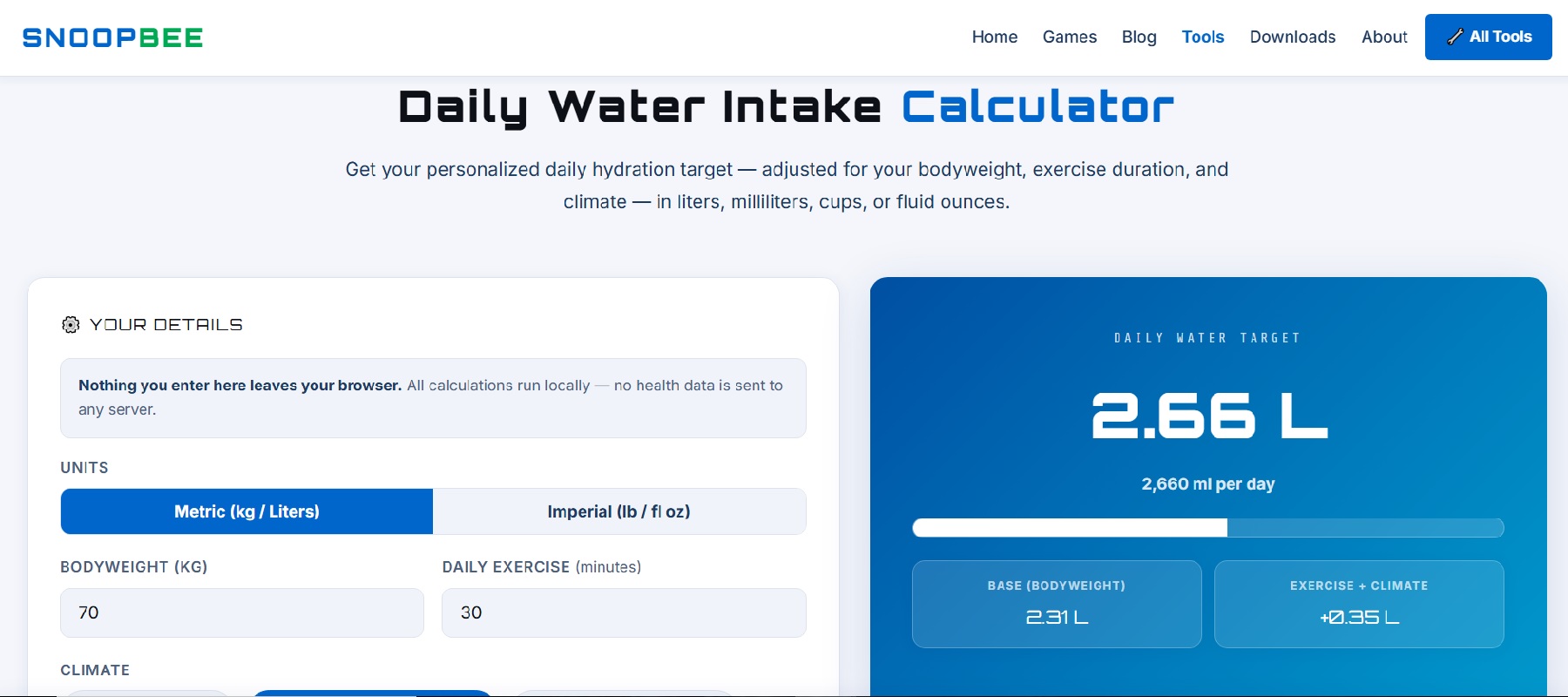
Worked example: a 70 kg adult has a baseline target of 70 × 0.033 = 2.31 liters per day, before any adjustment for exercise or climate — already a more personalized starting point than a flat 1.9-liter rule that ignores bodyweight entirely.
Why does bodyweight matter so directly? Larger bodies generally have proportionally more total body water, a larger blood volume to maintain, and often a greater metabolic rate generating more heat that needs to be dissipated through sweat — all of which scale fluid needs upward with body size, in a way a single fixed number never can. This is exactly why this calculator asks for bodyweight as its very first input, before any other adjustment is layered on top.
How Exercise Changes Your Fluid Needs
Physical activity is the single biggest daily variable affecting fluid needs beyond bodyweight, since sweating is the body's primary mechanism for shedding the substantial heat generated by working muscles.
This calculator adds roughly 0.35 liters (350 ml) for every 30 minutes of exercise, translating to an estimated 700 ml per hour of moderate-to-vigorous activity — a figure that sits within the commonly cited 400–800 ml per hour general range for sweat losses during exercise, chosen as a reasonable middle estimate for general planning purposes.
| Factor | Effect on Sweat Rate |
|---|---|
| Exercise Intensity | Higher intensity generates more heat, increasing sweat rate |
| Duration | Longer sessions compound total fluid loss |
| Individual Variation | Sweat rate varies severalfold between individuals even at identical intensity and conditions |
| Acclimatization | Regularly training in heat can increase sweat rate as the body adapts to cool itself more efficiently |
For serious athletes: a more precise, individualized method is the "sweat rate test" — weighing yourself immediately before and after a fixed-duration exercise session (without eating, drinking, or urinating in between), where each kilogram of weight lost approximately equals one liter of sweat loss. This calculator's exercise addition is a reasonable general estimate; a sweat rate test gives a genuinely personalized number for competitive or high-volume training.
How Climate & Humidity Change Your Fluid Needs
Heat increases sweat losses directly, but humidity plays an equally important, often underappreciated role: sweat cools the body by evaporating from the skin, and high humidity slows that evaporation, meaning the body compensates by producing even more sweat to achieve the same cooling effect — a hot, humid climate can meaningfully increase fluid needs beyond a hot, dry one at the identical temperature.
| Climate Category | Typical Addition |
|---|---|
| Cool (below 15°C / 59°F) | No addition |
| Moderate (15–25°C / 59–77°F) | No addition |
| Warm (25–32°C / 77–90°F) | +0.3 L |
| Hot & Humid (above 32°C / 90°F) | +0.6 L |
Relevant for readers across South and Southeast Asia, and other hot-humid regions: large parts of India, Southeast Asia, and similar tropical and subtropical climates combine consistently high temperatures with high humidity for much of the year, meaning many readers in these regions should reasonably expect to sit at or above the "Hot & Humid" tier in this calculator for a significant portion of the year — a materially higher target than someone in a temperate climate, even at an identical bodyweight and activity level.
The Overlooked 20%: Water From Food
A detail frequently missing from popular hydration advice: food supplies a substantial share of total daily fluid intake, commonly estimated at around 20% for a typical diet, and considerably more for diets rich in water-dense foods like fruits, vegetables, and soups. Watermelon is roughly 92% water by weight; cucumber, around 95%; even foods that don't seem obviously "wet," like cooked rice or pasta, retain meaningful water content after cooking.
This calculator's target — like most hydration calculators — is generally intended as a total fluid intake goal from all beverages combined (water, tea, coffee, milk, and other drinks), understanding that food contributes additional fluid on top of that beverage target rather than needing to be separately tracked and added.
This point has genuine cultural relevance across the global audience this calculator serves. In many parts of the world — including much of India, China, the UK, and Japan — tea consumption is a deeply embedded daily habit, often consumed multiple times throughout the day. In many parts of Southern Europe, the Middle East, and Latin America, coffee plays a similarly central cultural role. Both beverages count meaningfully toward a beverage-based hydration target like this calculator's, which is worth knowing if you've ever worried that your tea or coffee habit was somehow "not counting" toward your daily fluid needs — for most regular consumers, it does.
Dehydration: Signs, Stages & Simple Self-Checks
| Level | Common Signs |
|---|---|
| Mild (1–2% body water loss) | Thirst, slightly darker urine, mild fatigue, subtly reduced concentration |
| Moderate (3–5% body water loss) | Dry mouth, headache, noticeably dark urine, dizziness, reduced physical performance |
| Severe (6%+ body water loss) | Rapid heartbeat, confusion, very dark or minimal urine output, requires prompt medical attention |
These percentage thresholds are measured against total bodyweight, which is why they can sound small in isolation but represent a genuinely significant fluid deficit in practice — a 70 kg adult reaching even the "moderate" tier has lost somewhere in the range of 2 to 3.5 liters of fluid, a substantial amount that typically requires more than a single glass of water to fully correct, and is best addressed gradually over the following hours rather than all at once.
The simplest practical self-check: urine color. Pale, straw-colored urine generally indicates adequate hydration; darker yellow or amber urine is one of the clearest, easiest everyday signals that fluid intake needs to increase. This single visual check requires no equipment and remains one of the most practical hydration self-monitoring tools recommended by sports medicine and clinical nutrition professionals alike.
Overhydration & Hyponatremia: Can You Drink Too Much?
Yes — and it can be dangerous. Drinking very large volumes of water in a short period can dilute sodium concentration in the blood, a condition called hyponatremia. In severe cases this can cause confusion, seizures, and has, in rare documented cases, been fatal — most notably in endurance athletes who over-hydrate during long events, and in extreme water-drinking contests.
For context, this is genuinely rare in ordinary daily life for a healthy adult drinking to thirst or following a reasonable calculated target like this calculator's — the well-documented cases almost always involve either a medical condition affecting fluid regulation, or an unusual, deliberate short-period consumption of an extreme volume of water, far beyond typical daily hydration targets. It's included here not to cause alarm about normal hydration habits, but because "more water is always better" is a genuinely inaccurate oversimplification worth correcting directly.
Practical Ways to Track Your Daily Intake
Knowing your target number, as this calculator provides, is only half the challenge — actually reaching it consistently, day after day, is where most people's hydration habits fall short. A few practical, low-effort approaches tend to work well:
- Marked water bottles: a bottle with volume markings, or simply knowing your bottle's total capacity, turns your daily target into a simple "refill it X times" habit rather than requiring mental math throughout the day.
- Anchor habits: pairing a glass of water with an existing daily routine — waking up, each meal, each bathroom break — builds consistent intake without requiring active, ongoing attention.
- Phone reminders or hydration apps: simple scheduled reminders can meaningfully help during busy periods when hydration easily gets deprioritized, particularly in air-conditioned office environments where the usual sweating cues are muted.
- The urine-color check: as discussed above, this remains one of the simplest, most accessible ongoing hydration checks available, requiring no app, device, or calculation to use consistently.
Electrolytes: Why Water Alone Isn't Always Enough
Sweat isn't pure water — it also contains electrolytes, primarily sodium, along with smaller amounts of potassium, magnesium, and chloride. During prolonged or intense exercise, particularly in hot conditions, replacing fluid with plain water alone, without any electrolyte replacement, can in some cases further dilute remaining sodium levels — one contributing factor in some documented cases of exercise-associated hyponatremia discussed above.
Practical guidance: for exercise sessions under about an hour at moderate intensity, plain water is generally sufficient for most people. For longer or more intense sessions, particularly in heat, an electrolyte-containing sports drink or added electrolytes can help maintain the fluid-sodium balance more effectively than water alone.
Sodium in particular deserves a closer look, since it's the electrolyte most directly implicated in the hyponatremia risk discussed above. Sodium is the primary electrolyte responsible for maintaining fluid balance between the inside and outside of cells, and it's lost in meaningful quantities through sweat — which is precisely why sports drinks and oral rehydration solutions are formulated with sodium as a core ingredient rather than being pure flavored water. For everyday, non-athletic hydration, a typical diet generally supplies more than enough sodium to maintain this balance without needing deliberate electrolyte supplementation; it's specifically prolonged heavy sweating, particularly across multiple hours, where electrolyte replacement becomes practically relevant for most people.
A Life-Stage Guide: Students, Professionals & Retirees
Students & Young Adults
Children and adolescents generally have less efficient temperature regulation than adults and can be more vulnerable to dehydration during sports and physical activity, particularly in hot weather — school sports programs increasingly build in scheduled hydration breaks specifically for this reason, rather than relying purely on thirst.
Working Professionals
A genuinely common and easily overlooked pattern in office environments: air-conditioned indoor settings reduce the obvious sweating cues that prompt fluid intake, even though mild dehydration from simply forgetting to drink throughout a busy workday remains common and can subtly affect afternoon concentration and energy levels.
Retirees & Older Adults
The sensation of thirst naturally becomes less reliable with age, meaning older adults may not feel thirsty even when meaningfully dehydrated — this is a well-documented, clinically significant pattern, and it's part of why proactive, scheduled fluid intake (rather than waiting for thirst) becomes increasingly important, rather than less, in this age group. Certain common medications, including some diuretics, can further affect fluid balance, making a conversation with a doctor about individual fluid needs particularly worthwhile for older adults on regular medication.
Kidney function also naturally declines somewhat with age for many people, which can affect how efficiently the body regulates fluid balance in both directions — meaning older adults, and particularly those with any diagnosed kidney condition, should treat any general-purpose hydration calculator, including this one, as a starting conversation point with a doctor rather than a firm personal target, since individualized medical guidance appropriately takes precedence over a general population-based formula in this specific circumstance.
How to Use the Water Intake Calculator
- Open the Daily Water Intake Calculator and choose your unit system — metric (kg/liters) or imperial (lb/fl oz).
- Enter your bodyweight and your typical daily exercise duration in minutes.
- Select your climate — cool, moderate, warm, or hot and humid.
- Check the pregnancy or breastfeeding boxes if applicable, for the relevant standard guideline addition.
- Read your results instantly: your total daily target in liters, ml, cups, and fl oz, plus a simple glasses-per-day equivalent, all update as you type.
- Use the Export buttons to download a PDF or Excel summary for reference.
Terminology Key
| Term | Meaning |
|---|---|
| 8x8 Rule | The popular but scientifically incomplete "eight 8-oz glasses a day" guideline |
| Hyponatremia | Dangerously low blood sodium, sometimes caused by excessive water intake |
| Sweat Rate | The volume of fluid lost through sweat per unit of time during activity |
| Electrolytes | Minerals like sodium and potassium that regulate fluid balance and nerve/muscle function |
| Acclimatization | The body's gradual physiological adaptation to a new climate, including changes in sweat rate |
Understanding this shared vocabulary makes it considerably easier to read further hydration and sports-science research beyond this guide, since these terms recur constantly across clinical nutrition literature, sports medicine resources, and product labeling for electrolyte and sports drink formulations sold worldwide.
Frequently Asked Questions
Is the 8 glasses a day rule accurate?
Not precisely — it doesn't account for bodyweight, activity, climate, or water from food. It's a reasonable floor for a sedentary adult in a mild climate, not a personalized target.
Can you drink too much water?
Yes. Excessive water intake in a short period can dilute blood sodium (hyponatremia), which is rare in normal daily life but has occurred in endurance athletes and extreme water-drinking situations.
Do coffee and tea count toward daily water intake?
Yes, for most people — research shows moderate caffeinated beverages still contribute net positive fluid, despite caffeine's mild diuretic effect.
How much extra water do you need when exercising?
A commonly cited general guideline is 400–800 ml per hour of moderate to vigorous exercise, though actual needs vary significantly by individual.
What are the early signs of dehydration?
Thirst, dark yellow urine, fatigue, headache, and dry mouth — urine color is one of the simplest practical self-checks.
Calculate Your Personalized Water Target Now
Open the Water Intake Calculator →This article is for general educational purposes only and is not medical advice. Individual fluid needs vary based on health conditions, medications, and other factors. Always consult a doctor before making significant changes to your fluid intake, particularly if you have a kidney, heart, or liver condition. Last updated: August 2026.
💬 Questions & Reader Comments
Ask a question about hydration, sweat rate, or electrolytes, or share your own experience. (Max 200 words)