What Is "Ideal Body Weight," and Where Did the Idea Come From?
Ideal Body Weight (IBW) is a reference weight, calculated from height and sex alone, that was originally developed by clinicians and pharmacologists as a standardized baseline — most often for calculating safe and effective medication dosages, not as a personal fitness or aesthetic target.
This is genuinely one of the most misunderstood terms in popular health and fitness culture. The phrase "ideal body weight" sounds like it should mean something like "the weight you should personally aim for" — but every formula behind that phrase was actually built for a completely different, much narrower purpose: giving doctors, nurses, and pharmacists a fast, consistent way to estimate a patient's lean body mass at the bedside, primarily to calculate drug dosages accurately, decades before body composition scanners or detailed medical records were commonplace.
Understanding this origin story is the single most important thing to know before using any ideal body weight calculator, including this one — it immediately explains both why these formulas exist and why they shouldn't be treated as a personal weight-loss finish line.
It's also worth appreciating just how influential these formulas have been, given how simple they are. Before body composition scanning technology like DEXA or bioelectrical impedance became widely available in clinical settings, calculating a fast, reasonably reliable estimate of a patient's lean body mass at the bedside — using nothing but a tape measure for height and a quick mental calculation — was a genuinely valuable clinical tool. These formulas solved a real practical problem for mid-20th-century medicine, and remarkably, several of them remain embedded in hospital pharmacy software and clinical dosing protocols worldwide today, more than fifty years after they were first published.
The Devine Formula (1974)
Dr. Benjamin Devine, an American physician, published his formula in 1974 in a paper about calculating drug dosages, specifically for the antibiotic gentamicin — a medication where dosing needed to be based on lean body mass rather than total body weight, since dosing overweight patients by their actual total weight risked toxic drug levels.
Worked example: a man who is 175 cm tall (68.9 inches) has an "inches over 60" figure of 8.9. IBW = 50 + (2.3 × 8.9) = 50 + 20.5 = 70.5 kg.
Despite its narrow original medical purpose, the Devine formula has since become, by a wide margin, the most widely cited and reused ideal body weight formula in clinical practice worldwide — largely because of how simple and memorable its structure is, and because subsequent research found it correlated reasonably well with lean body mass across a broad range of adult heights.
The Robinson Formula (1983)
Published nine years after Devine's original formula, J. D. Robinson and colleagues proposed a refinement using an updated reference dataset, adjusting the per-inch weight increment slightly downward from Devine's original coefficients.
Worked example: the same 175 cm (68.9 in) man: IBW = 52 + (1.9 × 8.9) = 52 + 16.9 = 68.9 kg — notably close to, but not identical to, the Devine result.
The Miller Formula (1983)
Published the same year as Robinson's revision, D. R. Miller and colleagues proposed yet another refinement, using still smaller per-inch coefficients — reflecting ongoing academic disagreement in this era about exactly how quickly "ideal" weight should scale with height.
Worked example: the same 175 cm man: IBW = 56.2 + (1.41 × 8.9) = 56.2 + 12.5 = 68.7 kg.
The Hamwi Formula (1964)
The oldest of the four formulas covered here, G. J. Hamwi published his method in 1964 as a quick mental-math rule of thumb for clinicians — designed to be simple enough to calculate without a calculator, using round numbers that were easy to remember at the bedside.
Worked example: the same 175 cm man: IBW = 48.0 + (2.7 × 8.9) = 48.0 + 24.0 = 72.0 kg — the highest of the four estimates for this particular height, illustrating the spread these formulas can produce even for the exact same person.
Why all four formulas use "60 inches" (5 feet) as a starting point: each formula was originally calibrated using 5 feet as a baseline reference height, then adds a fixed amount of weight for every inch taller than that baseline. This is a practical historical convention from mid-20th-century clinical practice rather than a meaningful biological threshold — it simply made the original bedside mental-math calculation easier for the height range clinicians most commonly encountered.
How These Formulas Handle Heights Below Five Feet
A reasonable question arises for anyone under 5 feet (152 cm) tall: since every formula on this page is expressed as "a base amount, plus extra weight for every inch over 60," what happens when height falls short of that 60-inch reference point?
In their original published form, these formulas were primarily validated and used for adult heights at or above 5 feet, since this covered the vast majority of the adult clinical population the original researchers were working with. In practice, most modern implementations — including this calculator — extend the same linear formula below 60 inches by subtracting rather than adding, which produces a smooth, continuous result across the full adult height range rather than an artificial cutoff. This is a widely used practical extension rather than something explicitly validated in the original 1960s-80s research papers, and results for unusually short adult heights should be treated with slightly more caution than results closer to the original 5-to-6-foot range these formulas were built around.
A note relevant to a global audience: average adult height varies meaningfully across different countries and regions. In populations where average adult height sits closer to, or below, the 60-inch reference point these formulas were built around, results should be interpreted with particular caution, and a BMI-based range or a doctor's individualized assessment becomes an especially valuable second reference point.
Comparing the Four Formulas: Why They Don't Agree Exactly
| Formula | Year | Men's Result (175 cm example) | Base Reference Population |
|---|---|---|---|
| Hamwi | 1964 | 72.0 kg | General clinical rule of thumb |
| Devine | 1974 | 70.5 kg | Gentamicin dosing study cohort |
| Robinson | 1983 | 68.9 kg | Updated general population dataset |
| Miller | 1983 | 68.7 kg | Updated general population dataset |
Notice the four results for this single example span from 68.7 kg to 72.0 kg — a spread of roughly 3.3 kg, or about 5% of the total figure. This isn't a sign that any of the formulas are "wrong." Each one was derived from a different reference population, at a different point in time, using different statistical methods available to researchers in that era. The honest takeaway is that these formulas were never claiming decimal-point precision in the first place — they were designed as fast, reasonable clinical approximations, and the modest spread between them is a direct, visible reminder of that original purpose.
It's worth noting that this same pattern — several independently derived formulas producing results that cluster closely but don't agree exactly — shows up throughout body composition science, not just here. The BMR formulas discussed in our companion BMI, BMR & TDEE guide, and the body fat percentage methods covered in our body fat calculator guide, follow an identical pattern: multiple validated approaches, each reasonable, each slightly different, converging on a similar answer rather than a single definitive one. Recognizing this pattern is a genuinely useful piece of health literacy in its own right — it explains why so many health calculators show a range or an average rather than one confident number, and why that range, rather than being a weakness, actually reflects an honest representation of the underlying scientific uncertainty.
Why Hospitals Still Use These Formulas Today
Even in an era of sophisticated body composition scanning technology, these decades-old formulas remain in active clinical use today, particularly the Devine formula, for a very practical reason: they're fast, require no special equipment, and correlate well enough with lean body mass to guide safe dosing for many medications where accuracy matters but a full body composition scan isn't practical in the moment — such as in an emergency department or during an urgent antibiotic prescription.
This durability is itself a useful lesson in how clinical medicine actually operates day to day: a scanning technology that is more accurate in a research setting doesn't automatically displace a simpler, decades-old formula in routine practice if that formula is fast enough, reliable enough, and well-understood enough by the entire clinical team to use confidently under time pressure. A busy emergency department calculating an antibiotic dose for a patient who needs treatment within minutes, not hours, is a genuinely different situation from a research study measuring body composition with maximum possible precision — and it's a good example of why "more accurate in theory" and "more useful in practice" are not always the same thing in real-world medicine.
This same principle is worth carrying into how you use this calculator personally: the goal was never to find the single most scientifically precise number possible, but rather to give you a fast, well-established, reasonably reliable reference point you can actually use and understand, right alongside the other tools on this site.
Want to see how this fits with your other numbers? This calculator's four formulas work well as a complementary reference point alongside your BMI, BMR & TDEE results, your body fat percentage, and your waist-based ratios — together, these five tools capture a considerably fuller picture than any single number could on its own.
Certain classes of medication — including some antibiotics, chemotherapy agents, and anesthesia dosing calculations — are specifically dosed using an ideal or "adjusted" body weight formula rather than a patient's actual total body weight, precisely because total body weight can significantly overestimate the appropriate dose for patients carrying a higher proportion of body fat, where a drug that primarily distributes through lean tissue would reach unsafely high concentrations if dosed by total weight alone.
For patients whose actual weight is substantially higher than their calculated ideal body weight, many clinical dosing protocols use a third figure entirely: adjusted body weight, which is calculated as ideal body weight plus a percentage (commonly 40%) of the difference between actual weight and ideal weight. This adjustment exists because dosing purely by IBW can underestimate appropriate drug levels for larger patients, since some fraction of excess weight still contributes meaningfully to drug distribution even when it's primarily fat tissue rather than lean mass. This adjusted-weight concept, while outside the scope of a personal-use calculator like this one, is a good illustration of just how much additional clinical nuance sits behind the seemingly simple phrase "ideal body weight" in real hospital practice.
Limitations: What These Formulas Cannot See
The single most important limitation: all four formulas use only height and sex as inputs. None of them can see muscle mass, bone density, frame size, or fat distribution — the exact same blind spot BMI has, discussed in depth in our companion BMI, BMR & TDEE guide. A muscular athlete and a sedentary individual of the identical height and sex will receive the identical "ideal body weight" figure from every formula on this page, despite potentially very different healthy weights for their actual body composition.
This is precisely why these formulas were never intended, by the researchers who created them, to function as personal fitness or weight-loss targets. Their entire design purpose was standardization for clinical dosing calculations across large patient populations — not personalization for an individual's health and aesthetic goals.
Frame Size: The Forgotten Adjustment
Older clinical references to "ideal body weight" — particularly the well-known Metropolitan Life Insurance height-weight tables discussed in more depth in our companion insurance article — traditionally included a further adjustment for frame size: small, medium, or large, typically estimated from wrist circumference or elbow breadth relative to height. A small-framed individual's target was traditionally adjusted downward by around 10% from the medium-frame baseline figure, and a large-framed individual's target adjusted upward by a similar margin.
This frame-size concept has fallen out of common use in most modern calculators, including this one, partly because wrist or elbow measurements are more cumbersome to self-assess accurately than height, and partly because body composition science has moved toward more direct measurements — like the body fat percentage and waist ratio tools elsewhere on this site — rather than trying to infer frame size as a proxy. Still, understanding that this adjustment historically existed helps explain why a single formula-based number was never meant to apply uniformly to every body type, even within the clinical tradition these formulas come from.
Why a Range Beats a Single Number
Given the limitations above, this calculator deliberately shows all four formulas side by side, along with their average and a BMI-based healthy weight range (18.5–24.9 BMI applied to your height) as a fifth reference point, rather than presenting any single number as a definitive target.
How to actually use this information: treat the spread across all four formulas, plus the BMI-based range, as a rough band of reasonable reference weights for your height — not a precise target to hit exactly. Where you personally should sit within, above, or even below that band depends on factors none of these formulas can see: your muscle mass, frame size, training history, and overall health, which is exactly the kind of individualized assessment a doctor or registered dietitian is positioned to help with.
A Life-Stage Guide: Students, Professionals & Retirees
Students & Young Adults
These formulas were derived from adult reference populations and are not appropriate for growing children or adolescents, whose healthy weight is properly assessed using age- and sex-specific growth charts and percentiles instead. A student using this calculator should treat it purely as a lesson in the history of clinical formulas, not a personal target, until full physical development is complete.
Working Professionals
This age range is where these formulas were originally validated and remain most directly applicable as general reference points. The most useful approach is viewing the full spread of results, plus the BMI-based range, as context for a broader health conversation — rather than fixating on hitting any single formula's output exactly.
Retirees & Older Adults
It's worth knowing that some research suggests slightly higher body weight, within the "overweight" BMI range, may be associated with better health outcomes in some older adult populations compared to the "normal" range — a pattern sometimes referred to as the "obesity paradox" in geriatric research, and an active area of ongoing scientific debate. This is one of several reasons a doctor's individualized guidance becomes increasingly valuable, rather than less, when interpreting any general weight formula in this age group.
There's also a specific, practical reason older adults should be cautious about chasing a formula-derived "ideal" weight downward: unintentional weight loss in older age is a recognized clinical warning sign, sometimes linked to reduced appetite, muscle loss (sarcopenia), or an underlying health condition, and is generally treated very differently by clinicians than intentional weight loss in a younger, healthy adult. A weight comfortably within, or even modestly above, one of these formula-derived ranges is often perfectly appropriate for an older adult, and pushing toward the lowest end of these ranges without medical guidance is not automatically a healthier choice in this life stage.
How to Use the Ideal Body Weight Calculator
- Open the Ideal Body Weight Calculator and choose your unit system — metric (cm) or imperial (ft/in).
- Select your biological sex, since each formula uses a different constant for men and women.
- Enter your height.
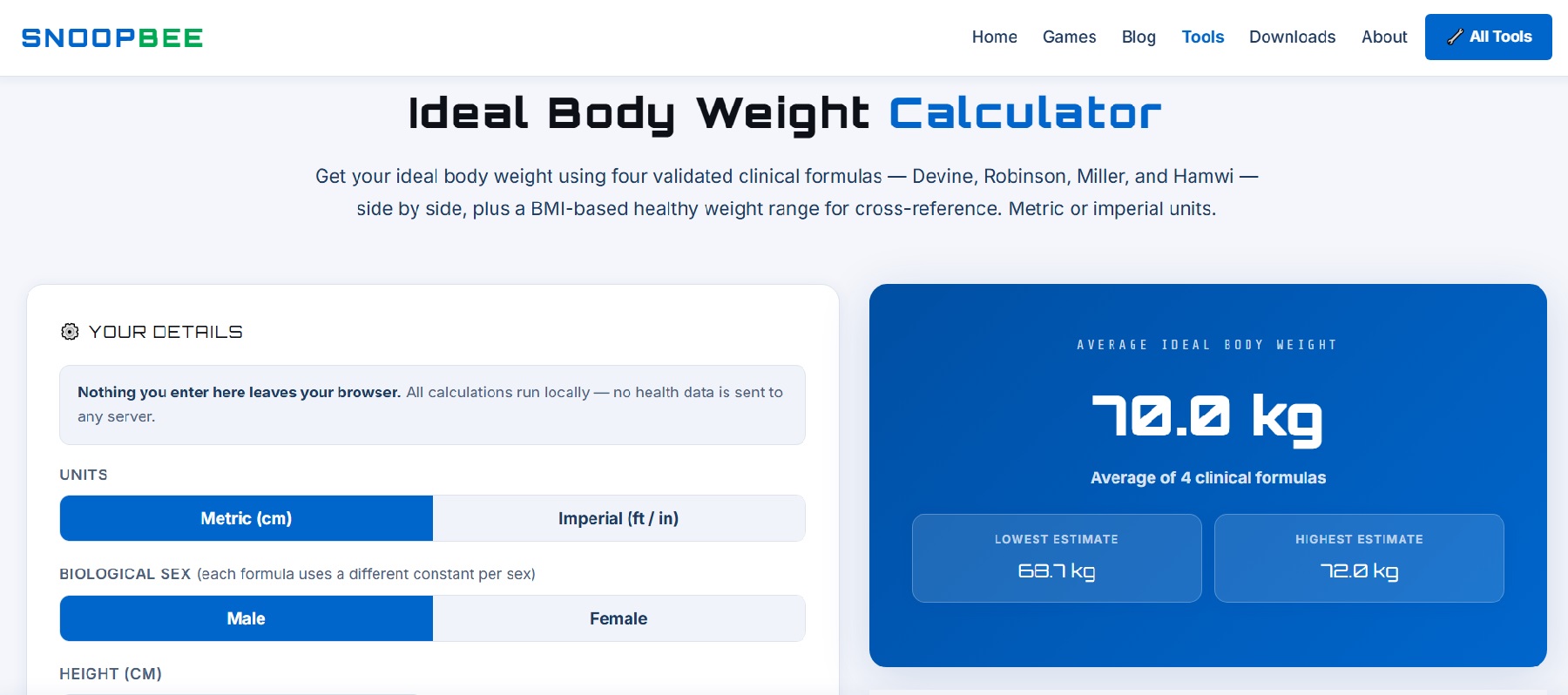
- Read your results instantly: all four formula outputs, their average, the lowest and highest estimates, and a BMI-based healthy range all update as you type.
- Use the Export buttons to download a PDF or Excel summary for reference or to bring to a doctor or dietitian.
Terminology Key
| Term | Meaning |
|---|---|
| Ideal Body Weight (IBW) | A reference weight calculated from height and sex, originally developed for clinical dosing calculations |
| Lean Body Mass | Total bodyweight minus fat mass — the tissue these formulas were originally designed to approximate |
| Devine Formula | 1974 formula originally created for antibiotic dosing calculations |
| Adjusted Body Weight | A dosing-specific weight calculation, sometimes derived from IBW, used for certain medications in overweight patients |
Frequently Asked Questions
What is the most accurate ideal body weight formula?
No single formula is universally most accurate — they were derived from different reference populations and typically cluster within a few kilograms of each other. Using the average alongside a BMI-based range gives a more balanced estimate than any one formula alone.
Why was the Devine formula originally created?
Dr. Benjamin Devine published it in 1974 to help calculate accurate medication dosages, particularly for drugs needing to be dosed by lean body weight rather than total body weight.
Do ideal body weight formulas account for muscle mass?
No — they use only height and sex, so a muscular athlete and a sedentary person of the same height and sex receive an identical result despite very different body composition.
Is ideal body weight the same as a healthy weight?
Not necessarily. IBW is a single reference point from height and sex alone, while a BMI-based range accounts for wider individual variation and is generally a more practical target.
Should I use these formulas to set my personal weight loss goal?
They're useful as general reference points, but weren't designed as personal fitness targets. A doctor or registered dietitian can help translate this information into a realistic, individualized goal.
Calculate Your Own Ideal Body Weight Now
Open the Ideal Body Weight Calculator →This article is for general educational purposes only and is not medical advice. These formulas are population-average estimates originally developed for medical dosing calculations and do not account for muscle mass, frame size, or individual body composition. Always consult a doctor or registered dietitian before setting a personal weight target. Last updated: August 2026.
💬 Questions & Reader Comments
Ask a question about ideal body weight formulas, or share your own experience. (Max 200 words)