What Is GST, in Plain English?
GST (Goods and Services Tax) is a tax added to the price of most things you buy — a phone, a haircut, a software subscription, a plate of food. Instead of the government collecting tax only once at the very end (like a simple sales tax), GST is collected in small pieces at every stage a product moves through — from raw material, to factory, to wholesaler, to the shop you buy it from. Each stage pays tax on the value it added, not on the whole price all over again.
Think of GST like a relay race where each runner only carries the baton for their own leg of the race — nobody re-runs the parts already run by someone else. That "no double-running" idea is called Input Tax Credit, and we'll come back to it in detail later, because it's the concept that makes GST fundamentally different from older, cascading tax systems.
Before GST launched in July 2017, India had a patchwork of separate taxes — VAT charged by states, excise duty on manufacturing, service tax on services, entry taxes, octroi at city borders, and more. Each one had its own rules, its own paperwork, and its own rate. GST folded almost all of them into a single tax with one set of rules that applies (with some regional detail) across the entire country.
Why "One Nation, One Tax"?
Before GST, a truck carrying goods from Delhi to Chennai could be taxed multiple times crossing state borders, and the same product could cost differently depending on which state manufactured it versus which state sold it. This made it complicated for businesses to operate across state lines and added hidden costs that eventually landed on the customer.
GST replaced that patchwork with one indirect tax structure used nationwide. A shirt taxed at 5% in Mumbai is taxed at 5% in Guwahati too. The rate is uniform; what changes from transaction to transaction is only how that tax is divided between the Central Government and the State Government — which brings us to the dual model.
The Dual GST Model: Why CGST + SGST, or IGST?
India has both a Central Government and individual State Governments, and both need revenue to fund their own budgets — roads, schools, hospitals, police, and so on. Rather than picking one or the other, GST was designed so both levels of government share the same tax, without increasing the total amount the customer pays.
| Situation | Tax Charged | Who Gets What |
|---|---|---|
| Buyer and seller in the same state | CGST + SGST | 50% to Central Govt, 50% to State Govt |
| Buyer and seller in different states | IGST | 100% collected centrally, then shared with the destination state |
Here's the part students often find surprising: the total rate the customer pays never changes based on this split. An 18% sale is 18% whether it's charged as 9% CGST + 9% SGST, or as 18% IGST in one line. The split only changes which government department the money is routed to — it's an accounting and revenue-sharing mechanism, not an extra charge.
Memory trick: Same state = Split it (CGST + SGST). Different state = one Integrated line (IGST). "Split" and "same" both start differently, but think of it as: local sale, local-and-central split; long-distance sale, one combined tax that later gets shared out.
Understanding GST Rate Slabs
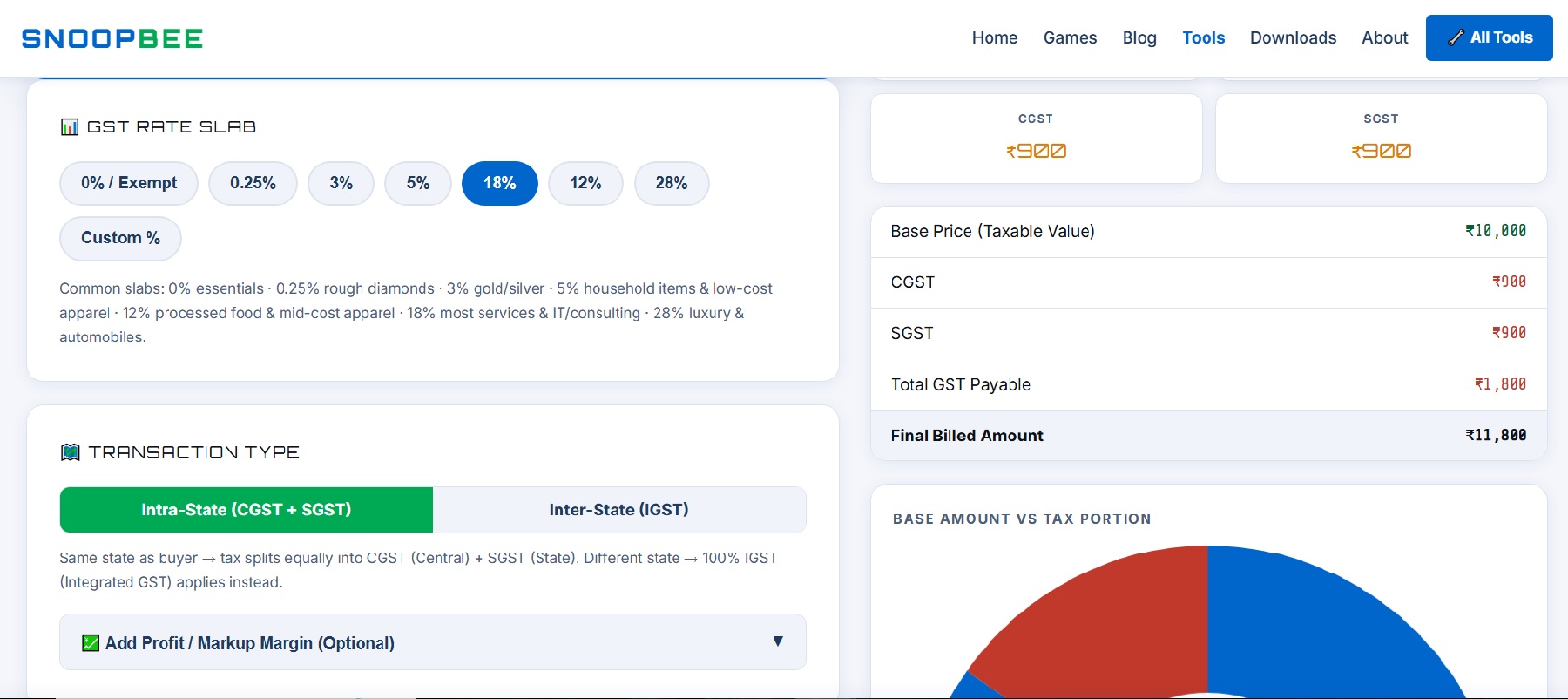
Not everything is taxed at the same rate. GST uses multiple slabs so that essential items stay cheap while luxury items contribute more revenue — a principle economists call taxing based on the necessity versus luxury of a good.
| Slab | Typical Examples | Why This Rate? |
|---|---|---|
| 0% / Exempt | Fresh vegetables, milk, unbranded grains, books, school & healthcare services | Essentials for daily life and basic wellbeing stay untaxed |
| 0.25% | Rough, unpolished diamonds | A special low rate for raw gemstones before processing |
| 3% | Gold, silver, precious metal jewellery | A concessional rate recognising gold's role as both a commodity and cultural asset |
| 5% | Household essentials, packaged food, low-cost apparel | Keeps frequently-bought items affordable for most households |
| 12% | Processed food, mid-cost apparel, business air travel | A middle ground for semi-essential, semi-discretionary goods |
| 18% | Most services, IT/software, consulting, most manufactured goods | The "standard" rate — the default for anything not specifically listed elsewhere |
| 28% | Luxury goods, automobiles, tobacco, aerated drinks | Higher rate for luxury or non-essential/"sin" goods, sometimes with extra cess |
If you're ever unsure which slab applies to a specific product or service, the rate is tied to that item's HSN or SAC code (explained further down) — not to guesswork. Two products that look similar in everyday language can sit in different slabs if their official classification differs.
Exclusive GST — Adding Tax to a Price
"Exclusive" means the number you're starting with does not yet include tax — it's the base, or taxable, value. This is the calculation a shop owner does when pricing a product: "My cost is ₹500, GST is 18%, what do I charge the customer?"
Worked example: Base Price = ₹500, GST Rate = 18%.
- GST Amount = 500 × 18 ÷ 100 = ₹90
- Final Price = 500 + 90 = ₹590
Inclusive GST — Reverse-Extracting Tax From a Final Price
"Inclusive" is the opposite situation: you already know the final price — maybe it's printed on an MRP sticker, or it's the total on a bill you just received — and you want to know how much of that total was the actual product value, and how much was tax.
Worked example: A shop receipt shows a final, GST-inclusive total of ₹118, at 18% GST.
- Base Price = 118 × (100 ÷ 118) = ₹100
- GST Amount = 118 − 100 = ₹18
Notice the denominator changes to "100 + GST%" — this is the step students most often get wrong, so let's look at exactly why in the next section.
The Most Common GST Calculation Mistake
Common error: Taking 18% of ₹118 directly gives ₹21.24 — which is wrong. The correct GST amount hidden inside ₹118 is only ₹18, as shown above.
Why does this happen? Because 18% of ₹118 assumes ₹118 is the base price and you're adding tax on top of it a second time — but ₹118 already contains the tax. You cannot apply a percentage meant for the base value onto a number that already includes that same tax; doing so effectively double-counts a sliver of the tax. This single mix-up is responsible for more incorrect GST invoices, homework answers, and personal budgeting errors than almost any other GST topic — which is exactly why the reverse formula divides by (100 + GST%) instead of just multiplying by the GST% directly.
CGST/SGST/IGST Split — A Full Worked Example
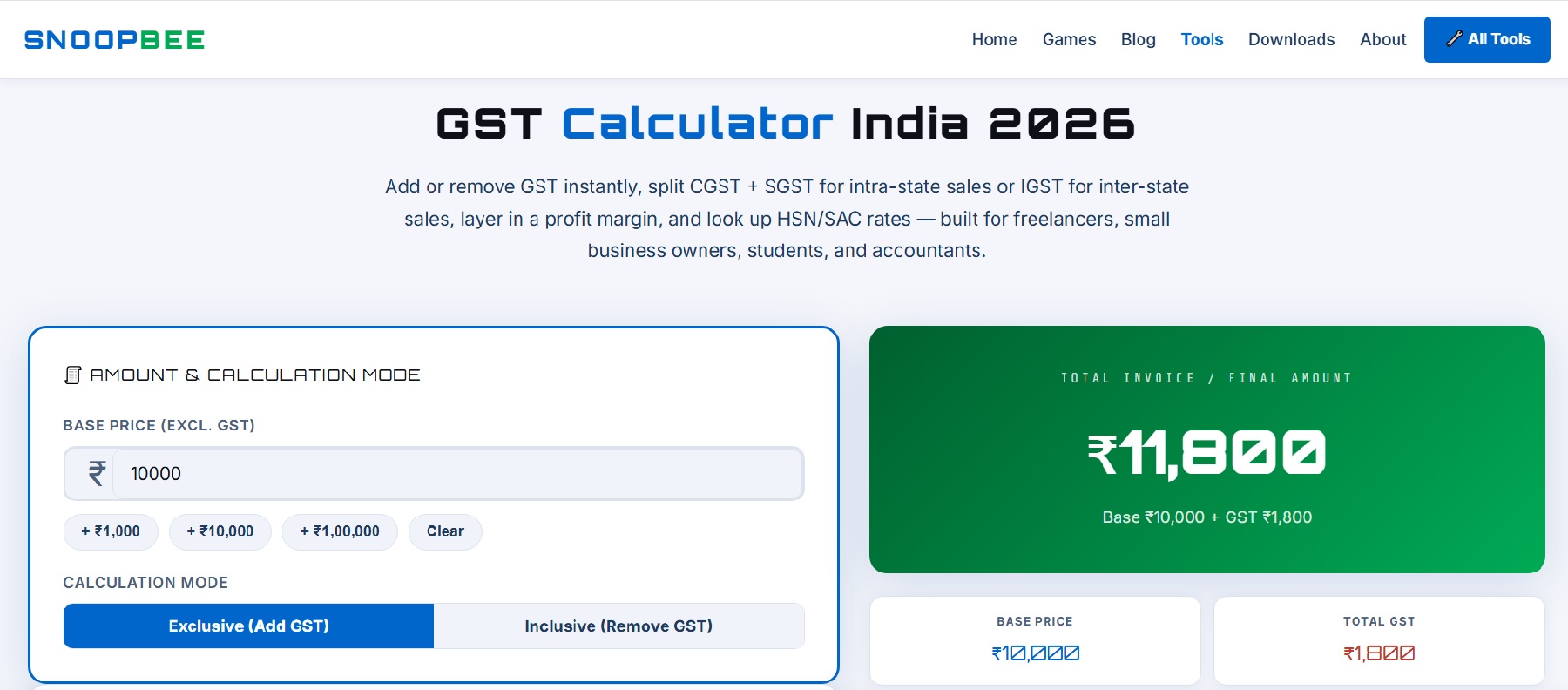
Let's take a concrete, realistic transaction: a Bengaluru-based consulting freelancer bills a client ₹10,000 for services, at the standard 18% GST rate for professional services.
Scenario A: Client Is Also in Karnataka (Same State)
- Base Price: ₹10,000
- Total GST (18%): ₹1,800
- CGST (9%): ₹900
- SGST (9%): ₹900
- Invoice Total: ₹11,800
Scenario B: Client Is in Maharashtra (Different State)
- Base Price: ₹10,000
- IGST (18%): ₹1,800
- Invoice Total: ₹11,800
Notice both scenarios charge the client exactly the same ₹11,800 — the only difference is how the ₹1,800 is labelled and routed on the invoice and in the GST return. This is precisely why getting the intra-state/inter-state selection right matters for compliance, even though it makes zero difference to what the customer actually pays.
Profit Margins Before GST
Wholesalers, manufacturers, and retailers rarely sell at cost price — they add a margin first. GST law requires tax to be charged on the actual selling price, which means the margin gets added before GST is calculated, not after.
Worked example: A trader buys goods at a cost price of ₹1,000 and wants a 20% margin, at 18% GST.
- Selling Price = 1,000 × (120 ÷ 100) = ₹1,200
- GST (18% of ₹1,200) = ₹216
- Final Invoice Amount = 1,200 + 216 = ₹1,416
A common mistake here is calculating GST on the ₹1,000 cost price and adding the margin afterward — this understates the tax and can cause invoice mismatches during filing.
HSN & SAC Codes — Why Every Invoice Needs One
HSN (Harmonized System of Nomenclature) is an internationally standardised numeric code used to classify physical goods — it's not unique to India, and is used by customs authorities worldwide. SAC (Services Accounting Code) is India's equivalent system specifically for classifying services.
Every GST invoice above a certain turnover threshold must quote the correct HSN or SAC code for each line item. This matters for three reasons: it removes ambiguity about what's being sold, it automatically determines the applicable GST rate, and it lets tax authorities compare transactions consistently across the whole country (and internationally, for HSN).
For instance, "computer services" isn't specific enough on its own — the SAC code for IT/software consulting (9983) tells the system exactly which rate slab (18%) applies, removing guesswork. Business owners can look up their exact code using the calculator's HSN/SAC Quick Finder, or the official GST portal for a definitive classification.
Input Tax Credit (ITC) — Avoiding Tax on Tax
Input Tax Credit lets a GST-registered business subtract the GST it already paid on its own purchases (inputs) from the GST it collects on its sales (output), and pay the government only the difference.
Here's why this matters so much: imagine a furniture maker buys wood and pays 18% GST on it, then sells a finished table and charges 18% GST to the customer. Without ITC, the government would effectively collect tax twice on the same wood — once when it was purchased, and again hidden inside the final table price. ITC prevents this "tax on tax" cascading effect, which is one of GST's core design goals and a major improvement over the pre-2017 tax system.
Simple example: The furniture maker pays ₹1,800 GST on wood purchases and collects ₹3,600 GST on table sales. Using ITC, they only need to pay the government ₹3,600 − ₹1,800 = ₹1,800 net — not the full ₹3,600.
ITC is a foundational concept for any registered business owner, though the actual claiming process involves matching invoices, filing returns on time, and meeting eligibility conditions — details best handled with a GST practitioner or accountant rather than worked out from first principles.
Everyday GST Scenarios
Buying Gold Jewellery
Gold attracts a concessional 3% GST rate. On jewellery worth ₹50,000, GST adds ₹1,500, making the final bill ₹51,500 — plus, separately, making charges (labour) are usually taxed at 5%, so a jeweller's final bill often has two different GST lines.
Eating at a Restaurant
Most standalone restaurants charge 5% GST without claiming input tax credit, while restaurants inside hotels with room tariffs above ₹7,500 typically charge 18%. This is why two seemingly similar restaurant bills can show very different tax rates.
Freelancing for a Client Abroad or Interstate
A freelancer billing a client in a different Indian state charges IGST, as shown in the worked example above. Billing a client outside India for services is usually treated as an "export of services" and may qualify for a zero-rated or exempt treatment under specific conditions — this is a case where checking current rules with a tax professional is worthwhile rather than assuming a default rate.
Shopping for Clothes
Apparel priced at or below ₹1,000 attracts 5% GST, while apparel above ₹1,000 attracts 12% GST — meaning two shirts of near-identical style can carry a different tax rate purely because of their price point.
Registration & Filing Basics
Not every business needs to register for GST. Broadly, registration becomes compulsory once annual turnover crosses a threshold that varies by state and whether the business supplies goods or services (commonly cited figures are around ₹40 lakh for goods and ₹20 lakh for services in most states, with lower thresholds in some special-category states). Smaller businesses below the threshold can often opt into a simplified Composition Scheme, which applies a lower flat rate but disallows claiming Input Tax Credit and restricts inter-state sales.
Registered businesses typically file periodic returns (monthly or quarterly, depending on turnover and scheme) reporting their sales, purchases, and the tax collected versus tax paid. Because rules, thresholds, and forms change periodically, this article intentionally stays at the conceptual level — for actual registration or filing decisions, check the current thresholds on the official GST portal (gst.gov.in) or consult a Chartered Accountant.
GST Beyond India — A Quick Regional Comparison
India's CGST/SGST/IGST structure is specific to its federal system, but the underlying idea — a broad-based tax on the value added at each stage of production — is used across much of South and Southeast Asia under different names.
| Country | Tax Name | Typical Standard Rate |
|---|---|---|
| India | GST | 18% (standard slab) |
| Singapore | GST | 9% |
| Malaysia | SST (Sales & Service Tax) | Varies by category, commonly 6–10% |
| Indonesia | PPN (Value Added Tax) | 11% |
| Thailand | VAT | 7% |
The exclusive and inclusive formulas explained earlier work identically for all of these systems — simply swap in the local rate using the "Custom %" option on the calculator, and skip the CGST/SGST split, since most of these countries don't use a dual-tax structure.
Quick Reference: Formulas, Slabs & Splits
A condensed recap of the core mechanics covered above — handy to skim before you open the calculator.
Exclusive vs Inclusive GST — What's the Difference?
Exclusive GST (Add Tax) is used when your starting number is the taxable value — the price before tax — and you need to find out how much GST to add and what the customer will finally pay.
Inclusive GST (Reverse Extraction) is used when you already know the final, tax-included price — for example, an MRP sticker or a total invoice amount — and need to work backward to find out how much of that was the base price and how much was tax.
Once the base price is known, the reverse GST amount is simply the total price minus that base price. This reverse formula is one of the most common sources of confusion — a frequent mistake is to calculate GST% of the total price directly, which overstates the tax because it applies the rate to an amount that already includes tax.
Worked example: A shop bill reads ₹118 with 18% GST included. Base Price = 118 × (100 ÷ 118) = ₹100. GST Amount = 118 − 100 = ₹18. Note this is not the same as 18% of ₹118 (which would incorrectly give ₹21.24).
CGST, SGST & IGST — How the Tax Actually Splits
India runs a dual GST model: both the Central Government and State Governments levy tax on the same transaction, but the total rate charged to the customer never changes — only how it's divided.
| Transaction | Tax Charged | Split |
|---|---|---|
| Intra-state (buyer & seller in same state) | CGST + SGST | 50% Central + 50% State |
| Inter-state (buyer & seller in different states) | IGST | 100% Integrated (shared between Centre & destination state later) |
For example, on a ₹10,000 sale at 18% GST within the same state: CGST = ₹900 and SGST = ₹900 (total tax ₹1,800). The same sale to a buyer in another state instead charges IGST = ₹1,800 in one line, with no CGST/SGST split on the invoice.
India's GST Rate Slabs Explained
| Slab | Typical Goods / Services |
|---|---|
| 0% / Exempt | Unbranded food grains, fresh vegetables, milk, educational & healthcare services, books |
| 0.25% | Rough, unpolished diamonds and precious stones |
| 3% | Gold, silver, and other precious metals and jewellery |
| 5% | Daily household essentials, packaged food, apparel below ₹1,000, footwear below ₹500 |
| 12% | Processed food, business-class air travel, apparel above ₹1,000, mobile phones (category dependent) |
| 18% | Standard rate for most services, IT & software, consulting, restaurants (non-AC in some cases), most manufactured goods |
| 28% | Luxury goods, automobiles, tobacco, aerated drinks (often with additional compensation cess) |
18% is the default assumption for most professional services and IT/consulting work in India, which is why it's pre-selected on the calculator. Always verify the exact slab for your specific HSN/SAC code, since sub-categories within a broad product group can sometimes carry a different rate.
Profit Margin Before GST — Why It Matters for Wholesalers
A trader who buys goods at a cost price and resells at a markup should apply GST on the selling price, not the original cost price. The calculator's optional margin field adds your % markup to the base amount first, and only then calculates GST on the marked-up figure — matching how invoices are legally structured.
Frequently Asked Questions
What is GST in simple terms?
GST is a single tax added to the price of most goods and services, collected in stages as a product moves from raw material to final sale, replacing India's older patchwork of separate state and central taxes.
What is the difference between CGST, SGST, and IGST?
CGST and SGST split an equal share of tax between the Central and State Governments for sales within the same state. IGST charges the full tax as one combined amount for sales between different states.
How do you calculate GST from a final, inclusive price?
Multiply the final price by 100, then divide by (100 + GST rate), to get the base price. Subtract that base price from the final price to find the GST amount.
What are HSN and SAC codes?
HSN codes classify physical goods and SAC codes classify services; both determine the correct GST rate for an invoice line item.
What is Input Tax Credit?
It's the mechanism that lets a business subtract GST already paid on its purchases from the GST it owes on its sales, so tax is charged only on the value it personally added.
Can GST rates change?
Yes — the GST Council periodically revises rates and slab structures. The rates in this guide and the calculator reflect the commonly used rate structure as of 2026; always cross-check the current rate for your specific goods or services on the official GST portal before filing returns or invoicing.
Try the Numbers Yourself With the Free GST Calculator
Open the GST Calculator →This article is for general educational purposes only and is not tax, legal, or accounting advice. GST rates, thresholds, and rules are subject to periodic revision by the GST Council; always confirm current figures on the official GST portal (gst.gov.in) or with a licensed Chartered Accountant. Last updated: July 2026.
💬 Questions & Reader Comments
Ask a question about GST, share your own example, or leave feedback. (Max 200 words)