What Is Body Fat Percentage, and Why It Beats BMI Alone
Body fat percentage is the proportion of your total bodyweight that is made up of fat tissue, with the remainder — muscle, bone, organs, water, and connective tissue — collectively called lean mass or fat-free mass.
Imagine two people who are both 1.75 m tall and weigh exactly 80 kg. They have the identical BMI — 26.1, placing both in the "overweight" category. But one of them is a competitive rugby player with 12% body fat and substantial muscle mass, and the other has a much more sedentary lifestyle with 30% body fat. BMI cannot tell these two people apart, because it only ever sees total weight relative to height. Body fat percentage is the missing piece: it tells you what that weight is actually made of.
This is precisely why sports scientists, physicians focused on body composition, and fitness professionals lean on body fat percentage rather than BMI alone whenever they need a more complete picture — it's a more direct measure of the tissue that's actually linked to most weight-related health outcomes.
There's also a second, subtler reason body fat percentage matters so much for anyone actively trying to change their body: it helps explain why the number on a bathroom scale can be a misleading, even discouraging, way to track progress. Someone who begins a new strength-training program while eating at a slight calorie surplus can simultaneously lose fat and gain muscle — two changes that partially cancel out on the scale, sometimes leaving total bodyweight almost unchanged for weeks, even though their body composition has meaningfully improved. Someone tracking only bodyweight in this situation might conclude, incorrectly, that "nothing is working," when in fact a great deal is working — it just isn't visible on a scale that can't distinguish tissue types. Tracking body fat percentage alongside bodyweight captures this shift and tends to keep motivation more accurately calibrated to what is actually happening physiologically.
Body fat percentage also has direct relevance beyond aesthetics or athletic performance. Excess storage fat, particularly around the abdomen, is an active, hormonally influential tissue — not simply inert padding. Fat tissue, especially visceral fat surrounding the internal organs, secretes inflammatory signaling molecules and hormones that can influence insulin sensitivity, blood pressure regulation, and long-term cardiovascular and metabolic health. This is part of why body composition, and not simply total bodyweight, has become an increasingly central focus in both preventative medicine and — as our companion article explores — insurance underwriting.
Essential Fat vs. Storage Fat
Not all body fat is the same, and understanding the difference is the key to understanding why body fat category charts look the way they do — and why the "healthy" ranges are never zero.
- Essential fat is the fat your body absolutely needs to function: it cushions organs, insulates nerves, and — critically for women — supports hormone production tied to reproductive health. Essential fat is typically around 2–5% of bodyweight in men and 10–13% in women; this is precisely why women's healthy body fat ranges sit meaningfully higher than men's at every category level.
- Storage fat is the fat your body accumulates beyond that essential baseline, held mostly under the skin (subcutaneous fat) and around internal organs (visceral fat). This is the fat that varies enormously between individuals and is what most fat-loss efforts specifically target.
Why body fat should never approach zero: dropping body fat near or below the essential fat threshold — a practice sometimes seen in extreme competitive bodybuilding preparation — is medically dangerous and unsustainable, associated with hormonal disruption, loss of menstrual cycles in women, weakened immune function, and other serious health consequences. Essential fat exists for a reason.
It's worth pausing on why women's essential fat requirement is so much higher than men's, since this single biological fact explains a great deal about how body composition science and category charts differ by sex throughout this guide. Female essential fat includes specialized fat deposits tied directly to reproductive function — including fat stored in breast tissue, the pelvic region, and thighs — that support hormone production necessary for a regular menstrual cycle and fertility. This is not incidental storage fat that happens to be present; it is functionally essential tissue, which is precisely why every body fat category chart, and both formulas covered in this guide, treat male and female bodies as genuinely different starting points rather than applying a single unisex standard with a simple offset.
The US Navy Method, Explained Term by Term
The US Navy Body Composition Assessment was developed and validated by the U.S. Navy in the 1980s as a fast, equipment-light way to estimate body fat percentage across large numbers of service members using only a measuring tape — no calipers, no water immersion tanks, no X-ray equipment. It correlates reasonably well with more precise laboratory methods for people of average build, which is why it remains one of the most widely used field methods worldwide today.
All measurements are in centimeters. Notice the formula uses logarithms — for a student encountering this for the first time, a logarithm is simply a mathematical tool that compresses a wide range of numbers into a smaller, more manageable scale, and it's commonly used in body-composition formulas because the relationship between circumference measurements and body fat isn't perfectly linear.
Worked example (male): height 175 cm, neck 38 cm, waist 85 cm. Waist − Neck = 47 cm. Plugging into the formula: 495 ÷ (1.0324 − 0.19077 × log₁₀(47) + 0.15456 × log₁₀(175)) − 450 = 16.9% body fat, which falls in the "Fitness" category for men.
Worked example (female): height 165 cm, neck 32 cm, waist 75 cm, hip 98 cm. Waist + Hip − Neck = 141 cm. Result: 28.9% body fat, which falls in the "Acceptable" category for women.
Notice that the women's formula adds a hip measurement and uses different constants entirely — this reflects both the different essential fat baseline discussed above and different average fat-distribution patterns between the sexes that the U.S. Navy's original validation studies specifically measured.
How to Take Accurate Tape Measurements
The US Navy formula is only as accurate as the three measurements that feed it. A flexible fabric tape measure (like a tailor's tape), not a rigid metal one, gives the most consistent results.
- Neck: measure just below the larynx (Adam's apple), with the tape sloping slightly downward toward the front.
- Waist (men): measure at the navel, standing relaxed — not sucking in or flexing.
- Waist (women): measure at the narrowest point of the torso, usually just above the navel.
- Hip (women only): measure at the widest point around the buttocks.
Consistency matters more than perfection: take each measurement twice and average the results, measure at the same time of day (ideally morning, before eating), and keep the tape snug against the skin without compressing it. Tracking the same measurements the same way every 2–4 weeks will show a far more meaningful trend than obsessing over single-day precision.
The Jackson-Pollock Skinfold Method & the Siri Equation
The Jackson-Pollock method, published by researchers Andrew Jackson and Michael Pollock in 1978, takes a fundamentally different approach: instead of circumference measurements, it uses a specialized pinching tool called a skinfold caliper to measure the thickness of a fold of skin and underlying fat at specific body sites, in millimeters.
Body density is a measure of mass per unit volume of the whole body. Because fat tissue is less dense than lean tissue, a body with a higher body density has proportionally less fat — this is the physical principle every skinfold and underwater-weighing method is built on.
The 3-site protocol used in this calculator measures different sites for men and women, reflecting where excess fat is most commonly and measurably stored for each sex:
| Sex | Site 1 | Site 2 | Site 3 |
|---|---|---|---|
| Men | Chest (diagonal fold, upper chest) | Abdomen (vertical fold, beside navel) | Thigh (vertical fold, front of thigh) |
| Women | Triceps (vertical fold, back of upper arm) | Suprailiac (diagonal fold, above hip bone) | Thigh (vertical fold, front of thigh) |
Where Σ (sigma) is the sum of the three skinfold measurements in millimeters, and Age is in years. Once body density (D) is calculated, it's converted into a body fat percentage using the Siri equation, published by William Siri in 1961 — the same conversion formula the US Navy method's final step also uses:
Worked example (male): chest 12 mm + abdomen 18 mm + thigh 15 mm = 45 mm sum, age 30. Body density = 1.10938 − (0.0008267 × 45) + (0.0000016 × 45²) − (0.0002574 × 30) = 1.0677. BF% = 495 ÷ 1.0677 − 450 = 13.6% body fat — the "Athletes" category for men.
Skinfold testing takes practice: results from skinfold calipers depend heavily on tester consistency — pinching too much or too little surrounding muscle, or measuring at a slightly wrong site, meaningfully changes the result. If a trained professional (such as a gym trainer or exercise physiologist) is available to take these measurements, results will generally be more reliable than self-testing, particularly for the harder-to-reach sites.
Body Fat Categories: Men vs. Women
This calculator uses the widely referenced American Council on Exercise (ACE) category system:
| Category | Men | Women |
|---|---|---|
| Essential Fat | 2–5% | 10–13% |
| Athletes | 6–13% | 14–20% |
| Fitness | 14–17% | 21–24% |
| Acceptable | 18–24% | 25–31% |
| Obese | 25%+ | 32%+ |
Notice again how every single category sits higher for women than for men, reflecting the essential fat difference discussed earlier — a woman at 22% body fat is in the "Fitness" category, while a man at 22% is in the "Acceptable" category, and this is expected, healthy biological variation rather than an inconsistency in the chart.
It's also worth understanding that these category boundaries were developed as general population reference ranges rather than universal targets everyone should aim for. The American Council on Exercise built these ranges from a combination of athletic performance research and general population health data, and they're widely used because they're practical and easy to communicate — not because every individual's optimal, healthiest body fat percentage sits at exactly the same point within each category. A person's age, genetics, training history, and personal health goals all reasonably influence where within a healthy range they should aim to sit, and "lower is always better" is not accurate advice once someone is already within the Fitness or Acceptable ranges — pushing meaningfully below the Athletes category for an extended period, outside of a specific competitive context with professional guidance, carries real risks rather than additional benefits.
Comparing Measurement Methods: Accuracy & Accessibility
| Method | Equipment Needed | Typical Accuracy vs. DEXA | Best For |
|---|---|---|---|
| US Navy (Tape) | Flexible measuring tape | ±3–4% | Quick home tracking, no equipment |
| Jackson-Pollock (Skinfold) | Skinfold calipers | ±3–5% (tester-dependent) | Gyms, trainers, repeated tracking by the same tester |
| Bioelectrical Impedance (Smart Scale) | BIA scale or handheld device | ±3–8% (hydration-sensitive) | Convenient daily trend tracking |
| DEXA Scan | Clinical X-ray equipment | Reference standard (±1–2%) | Highest precision, periodic clinical check-ins |
Practical takeaway: no field method — tape, skinfold, or smart scale — will match clinical precision, and that's fine. The real value of any of these methods is in tracking your own trend consistently over weeks and months using the same method and the same technique, not in treating any single reading as an exact, absolute number.
Common Measurement Mistakes to Avoid
A handful of avoidable errors account for most of the noisy, inconsistent readings people run into with home body fat testing. Being deliberate about the following will meaningfully improve the reliability of your results with either method:
- Measuring at inconsistent times of day. Fluid shifts throughout the day — from food and beverage intake, exercise, and even standing versus lying down — can shift waist and skinfold measurements by a surprising margin. Morning, before eating or drinking and after using the bathroom, is the most consistent and widely recommended time.
- Testing during unusual hydration states. Dehydration, a recent high-sodium meal, alcohol consumption, or the days surrounding a woman's menstrual cycle can all cause temporary water retention or fluid loss that shows up as a skewed body fat reading, especially with bioelectrical impedance methods. If a single reading looks unusual, it's often worth treating it as an outlier and rechecking a few days later rather than reacting to it immediately.
- Inconsistent tape tension. Pulling a measuring tape too tight compresses skin and underlying tissue, artificially shrinking the reading; too loose, and the tape sags and inflates it. A snug-but-not-compressing tension, held level and parallel to the floor, is the standard to aim for every time.
- Pinching muscle along with skinfold. With calipers, the goal is to grasp only skin and the fat layer beneath it, pulling the fold slightly away from the underlying muscle before placing the caliper jaws. Pinching too deep, capturing muscle tissue in the fold, is one of the most common sources of skinfold measurement error, particularly for less experienced testers.
- Switching methods mid-tracking and expecting continuity. The US Navy method, Jackson-Pollock skinfolds, and a bioelectrical impedance smart scale are each internally consistent for tracking your own trend over time — but they are not designed to produce identical absolute numbers to each other. Switching methods partway through a tracking period and being confused by a sudden "jump" in the number is a common, avoidable source of frustration; stick with one method for any given tracking period.
A Life-Stage Guide: Students, Professionals & Retirees
Students & Young Adults
Body fat percentage naturally varies more during adolescence and the late teens as bodies continue developing — a school student using this calculator should treat it as an educational tool for understanding the underlying math and biology, not as a personal target, and should involve a parent or doctor before drawing conclusions from any single reading.
Working Professionals
This is the age range both formulas were most directly validated for. The most useful habit is tracking the same method, at the same time of day, roughly every 2–4 weeks, and watching the trend line rather than any single measurement.
Retirees & Older Adults
Body composition shifts naturally with age even at a stable weight, as muscle mass gradually declines (sarcopenia) while fat mass often increases — this is exactly the situation where body fat percentage tracking is more informative than watching bodyweight or BMI alone, since it can reveal this composition shift that the scale alone would miss entirely. Resistance training, even at a modest intensity appropriate for older adults, has been consistently shown to help preserve muscle mass and can measurably slow this age-related composition shift, which is one of the most evidence-backed reasons body fat tracking — rather than bodyweight tracking alone — is often recommended for this age group specifically.
How to Use the Body Fat Calculator
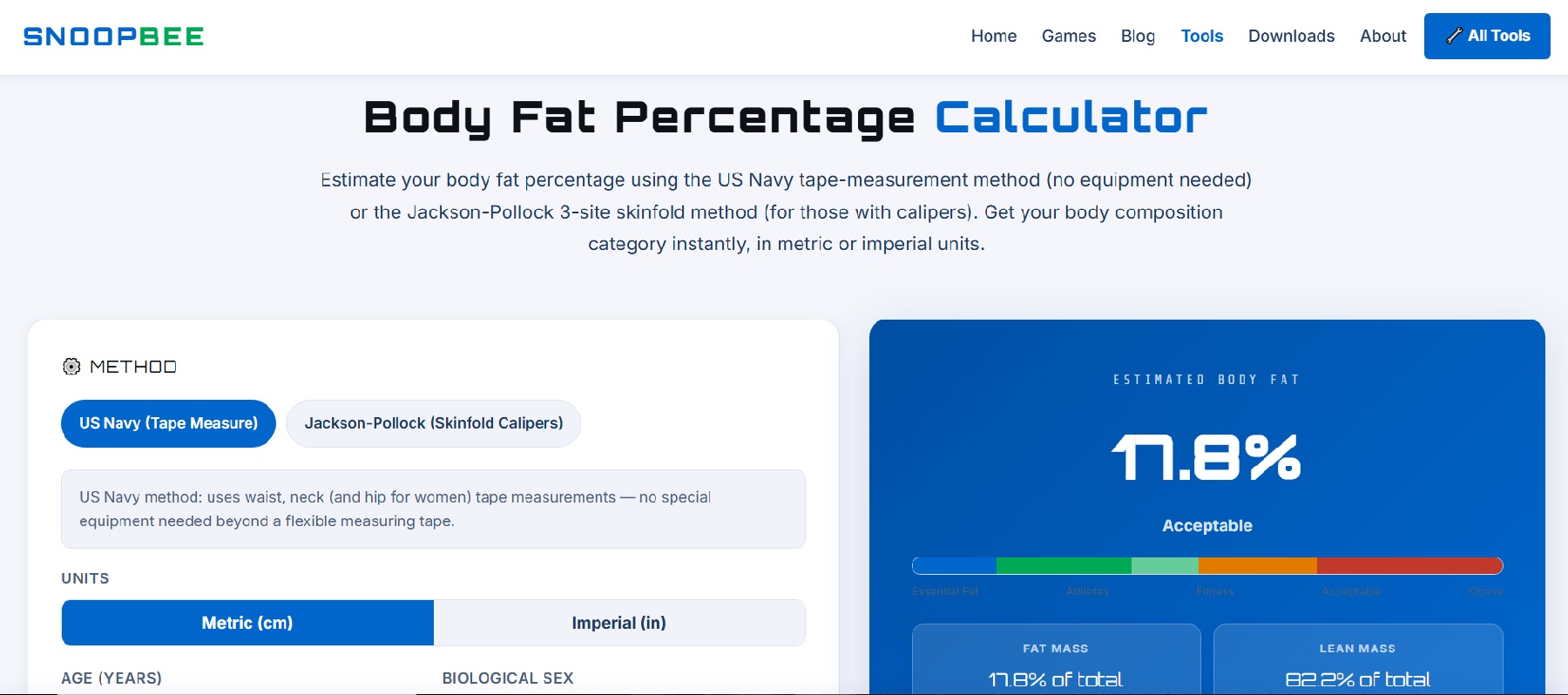
- Open the Body Fat Percentage Calculator and choose your method — US Navy (tape) or Jackson-Pollock (skinfold calipers).
- Choose your unit system — metric (cm) or imperial (in) — and select your biological sex, which determines both the formula used and the measurement sites required.
- For the US Navy method: enter height, neck, waist, and (for women) hip measurements taken as described above.
- For Jackson-Pollock: enter your age and your three skinfold measurements in millimeters at the sites specified for your sex.
- Read your results instantly — body fat percentage, category, and your lean mass share update as you type.
- Use the Export buttons to download a PDF or Excel summary for tracking over time or sharing with a trainer.
Terminology Key
| Term | Meaning |
|---|---|
| Body Fat Percentage | Proportion of total bodyweight that is fat tissue |
| Lean Mass | Everything that isn't fat — muscle, bone, organs, water |
| Essential Fat | The minimum fat needed for normal body function |
| Storage Fat | Fat accumulated beyond the essential baseline |
| Body Density | Mass per unit volume of the body — used to derive body fat % via the Siri equation |
| Siri Equation | The formula converting body density into body fat percentage |
| Skinfold Caliper | A pinching tool used to measure subcutaneous fat thickness in millimeters |
| DEXA Scan | Dual-energy X-ray absorptiometry — a clinical reference method for body composition |
Frequently Asked Questions
What is a healthy body fat percentage?
Using the ACE categories, an "acceptable" range is roughly 18–24% for men and 25–31% for women, with lower ranges associated with athletic or fitness-level leanness.
How accurate is the US Navy body fat method?
Typically within about 3–4% body fat compared to a DEXA scan for most healthy adults with an average body shape, when measurements are taken carefully and consistently.
Why do men and women use different body fat formulas?
Women naturally carry more essential fat than men due to reproductive biology, and fat distribution patterns differ by sex, so separate validated formulas and category ranges exist for each.
What is the Siri equation?
It converts a measured or estimated body density value into a body fat percentage, and is the final step in both the skinfold method and the US Navy method.
Is DEXA more accurate than tape or calipers?
Yes — DEXA is generally considered the clinical reference standard, typically accurate to within 1–2% body fat, though it requires specialized equipment unavailable for home use.
Measure Your Own Body Fat Percentage Now
Open the Body Fat Percentage Calculator →This article is for general educational purposes only and is not medical advice. Tape-measurement and skinfold methods are estimates that can vary with measurer technique, hydration status, and individual body shape, and are not a substitute for a clinical body composition assessment. Always consult a doctor or qualified professional before making significant changes to your diet or exercise routine. Last updated: August 2026.
💬 Questions & Reader Comments
Ask a question about body fat measurement methods, or share your own experience. (Max 200 words)